The river looked like black glass under the late-afternoon sky, cold and indifferent, sliding past the muddy bank as if it had never carried anything heavier than leaves.
I would’ve kept walking—hands stuffed in my jacket pockets, mind on dinner and bedtime stories—if I hadn’t heard my mother laugh.
Not her polite, church-lady laugh. Not the one she used at bake sales or PTA meetings.
This laugh was sharp. Private. Mean.
I turned, and there they were.
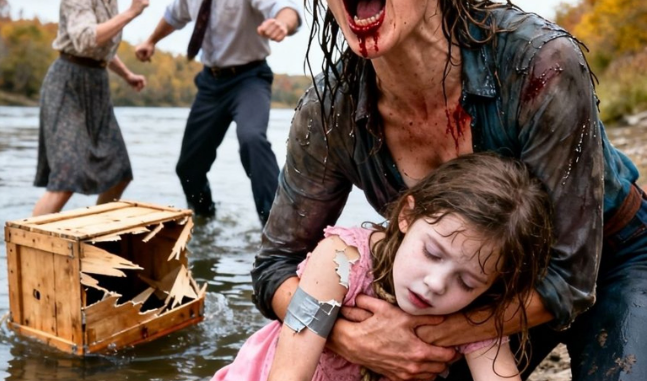
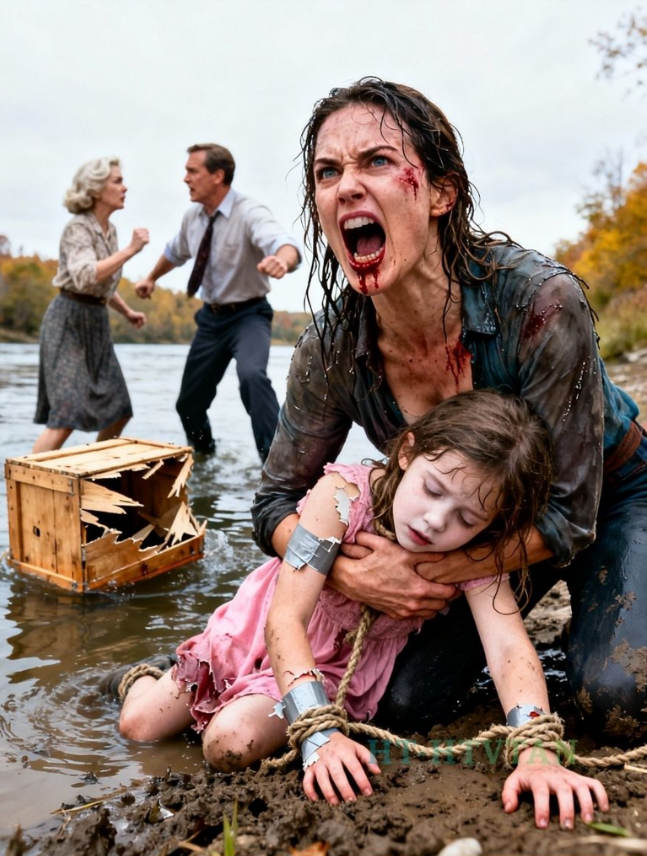
My parents—Darlene and Frank Whitlock—standing at the water’s edge like they owned the world. My father’s broad shoulders hunched forward as he and my mother shoved a large wooden crate off the bank. It splashed hard, sending up a spray of icy droplets, then bobbed once… twice…
arrow_forward_ios
Read morePause
00:00
00:09
01:31Mute
Powered by
GliaStudios
…and started drifting toward the deeper current.
They watched it like it was entertainment.
My mother wrapped her scarf tighter and laughed again. My father clapped his hands together as if finishing a job. Then they turned to walk away, light-footed and careless, like they’d just tossed out old furniture.
For half a second, my brain refused to translate what my eyes were seeing.
A crate. In the river.
Why would anyone throw a crate into the river?
Then the sound reached me—faint, muffled, almost swallowed by the water and the wind.
A soft thump.
A tiny whimper that didn’t belong to the river.
My stomach dropped so violently I thought I might vomit.
“Please be empty,” I whispered, and the words came out like a prayer and a curse at once.
I broke into a run.
The bank was slick with old leaves and damp clay. I skidded, nearly lost my footing, and caught myself on a low branch. The crate had already tilted as the current tugged at it. Water licked around the edges, seeping in through the seams.
The muffled sound came again.
This time I recognized it.
Not because it was loud, but because my body knew it the way you know your own heartbeat.
A child.
No. Not just any child.
My child.
I didn’t think. I didn’t plan. I didn’t hesitate.
I jumped.
The river hit me like a fist made of knives.
Freezing water slammed into my chest, stealing my breath. My limbs seized. For a terrifying moment I couldn’t move—couldn’t even inhale—just flailed in shock.
The crate bobbed ahead of me, already sinking lower.
I forced my arms to work, lungs burning. I swam with pure panic powering me, dragging myself through water that felt thick as oil. My hands slapped wet wood and slipped. I grabbed again, fingers digging into the crate’s rough edge.
It was heavier than it looked, waterlogging fast. I kicked and pulled, fighting the current that wanted to claim it.
On shore, my parents had stopped walking.
They’d noticed me.
My mother’s head snapped around first. Her eyes narrowed like I’d interrupted something important. My father pivoted, anger flashing across his face.
I managed to angle the crate toward the shallows. My boots scraped the rocky bottom. I stumbled, half-swimming, half-wading, hauling the crate like a deadweight anchor.
My muscles screamed. My hands went numb.
But I didn’t let go.
I dragged it onto the muddy bank, chest heaving, soaked to the bone.
The muffled sound inside came again—more frantic now.
I scrambled for the lid, fingers clawing at metal latches.
And then my father was there.
He didn’t shout my name.
He didn’t ask what I was doing.
He grabbed me by the hair.
Pain exploded across my scalp as he yanked my head back and threw me down into the mud like I was nothing but a rag doll.
“Mind your own business,” he snarled.
I tasted dirt. My jaw slammed against a rock.
I blinked, disoriented, then looked at the crate.
The crate was still moving—subtle, like something inside was shaking.
My heart pounded so hard my vision pulsed.
I tried to crawl toward it.
My mother stepped into my path and punched me in the face.
A clean, practiced hit.
White light burst behind my eyes. My nose flooded with heat. I rolled onto my side, stunned.
“Stop,” she hissed, her voice low and furious. “Stop right now.”
I heard myself making a sound—half sob, half growl.
I pushed up on shaking arms. Blood dripped onto the mud.
My father stepped closer, towering, fists clenched.
“You always did have a problem,” he said. “Always had to be the hero.”
I spit blood and mud. “What’s in the crate?”
My mother’s lips curled. “Nothing that concerns you.”
The crate thumped again.
My body moved before my mind could.
I lunged, not at them—at the crate.
My father grabbed my jacket. I twisted out of it, slipping free like an animal. I crawled fast, fingers sinking into mud, nails breaking.
My hands found a rock—flat and heavy.
I raised it and slammed it against the lid’s nailed seam.
Wood cracked.
My father reached for me again, but I kicked backward, catching his shin. He cursed, stumbling.
My mother grabbed my shoulder, trying to drag me away. I swung the rock without looking. It clipped her wrist. She yelped, shocked more than hurt.
I didn’t stop.
Again.
Crack.
Again.
The wood split, the nails popping loose one by one.
My hands were shaking so hard I could barely grip the rock. Tears mixed with river water on my cheeks.
The lid gave way.
I pried it open with all my strength—
—and screamed.
My four-year-old daughter, Daisy, was inside.
Tied.
Rope wrapped around her wrists and ankles. Tape over her mouth. Her cheeks were blue with cold, eyes wide with terror, little body curled like she’d tried to make herself smaller.
Her chest rose in shallow, jerking breaths.
For one horrifying heartbeat, I thought she was dead.
Then her eyes locked on mine, and she made a muffled sound that shattered me.
“Daisy,” I choked, scrambling into the crate, ripping at the tape with numb fingers. “Baby—oh my God—oh my God—”
She shook, sobbing silently.
I fumbled with the rope, fingers clumsy from cold. The knots were tight, deliberate. Someone had taken time with this.
My mother’s voice came like ice from behind me.
“You did this,” she snapped.
I turned, blinking hard. “What?”
My father’s face was twisted with rage—rage that I’d ruined something, not rage that a child had nearly drowned.
“You made us do it,” he said.
I stared at him, sure I’d misheard.
“You made us do it,” he repeated, stepping closer. “Because you can’t keep your mouth shut.”
My stomach churned. “You put my daughter in a crate.”
My mother’s eyes gleamed. “She’s not your daughter.”
The words hit so hard I stopped breathing.
Daisy whimpered against my chest, hands finally free enough to clutch my shirt.
I swallowed, voice shaking. “What are you talking about?”
My father’s jaw clenched. “You know exactly what.”
I didn’t.
But some part of my brain—the part that had survived them my whole life—began assembling the puzzle.
The way my parents had insisted I move back home after my divorce.
The way they’d offered to “help” with Daisy.
The way my mother watched her like she was measuring something.
The way my father had started making jokes about “fresh starts.”
I’d told myself it was just their weird brand of control.
Now, standing over a riverbank with my trembling child, I realized it was something else.
Something planned.
Something rotten.
I pulled Daisy out of the crate and wrapped her in my arms, shielding her with my body.
My father took another step forward.
“You hand her over,” he said.
My blood went cold. “No.”
My mother’s smile was thin. “Oh, sweetheart. You don’t have a choice.”
I backed up, boots sliding in mud. Daisy clung to me, sobbing now that the tape was off, tiny gasps that sounded like pain.
My eyes scanned the riverbank—empty. The nearest houses were across the road, hidden by bare trees. The park path behind us was silent.
We were alone.
My father lunged.
I turned and ran.
I didn’t think about direction. I didn’t think about distance. I just ran, carrying Daisy like she weighed nothing, legs slipping on wet ground.
My lungs burned. My soaked clothes clung heavy and cold.
Behind me, I heard my father’s boots pounding, my mother’s voice calling, sharp and furious:
“Stop! You’re going to regret this!”
I hit the path and sprinted toward the parking lot where my car was parked under a dying oak. My keys were in my jeans pocket, but my fingers were numb and clumsy.
“Mommy,” Daisy cried into my shoulder, voice raw. “I was scared.”
“I know,” I gasped, tears streaming. “I know, baby.”
I reached my car, nearly dropped her trying to open the door. The key fob slipped from my shaking fingers and hit the asphalt.
A shadow fell over me.
My father.
He grabbed the back of my hoodie and yanked hard, pulling me away from the car door. Daisy screamed.
My mother caught up, face flushed, eyes wild.
“This is what you do,” she spat. “You make everything messy.”
I kicked. I elbowed. I fought like an animal.
My father slammed me against the car. Stars burst behind my eyes.
Daisy slid from my arms to the ground, still wrapped in my coat.
“Daisy!” I screamed.
My mother stepped toward her.
A sound came out of me that didn’t feel human.
I shoved my father with everything I had. He stumbled back half a step—enough.
I dropped to Daisy, scooped her up, and ran around the car.
My father reached for me again, but I swung the car door open hard. It caught his arm. He cursed.
I threw Daisy into the back seat and slammed the door.
I dove into the driver’s seat, hands shaking violently on the steering wheel, fumbling the keys into the ignition.
My mother pounded on the window. “Stop! STOP!”
My father yanked the driver’s door handle. I locked it just in time.
The engine sputtered, then caught.
I hit reverse so hard the tires screamed.
My father leaped back as the car jerked away.
My mother’s face twisted into something ugly as she screamed my name, but I didn’t stop.
I didn’t look back.
I drove.
The hospital was fifteen minutes away.
It felt like five years.
Daisy cried the whole way, a panicked, exhausted sound that made my chest ache. I kept reaching back one hand at red lights to touch her knee, to prove I was real.
Her skin was icy. Her lips had a bluish tint.
My mind screamed one word over and over:
Hypothermia.
I ran inside the ER with Daisy in my arms, dripping river water onto the floor.
“Help!” I shouted. “My daughter—she was in the river—she’s freezing—please!”
Nurses moved fast. A doctor appeared. Someone took Daisy from my arms gently but firmly.
“What happened?” a nurse demanded as they rushed her down the hall.
“My parents—” I started, choking. “They— they put her in a crate and threw it in the river.”
The nurse’s expression changed instantly—shock, then hardened professional focus.
“Security,” she called. “Get security.”
A doctor turned toward me. “Ma’am, we’re treating your daughter. We also need you to tell us exactly what happened.”
My whole body shook. “My parents tried to kill her.”
The doctor’s jaw tightened. “We’re calling police.”
I nodded, swallowing bile. “I already— I should call 911—”
“You’re here,” she said. “They’ll come.”
I collapsed into a plastic chair, soaked and shaking, staring at the hallway where Daisy disappeared.
My hands were scraped raw. My face throbbed where my mother hit me. My scalp burned from my father’s grip.
But none of it mattered because Daisy was alive.
Alive.
I pressed my palms to my eyes and sobbed.
A police officer arrived within minutes, then another. They asked questions. I answered through shivering teeth, giving names, addresses, everything.
“Do you have any idea why they would do this?” Officer Ramirez asked, pen moving fast.
I stared at him, numb. “No.”
But even as I said it, memory crawled up like a shadow.
Two months earlier, my mother had cornered me in the kitchen while Daisy played with blocks on the living room rug.
“She’s such a sweet child,” Mom had said, voice soft. “You’re lucky.”
I’d smiled politely. “Yeah. I am.”
Mom had leaned closer. “You know… we could give her a better life.”
I’d laughed awkwardly. “What are you talking about?”
“A stable home,” she’d said. “A real family. Not… whatever you’re doing.”
I’d felt irritation flare. “She’s my daughter.”
Mom’s eyes had gone flat. “Is she?”
At the time I thought she was insulting me, implying I’d failed as a mother.
Now, sitting in an ER with police writing down my story, those two words came back like poison:
Is she?
Officer Ramirez frowned at my silence. “Ma’am?”
I swallowed hard. “My mother said something once. That Daisy could have a better life with them.”
“Did they ever talk about custody?” he asked.
“They offered to help,” I whispered. “They tried to get me to sign papers once—like power of attorney for medical decisions. I refused.”
Officer Ramirez’s eyes sharpened. “That’s important.”
Before I could ask why, another officer approached.
“Ma’am,” he said, “we just got a call. Your parents’ vehicle was spotted leaving Riverside Park.”
My stomach twisted. “They’re running.”
Officer Ramirez nodded. “We’re putting out a BOLO. We have their names, their car, their plates.”
My throat went tight. “Please find them.”
He looked at me, steady. “We will.”
Daisy was admitted overnight.
The doctors said she was hypothermic but stable. She had bruises on her wrists and ankles from the rope and redness around her mouth from the tape. Her lungs were clear—thank God—meaning she hadn’t inhaled too much water. She would be monitored for complications.
I sat by her hospital bed, holding her small hand.
Her eyes were half-open, glassy with exhaustion.
“Mommy?” she whispered.
“I’m here,” I said quickly, voice breaking. “I’m right here.”
Daisy’s brow furrowed. “Grandma was mad.”
My stomach clenched. “What did Grandma say?”
Daisy’s voice was tiny. “She said I was going to be quiet. Like… quiet forever.”
Ice flooded my veins.
I swallowed hard. “Did Grandpa… hurt you?”
Daisy nodded faintly, tears spilling. “He tied me. I cried. Grandma laughed.”
My vision blurred with rage and grief.
I leaned down carefully and kissed her forehead. “You’re safe now. I promise.”
Daisy’s grip tightened weakly around my finger.
“Don’t let them take me,” she whispered.
The words broke something inside me.
“I won’t,” I said, fierce and trembling. “No one will ever take you from me again.”
The next morning, Detective Lisa Monroe introduced herself in the hospital cafeteria, coffee in one hand, a folder in the other.
“We found your parents,” she said without preamble.
My heart slammed. “Where?”
“About thirty miles north,” she said. “They were heading toward Toledo.”
My breath hitched. “Did you arrest them?”
Detective Monroe nodded. “Yes. They didn’t go quietly.”
Relief crashed through me so hard I almost couldn’t sit upright.
But Detective Monroe’s expression stayed serious.
“There’s more,” she said.
I swallowed. “Of course there is.”
She opened the folder and slid a document across the table.
It was a photocopy of a birth certificate.
My hands went cold as I saw Daisy’s name.
Then my eyes caught the part that made my stomach drop:
Mother: Sarah Whitlock.
Not my name.
Sarah.
My sister.
I stared, heartbeat roaring. “That’s— that’s wrong.”
Detective Monroe’s gaze was steady. “Is your sister Sarah?”
I nodded, stunned. “Yes. But… Daisy is my daughter.”
Monroe tapped the document. “According to this, she’s Sarah’s.”
My mouth went dry. “That’s impossible.”
Detective Monroe leaned in, voice low. “Your parents had this document in their glove compartment along with notarized forms and a lawyer’s card. They were preparing something.”
The room tilted.
My sister Sarah had been gone for five years—disappeared from our lives after a fight so explosive my parents told everyone she’d “moved away” and that I wasn’t to ask questions.
But I had asked.
And every time, my parents shut me down with the same icy line:
“Some things aren’t your business.”
I stared at the birth certificate again until the words blurred.
Detective Monroe continued, “We’re still verifying authenticity. It could be fraudulent. But it suggests a motive: they believed they had legal claim to your child.”
My hands shook. “No.”
Monroe’s eyes softened slightly. “We need to ask you some difficult questions. Your daughter was four. That matches the timeline of Sarah’s disappearance. Is there any chance…”
She didn’t finish.
She didn’t have to.
My throat closed.
Because suddenly I remembered the night Daisy was born.
I’d been twenty-six. Single. Pregnant after a relationship that ended badly. I’d gone into labor early. My parents drove me to a small hospital because it was “closer.”
I remembered being exhausted. Drugged. In and out.
I remembered my mother holding Daisy before I did.
I remembered her saying, “She’s ours now,” and laughing like it was a joke.
I stared at Detective Monroe and felt nausea rise.
“You think…” I whispered, “you think they took her.”
Detective Monroe didn’t flinch. “We’re looking into it.”
My hands covered my mouth.
Tears spilled down my face in silence.
When I went back to Daisy’s room, she was awake, sipping apple juice with trembling hands.
Her eyes brightened when she saw me. “Mommy!”
I crossed to her and sat, taking her hand carefully.
Daisy stared at my bruised cheek. “You got an owie.”
“I’m okay,” I said softly.
Daisy’s face crumpled. “Grandpa was mean.”
“I know.”
She swallowed hard. “Grandma said you’re not my real mom.”
My heart stopped.
I forced myself to breathe. “She said that?”
Daisy nodded, lip wobbling. “She said… you were pretending.”
My vision blurred.
I leaned in close, voice steady even as my body shook. “Listen to me, Daisy. I am your mom. I love you. I have always been your mom. Do you understand?”
Daisy sniffed. “But she said—”
“Grandma lies,” I said gently but firmly. “She lies to hurt people.”
Daisy stared, trying to understand the adult world with a child’s heart.
Then she whispered, “I want you.”
I pulled her into my arms carefully, mindful of bruises and IV lines.
“I’m here,” I promised again. “I’m not going anywhere.”
Over the next week, the case cracked open like rotten wood.
Detective Monroe and a social worker named Janice interviewed me for hours. They asked about Sarah. About my parents. About Daisy’s birth.
It turned out the “closer” hospital where I gave birth had no record of my admission.
No record of Daisy’s birth under my name.
The hospital I thought I delivered in existed—but the wing my mother described had been renovated two years before Daisy was born. The dates didn’t match.
My memories—drugged, fragmented—had been shaped by what my parents told me.
A private midwife had signed papers.
A notary stamp appeared on documents I’d never seen.
Detective Monroe said the words I couldn’t:
“It’s possible your parents orchestrated an illegal adoption.”
My skin went numb.
They also found something worse.
In my parents’ house, police recovered a locked file box containing Sarah’s old medical records, Daisy’s prenatal records—Sarah’s prenatal records—and a letter from a lawyer about custody.
The letter was dated four years ago.
My parents had been planning, for years, to “secure” Daisy permanently.
By controlling me.
By isolating me.
By rewriting reality.
And when I resisted signing legal documents and talked about moving out of state for a better job—
They escalated.
They tried to dispose of the problem the only way they knew:
With cruelty and laughter.
The criminal charges came fast.
Attempted murder.
Kidnapping.
Child endangerment.
Assault—against me.
Obstruction.
Fraud.
My parents’ faces flashed on the local news: Frank and Darlene Whitlock, longtime residents of Kingston Township, arrested after a four-year-old was found tied inside a crate thrown into the river.
Neighbors came forward, shocked. Old church friends defended them for a day, then went silent when the evidence rolled out.
The county prosecutor said on camera, “This is one of the most disturbing cases we’ve seen.”
I couldn’t watch the broadcast.
I sat on my couch with Daisy curled against me under a blanket, her hair still smelling faintly of hospital shampoo.
When the doorbell rang, I flinched.
I started locking the door twice.
I started checking windows at night.
Fear burrowed into my bones like cold river water.
The worst part wasn’t even what my parents did.
It was how easily they did it.
How they laughed.
Two months later, Detective Monroe called me into her office.
Her face was tired.
“We found Sarah,” she said.
My world stopped.
“What?” I whispered.
“She’s alive,” Monroe said quickly. “And she’s in Indiana.”
My hands flew to my mouth. Tears burst from me without warning.
“How—how—”
Monroe exhaled. “She was reported as a runaway years ago. She never filed anything because she was terrified your parents would find her. She’s agreed to speak with us.”
I shook, unable to process.
Monroe slid a piece of paper across the desk.
A phone number.
“Would you like to talk to her?” Monroe asked gently.
I stared at the number like it might bite.
Then I nodded.
I sat in my car in the parking lot with my phone pressed to my ear, palms sweating.
It rang twice.
A voice answered.
Soft. Cautious.
“Hello?”
My throat tightened. “Sarah?”
Silence.
Then, barely audible: “Megan?”
My name—my real name—said by my sister after five years felt like being struck by lightning.
I sobbed. “It’s me.”
Sarah’s breath hitched. “Oh my God.”
We stayed like that for a moment, both crying, both trying to bridge years of silence with broken breaths.
Finally Sarah whispered, “They found you?”
“No,” I said quickly. “I found them. They… Sarah, they tried to kill Daisy.”
A choked sound came from her. “What?”
I forced the words out, shaking. “They put her in a crate. Threw her into the river. I saved her.”
Sarah sobbed openly now. “No… no…”
My chest hurt. “Sarah, Detective Monroe says… Daisy might be your daughter.”
The silence that followed was heavy as stone.
Then Sarah whispered, “She is.”
My breath stopped.
Sarah’s voice shook. “They took her from me.”
I couldn’t speak.
Sarah continued, words spilling like she’d held them in for years. “I was pregnant. I wanted to keep her. I wanted to leave. They told me I was unfit. They locked me in the house. They said if I fought them, they’d ruin me.”
I swallowed, throat burning. “Why didn’t you come back?”
Sarah’s laugh was bitter. “Because they told me you agreed. They told me you wanted her.”
My stomach twisted. “I didn’t— I swear to God, I didn’t know.”
“I know,” Sarah whispered, voice breaking. “I know now. I’m sorry.”
I cried harder. “I thought she was mine.”
“She’s yours too,” Sarah said softly, and the words landed with a strange, aching truth. “You raised her. You love her. That matters.”
I sat shaking in my car, feeling grief and love and rage mix into something overwhelming.
“Sarah,” I whispered, “what do we do now?”
Sarah inhaled. “We protect her. Together.”
The family court case was brutal.
The state opened dependency proceedings. There were hearings about Daisy’s safety, her legal parentage, my role, Sarah’s role.
The DNA test confirmed it.
Sarah was Daisy’s biological mother.
My name appeared on Daisy’s records because my parents had forged documents, created a false story, and used my vulnerability—my loneliness, my trust—to place Daisy in my care as if it were “my” child.
The judge—a stern woman with silver hair and sharp eyes—looked at me during one hearing and said, “You were also a victim here.”
I didn’t feel like a victim.
I felt like a mother.
Because biology didn’t change the way Daisy’s little hand reached for mine at night.
It didn’t change the way she called me Mommy without hesitation.
It didn’t change the way I’d kissed scraped knees and braided her hair and sung her to sleep.
But it did change everything about the story I thought I lived.
Sarah moved back to Ohio temporarily, staying with a friend, attending supervised visits with Daisy at first while Daisy adjusted.
The first meeting was in a child-friendly room at a family services building, with toys and pastel walls and a caseworker watching quietly.
Daisy clung to me so hard I thought she’d never let go.
Sarah entered slowly, eyes red, hands trembling.
She looked like me. Same brown hair. Same nervous habit of pressing fingers to her lips.
Daisy stared at her, wide-eyed.
“Hi,” Sarah whispered. “I’m… I’m Sarah.”
Daisy’s voice was small. “Are you… my aunt?”
Sarah’s lips trembled. “I’m… your mom.”
Daisy blinked, confused. She looked up at me in panic, as if waiting for me to disappear.
I crouched beside her and held her shoulders gently. “Daisy,” I said softly, “Sarah is your first mommy. She loves you very much.”
Daisy’s eyes filled with tears. “But you’re my mommy.”
I swallowed hard, voice shaking. “I am. And I always will be.”
Sarah cried silently.
Daisy’s face crumpled, overwhelmed. She buried her face in my neck.
I held her tight and looked at Sarah over Daisy’s head.
Sarah nodded through tears.
No jealousy. No rage.
Just grief…and gratitude…and a shared understanding:
Our parents had broken something, but Daisy didn’t have to be broken with it.
The criminal trial took a year.
During that year, I learned new kinds of exhaustion.
Therapy appointments. Court dates. Social worker check-ins. Daisy’s night terrors. My own panic attacks when I heard rushing water.
Sarah and I built a fragile partnership, carefully, honestly, with counselors helping us untangle what “family” could mean after betrayal.
Sometimes we fought—quietly, painfully—about boundaries and titles and guilt.
But we always came back to the same truth:
Daisy mattered more than our pain.
When the trial began, the courtroom was packed.
Local reporters. Curious neighbors. People who loved a horror story as long as it wasn’t theirs.
My parents sat at the defense table looking older, grayer, still somehow convinced they were wronged.
My mother wore a cross necklace and dabbed at dry eyes like she was the victim.
My father glared at everyone, jaw set.
When I took the stand, my hands shook.
The prosecutor asked me to describe what I saw at the river.
I told the truth, word by word, even when my voice broke.
I described the laugh. The crate. The muffled sound. The freezing water. The violence—my father yanking my hair, my mother’s punch.
Then I described opening the crate.
When I said, “My four-year-old daughter was tied inside,” the courtroom went so quiet I heard the air conditioning hum.
My mother’s attorney tried to frame it as a misunderstanding, a “discipline incident that got out of hand.”
I stared at him and said, “They threw her into a river.”
He asked why I didn’t call police before I opened the crate.
I answered honestly: “Because if I waited, she would’ve drowned.”
The jury watched me with grim attention.
Then Sarah testified.
She told them how our parents controlled her, isolated her, took her child, forged records, and threatened her into disappearing.
My mother stared straight ahead, face stiff.
My father’s hands clenched until his knuckles whitened.
When the prosecution played the video from a park security camera—showing my parents rolling the crate off the bank, laughing, walking away—the defense had nothing left to say.
Laughter doesn’t look like discipline.
Laughter looks like intent.
The verdict came on a rainy Thursday.
Guilty.
On all major charges.
The judge sentenced my father to decades in prison.
My mother received a lengthy sentence as well, slightly shorter due to her cooperation in revealing some of the fraud details—but still long enough that Daisy would be grown before she ever saw daylight outside a prison fence again.
When the judge finished reading, my mother turned toward me, eyes blazing with hate and something like disbelief.
“You ruined us,” she hissed as officers led her away.
I didn’t flinch.
“No,” I said softly. “You tried to drown a child.”
My father didn’t speak. He only stared at me, rage simmering, as if he still believed I was the problem.
Then they were gone.
And for the first time in my life, silence felt like safety instead of punishment.
A year after the river, Daisy stood at the edge of a pond in a small park near our new apartment—far away from Riverside Park, far away from memories.
Sarah and I had moved into neighboring buildings in the same complex, a decision made slowly, carefully, with therapists and custody mediators. Daisy spent time with both of us. She called Sarah “Mama Sarah” and me “Mommy,” a solution that felt right to her and therefore right to us.
Daisy held my hand, staring at the water with serious eyes.
“It won’t take me,” she said quietly.
My throat tightened. “No, baby. It won’t.”
Sarah stood on Daisy’s other side and took her free hand.
“We’re here,” Sarah said softly. “Always.”
Daisy looked up at both of us, then nodded, satisfied.
A duck waddled by, quacking like it owned the shoreline. Daisy giggled—a real giggle, light and surprised, like laughter was safe again.
I crouched and brushed a strand of hair from her face. “Do you remember the river?” I asked gently, because her therapist said naming fears took away their claws.
Daisy’s smile faded slightly. She nodded.
“I remember cold,” she whispered. “And dark.”
My chest tightened.
Daisy looked at me, then at Sarah. “But I remember you,” she said. “You came.”
Tears stung my eyes.
Sarah’s eyes filled too.
Daisy squeezed our hands. “I’m not in a box anymore.”
I swallowed hard. “No,” I said, voice shaking. “You’re not.”
We stayed there for a long time, watching ripples move across the pond like quiet breathing.
And I realized something that felt like closure, even if scars remained:
My parents had tried to make the river swallow our child.
Instead, the river became the place where the truth finally surfaced.
Where I finally saw them for who they were.
And where I chose—at last—to be who I was meant to be:
Not their daughter.
Not their victim.
A mother who jumped into freezing water and refused to let go.
THE END
Để lại một phản hồi