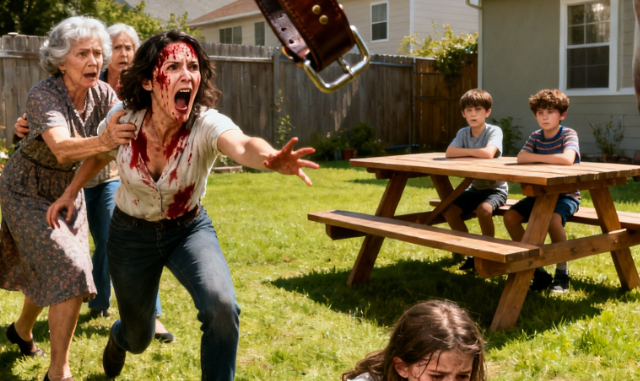
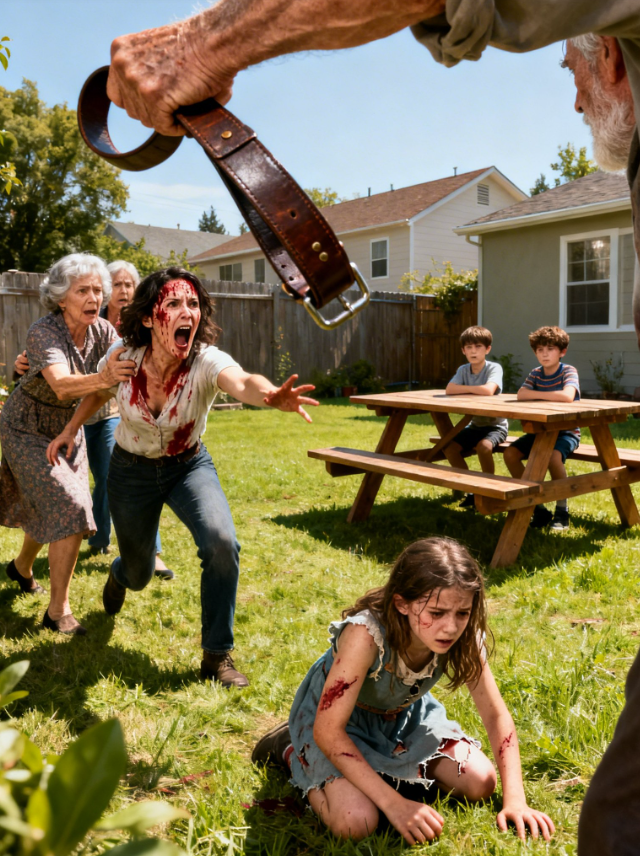
I took my daughter in my arms the way you take something precious out of a fire—tight, shaking, and already grieving the parts you couldn’t get back.
Maisie was five years old. She smelled like strawberry shampoo and the cheap bubble gum toothpaste she insisted on using even though it made her cheeks foam. Her little sneakers were still on, one lace half-untied from running around my sister’s living room with a plastic tiara sliding off her forehead.
Her eyes were closed.
Her body was too still.
And behind me, my mother’s voice came like ice down the spine.
“Cold as ice,” Diane Caldwell said, as if she were congratulating herself. “Pick her up and get out. You’ve messed up our relationship with your sister’s family. Never step foot in this house again.”
arrow_forward_ios
Read morePause
00:00
00:08
01:31Mute
Powered by
GliaStudios
My father’s belt hung loose in his hand. He stood with his chest puffed out, face red, like what he’d just done was a civic duty. Ray Caldwell—retired union man, longtime “patriarch,” the kind of guy who called himself old-school like it was a license to break people.
My sister Brooke stood beside him, eyes wide and wet, but her feet planted. My sister had always been good at looking upset while doing nothing.
I stared at them for one heartbeat longer than I should have, because something in me still wanted this to be a nightmare I could wake up from. Something in me still wanted my mother to be a mother, my sister to be a sister, my father to be anything but what he was.
Then Maisie’s head lolled against my shoulder, and my body took over.
I turned and walked.
My legs felt like they didn’t belong to me. My vision tunneled. The air in my parents’ house tasted like barbecue smoke from the backyard grill and the metallic tang of rage. Somewhere behind me, someone—one of Brooke’s in-laws, maybe—made a small sound, like a cough they were trying to swallow.
No one stepped in front of my father.
No one said, Stop.
Because in my family, Ray’s anger was weather. It wasn’t questioned. It was prepared for.
I pushed through the hallway, past framed photos of us as kids—Brooke in front, smiling, me behind her, half hidden. Past the hallway mirror where I caught a glimpse of myself: hair half-falling out of its clip, lipstick smudged, my daughter limp in my arms.
And I understood with perfect clarity: if I stayed in this house one second longer, Maisie might not leave it alive.
I kicked the front door open with my hip and stumbled into the bright afternoon.
The neighborhood looked absurdly normal—sprinklers ticking on lawns, a golden retriever barking at nothing, a kid two houses down riding a bike in slow circles. In the driveway, my dusty Honda sat beneath my father’s neat American flag, the stars and stripes fluttering like irony.
I laid Maisie in the back seat on the blanket I kept there for emergencies—because motherhood trains you for emergencies the way other people train for vacations.
My hands shook so hard it took two tries to pull my phone from my pocket.
I dialed 911.
The operator answered, calm, practiced.
“911, what’s your emergency?”
“My daughter,” I said, and my voice didn’t sound like mine. It sounded like someone already broken. “She’s five. She’s not moving. My father—he—he hit her.”
“Where are you?” the operator asked.
I gave the address. My parents’ address, the house I’d once thought of as home.
“Is she breathing?” the operator asked.
I leaned over Maisie, watching her chest. It moved—shallow, too quiet, but moving.
“Yes,” I whispered, and relief hit me so hard I almost threw up. “Yes, but she won’t wake up.”
“Stay on the line,” the operator said. “Ambulance is on the way. Do not move her unless necessary. Keep her airway clear.”
I did everything the operator told me. Tilted Maisie’s chin gently. Kept my hand on her little shoulder. Talked to her even though she couldn’t answer.
“Maisie,” I whispered. “Baby, it’s Mommy. Stay with me. You hear me? Stay.”
My throat burned. My eyes stung.
Behind me, the front door opened.
I turned and saw my mother standing on the porch, arms crossed.
She didn’t look scared. She didn’t look guilty. She looked inconvenienced.
“What are you doing?” she snapped.
I stared at her like she was speaking a foreign language. “I called an ambulance.”
“You did what?” she barked, as if I’d set her house on fire.
“My daughter is unconscious,” I said, voice shaking. “He hit her.”
My mother’s face tightened with disgust. “He disciplined her.”
“She’s five,” I spat. “She’s—she’s not waking up.”
My mother’s gaze flicked toward the back seat. For half a second, I thought I saw something human pass through her eyes. Concern. Panic. A crack.
Then it vanished.
“She embarrassed us,” Diane said. “She was screaming. She was disrespectful.”
“She spilled juice,” I said, stunned. “She spilled a cup of juice.”
My mother’s mouth hardened. “In Brooke’s living room. In front of her husband’s family. They already think our side is—”
“Trashy?” I said, voice rising. “Is that what Dad called her? ‘Your trashy little thing needs to learn manners’?”
My mother’s nostrils flared. “Don’t you put words in his mouth.”
I laughed once—sharp, ugly. “I don’t have to. He said it. And you stood there.”
My mother stepped off the porch and walked closer, lowering her voice like she was delivering a threat in church. “You call the police on your father, you will regret it.”
I stared at her. “Regret?”
“You’ll lose your family,” she hissed.
I looked at my back seat, at my daughter’s small body. “I already did.”
Sirens wailed in the distance—growing louder, closer, real.
My mother’s face changed—calculating. She glanced behind her toward the house, as if considering who was watching.
Then she leaned closer and said, “If anyone asks, she fell.”
I froze.
My mother’s eyes were hard. “She fell into the pool. She’s clumsy. You know she is. And you panicked.”
Something in me turned to stone. “Get away from my car.”
My mother’s lips curled. “You’ve always been dramatic, Jenna.”
That was my name—Jenna Caldwell. I kept my maiden name for a while after my divorce because it felt simpler, and then it felt like a chain I didn’t know how to break.
I pointed at the street. “Back up.”
My mother stared at me for a long moment, then lifted her hands like I was the unreasonable one. “Fine. Do what you want. Just remember who will be there for you when this blows up.”
I didn’t answer, because I finally understood: she wasn’t talking about being there for me. She was talking about being there for herself.
The ambulance turned onto the street, lights flashing. A police car followed.
My mother’s spine stiffened.
In the doorway behind her, my father appeared. He looked annoyed, like the sirens were interrupting his TV.
Brooke hovered behind him, crying now, but still not moving.
The paramedics rushed to my car. One of them—a woman with gray hair tucked under her cap—opened the back door and leaned in, her face sharpening as she assessed Maisie.
“What happened?” she asked.
I swallowed, voice trembling. “My father hit her with a belt.”
The paramedic’s eyes flicked to my parents on the porch.
Then she looked back at me, steady and sure. “Okay. We’ve got her.”
They moved fast—professional, efficient. They lifted Maisie carefully onto a small stretcher, strapped her down, checked her vitals. The male paramedic glanced at me.
“Mom, you riding with us?” he asked.
“Yes,” I said immediately. “I’m not leaving her.”
A police officer approached, not running, but purposeful. He looked at my parents, then at me.
“Ma’am,” he said, “I need to ask you some questions.”
I nodded, shaking. “Ask. Ask anything.”
But the paramedic interrupted, voice firm. “Officer, she can give a statement at the hospital. This child needs care now.”
The officer hesitated, then nodded. “Go.”
I climbed into the ambulance, the doors shutting behind me with a heavy finality.
Through the small window, I saw my mother grab my father’s arm, whispering sharply. I saw my father shrug like it was all a stupid misunderstanding. I saw my sister stand there with her hands covering her mouth, a perfect picture of helplessness.
The ambulance lurched forward.
My parents’ house—my childhood—fell away behind us.
At the hospital, time split into bright, harsh fragments.
A nurse guiding me down a hallway. A doctor asking questions I could barely answer. Monitors beeping. Someone saying, “Possible concussion,” “possible internal injury,” “we need imaging.”
I kept my eyes on Maisie’s face as they wheeled her away. Her lashes lay against her cheeks. Her lips were parted slightly. She looked like she was sleeping, except for how wrong everything felt.
A nurse tried to steer me into a waiting area.
“No,” I said, raw. “I’m staying with her.”
The nurse—young, kind eyes—said gently, “We’ll bring you as close as we can, but some things we have to do—”
“I’m her mother,” I said, and my voice shook, but it carried. “She doesn’t wake up and not see me.”
The nurse nodded quickly. “Okay. Okay. Right this way.”
They let me sit near the doorway of the pediatric unit while doctors worked.
A social worker came next. Her badge read KIMBERLY WATTS, LCSW. She had the calm face of someone who’d seen too many families crack.
“Jenna,” she said softly, sitting beside me. “I’m so sorry. I need to ask: do you feel safe? Do you have somewhere to go tonight?”
I laughed bitterly, staring at the floor. “Not my parents’ house.”
Kim didn’t smile. “Do you have support? A partner? Friends?”
“My ex is… not in the picture,” I said. “I have a friend. And I have a job. That’s it.”
Kim nodded, taking notes. “I need to be upfront with you. Because your daughter’s injuries were caused by an adult, we are required to contact Child Protective Services and law enforcement.”
My stomach twisted—because even though I knew it was right, part of me feared what CPS meant. Mothers were trained to fear it.
“Am I in trouble?” I whispered.
Kim’s gaze was steady. “From what you’ve said, you tried to protect her. You called 911. You brought her in. That’s exactly what you’re supposed to do.”
Relief hit me so hard my eyes filled. “Okay.”
“Tell me what happened,” Kim said.
So I did.
I told her about my father’s rage. About the way my sister and mother physically blocked me when I tried to step between him and Maisie. About the words—trashy little thing. About my mother ordering me out like Maisie was a broken piece of furniture.
Kim listened, her face tightening with each detail.
When I finished, my hands were clenched in my lap so tightly my nails bit skin.
Kim exhaled slowly. “Jenna… I want you to hear me. What happened is not discipline. It’s abuse.”
I nodded, tears spilling. “I know.”
“And you did the right thing coming here.”
I didn’t answer because I couldn’t trust my voice.
A police officer arrived not long after. Detective, actually—plain clothes, tired eyes, notebook in hand. His name was Detective Ross.
He spoke gently but directly. “Ms. Caldwell, I’m going to take your statement. Then I’m going to speak with the other parties.”
“Arrest him,” I said, my voice suddenly sharp. “Arrest my father.”
Detective Ross nodded once. “We’re investigating. Medical documentation matters. Witness statements matter.”
“There were people there,” I said. “My sister’s in-laws. Neighbors. Guests.”
Ross wrote quickly. “We’ll identify them. Do you have any proof—photos, video?”
I shook my head, nauseated. “It happened too fast. I was trying to—”
Ross held up a hand, calming. “I’m not blaming you. I’m asking so we can build a case.”
I swallowed. “My sister has cameras. Her husband installed those doorbell cameras. Their whole house is wired.”
Detective Ross’s eyes sharpened. “That’s helpful.”
Then he asked the question that punched me in the gut.
“Did anyone attempt to stop him?”
I stared at him. “I did.”
“And anyone else?”
My throat tightened. “No.”
Ross’s jaw flexed. He wrote something, then looked up.
“Where is the belt now?” he asked.
“In my father’s hand,” I said, voice flat. “Unless my mother made him hide it.”
Ross nodded. “Okay.”
A doctor appeared then—pediatrician, serious face. She glanced at me and then at Kim and Ross.
“Ms. Caldwell?” she asked.
I shot to my feet so fast my head spun. “Yes. How is she?”
The doctor’s voice was careful. “Maisie is alive. She’s stable.”
My knees almost gave out. I grabbed the wall.
“Is she—” I swallowed hard. “Is she okay?”
The doctor hesitated, and my blood turned to ice.
“She has significant bruising,” the doctor said, choosing words that wouldn’t tear me apart but still did. “She likely has a concussion. We’re running tests to make sure there’s no internal bleeding. She’s unconscious right now, but we’re monitoring her closely.”
I pressed my hands to my mouth to stop the sob.
“We need to keep her overnight,” the doctor continued. “Possibly longer depending on the results.”
“Can I see her?” I whispered.
The doctor nodded. “Yes. But she may not wake up yet.”
“I don’t care,” I said, voice breaking. “I just want her to know I’m there.”
They led me into her room.
Maisie lay in a small hospital bed, tubes and monitors attached. The sight was so wrong it felt like my brain couldn’t hold it.
I walked to the bed slowly, like approaching something holy.
I took her hand—tiny, warm.
“Hi, baby,” I whispered, tears dropping onto the sheet. “It’s Mommy. I’m here. I’m right here.”
Her fingers didn’t squeeze back. She didn’t move.
But she breathed.
And for that, I thanked every god I’d ever doubted.
That night, I didn’t leave her bedside.
I sat in the stiff chair, head bowed, holding her hand, listening to the monitor beep like a metronome for survival.
Kim came back with papers and resources. “CPS will interview you,” she said. “They’ll want a safety plan—where you’re staying, who has access, how you’ll protect her.”
“I’ll do anything,” I whispered.
Kim nodded. “I believe you.”
Detective Ross returned around midnight.
His face was harder now.
He pulled the curtain around us slightly for privacy.
“I spoke to your mother,” he said.
My stomach clenched. “And?”
“She claims Maisie was out of control,” Ross said, voice clipped. “She claims your father used ‘reasonable discipline.’ She claims you ‘overreacted’ and ‘escalated.’”
My hands curled into fists. “She’s lying.”
Ross nodded. “Yes. And your father refused to answer questions without a lawyer.”
Of course he did.
“And Brooke?” I asked, voice hollow.
Ross’s gaze sharpened. “Your sister is… complicated. She cried. She said she tried to stop him.”
I let out a sound—half laugh, half sob. “She did not.”
Ross continued. “Her husband, Mark, is also claiming it happened too fast. But he’s the one who mentioned the cameras.”
My head snapped up. “He mentioned them?”
Ross nodded. “He didn’t seem to realize what he was giving us.”
Hope, fragile as a thread, flickered in my chest.
Ross’s tone was firm. “We’re obtaining the footage legally. If it shows what you described, we’ll move quickly.”
I swallowed hard. “Please.”
Ross looked at Maisie, then back at me. “Ms. Caldwell… you understand that if your family tries to contact you, intimidate you, or take the child, you need to call us immediately.”
“They won’t take her,” I said, but my voice wavered because I knew my mother.
Ross nodded. “That’s why we’re going to put protections in place.”
He paused, then added, quieter: “For what it’s worth… I’m sorry you’re doing this alone.”
I stared at him, throat tight. “I’m not alone.”
He looked surprised.
I glanced at Maisie. “I’m with her.”
Ross nodded slowly, like he understood that kind of alone.
Maisie woke up at 3:17 a.m.
I remember the exact time because I was staring at the clock, bargaining with it, begging it to deliver me something besides terror.
Her eyelids fluttered. Her face tightened like she was waking from a nightmare.
I leaned forward so fast I nearly fell out of the chair.
“Maisie,” I whispered. “Baby? Can you hear me?”
Her eyes opened—glassy, confused.
She looked at me like she wasn’t sure where she was.
Then her mouth trembled.
“Mommy?” she whispered.
My whole body broke.
“Yes,” I choked. “Yes, sweetheart. I’m right here.”
She tried to sit up and winced.
“No, no,” I said quickly, touching her shoulder gently. “Stay still. You’re hurt. You’re safe. You’re in the hospital.”
Her eyes filled with tears instantly.
“Is Grandpa mad?” she whispered.
Something cold and violent moved through my blood.
“No,” I said, forcing softness. “Grandpa is not going to touch you again. Ever.”
Maisie’s face twisted. “He said I was bad.”
“You are not bad,” I said, voice shaking with fury. “You are a good girl. You spilled juice. That’s not bad.”
Maisie sniffed. “Aunt Brooke didn’t help.”
My throat tightened. “I know, baby.”
She stared at the ceiling for a moment, then her eyes slid back to me.
“Mommy,” she whispered, and there was a fear in her voice that didn’t belong in a five-year-old. “When I stopped crying, he still—”
I leaned in, kissing her forehead softly. “Shhh. You don’t have to tell me right now. You’re safe. That’s all you need to know.”
But I filed every word away like evidence.
Because it was.
By morning, CPS had arrived.
The caseworker, Ms. Patel, was professional but not unkind. She interviewed me in the hallway, then interviewed Maisie gently with a child therapist present.
I waited outside the room, hands trembling, hearing the faint cadence of adult voices, Maisie’s small answers.
When the therapist came out, she gave me a sad, steady look.
Ms. Patel followed.
“Jenna,” she said, “we’re opening a case. That’s standard. But I want to be clear: you are not the subject of suspicion right now. Your actions—calling 911, seeking medical care—are protective.”
Relief nearly made me dizzy.
“We’ll need you to agree to a safety plan,” she continued. “No contact between Maisie and your father, mother, or sister until further notice. We’ll also request an emergency protective order.”
“Yes,” I said immediately. “Yes. Anything.”
Ms. Patel nodded. “Where will you stay?”
I hesitated. My apartment was small, but it was mine. Safe. My mother didn’t have a key.
“My place,” I said. “In Seattle. And my friend Taryn can stay with us for a few nights if needed.”
Ms. Patel wrote. “Okay.”
Then she asked, “Any weapons in your home?”
“No.”
“Any substance use?”
“No.”
“Any history of violence with your ex?”
I swallowed. “No. He left when I was pregnant. He’s not involved.”
Ms. Patel’s eyes softened slightly. “Okay.”
It felt strange—being asked these questions after what my father had done—like the system still needed to make sure I wasn’t the problem. But I understood why. Children deserved certainty.
And I would give them certainty.
Detective Ross returned later that day with news.
They had obtained the camera footage.
My heart hammered.
Ross didn’t show it to me—he didn’t need to. His face told me everything.
“It’s worse than what you described,” he said quietly.
My stomach dropped. “Worse?”
Ross nodded. “Your sister and mother physically restrained you. Your father struck the child multiple times. Your mother made statements indicating intent to punish. Your father made threats. It’s all on video.”
My knees weakened.
And then Ross said the words I’d been holding my breath for:
“We’re arresting your father today.”
A sob escaped me—relief mixed with a rage so old it felt inherited.
“And my mother?” I asked.
Ross’s jaw tightened. “We’re charging her for aiding and abetting, and obstruction if she attempted to alter evidence.”
“And Brooke?”
Ross sighed. “Your sister’s involvement is being evaluated. The footage shows she restrained you. That matters.”
My throat tightened with fury. “So she gets away with it?”
Ross held my gaze. “Not if we do this right.”
I nodded, shaking. “Do it right.”
They discharged Maisie three days later.
She came home with a small stuffed bear from the pediatric unit, a stack of follow-up instructions, and a bruise I couldn’t look at without feeling like my chest would crack open.
She moved slowly. She startled at sudden noises. At night, she climbed into my bed and curled against me like she was trying to crawl back into safety.
I didn’t send her away. I held her.
The first night home, she whispered, “Mommy, are we going back to Grandma’s?”
I kissed her hair. “Never,” I said. “We’re never going back.”
Maisie’s voice was tiny. “But Grandma said you weren’t allowed.”
I swallowed hard, fighting tears.
“Grandma doesn’t get to decide where we belong,” I whispered. “I do. And you do.”
Maisie was quiet for a long time.
Then she whispered, “I like our house.”
I exhaled shakily. “Me too.”
My mother tried to contact me the next day.
A blocked number. A voicemail.
Her voice was syrupy with rage beneath it. “Jenna, this has gone far enough. Your father is a good man. He was trying to teach that child. You always let her run wild. Call the detective and tell them it was a misunderstanding.”
I stared at my phone, shaking.
Then I forwarded the voicemail to Detective Ross and blocked the number.
Two hours later, another number called.
My sister.
I stared at her name until my vision blurred.
Then I answered, because some part of me needed to hear if she had anything human left.
“Jenna,” Brooke sobbed immediately. “Oh my God—are you okay? Is Maisie okay?”
I laughed bitterly. “She was unconscious in a pool.”
“I didn’t mean—” Brooke choked. “I froze. I didn’t know what to do.”
“You knew what to do when Mom told you to grab my arm,” I said, voice low and shaking. “You knew what to do when Dad told you to move me away.”
Brooke cried harder. “Mom said it would calm him down. She said if you got in the way, he’d hit you too.”
“And that made it okay?” I snapped.
Brooke’s voice collapsed into whispers. “No.”
Silence stretched.
Then she said, “Mark is furious. His family is furious. They’re saying—”
I cut her off. “I don’t care what his family is saying.”
Brooke swallowed. “Mom says you’re destroying us.”
I felt something settle in my chest—cold and steady.
“I’m saving my daughter,” I said. “If that destroys you, that’s your problem.”
Brooke whispered, “What do you want from me?”
I thought about it.
I wanted her to rewind time. To stand between my father and my child. To shove my mother away. To choose decency.
But time doesn’t bend for apologies.
“I want you to tell the truth,” I said. “To the police. To CPS. To the court. I want you to say what you did.”
Brooke’s crying turned sharp. “If I do that, Mom will never forgive me.”
I stared at the wall, stunned by how small she still was inside.
Then I said, “Then you’re just like her.”
Brooke gasped like I’d slapped her.
I hung up.
The weeks that followed were brutal in the way survival is brutal: paperwork, appointments, therapy, court hearings.
Maisie started play therapy. The therapist, Dr. Nguyen, taught her language for feelings and safety plans for fear. Maisie drew pictures of our apartment with big locks on the door and a sun in the corner. Sometimes she drew a man with angry eyebrows and scribbled lines around him.
I didn’t ask her to explain every drawing. I just sat beside her and said, “Thank you for showing me.”
I got an emergency protective order. Then a longer restraining order. Then a permanent no-contact order while the criminal case was pending.
My father’s lawyer tried to paint him as a strict disciplinarian. My mother’s lawyer tried to paint her as a “worried grandmother.” They used words like family values and misunderstanding as if those words could erase bruises.
The footage erased their story.
Every time I felt myself wobble—fearful, exhausted, guilty from years of conditioning—I remembered Maisie’s whisper:
Aunt Brooke didn’t help.
And I hardened again.
One afternoon, after Maisie’s therapy session, I found a small envelope taped to my apartment door.
No return address.
Inside was a short note in my mother’s handwriting:
You will regret this.
My hands went numb.
I took a photo, sent it to Detective Ross, and called the non-emergency line. An officer came, documented it, added it to the case.
That night, I sat on my couch while Maisie slept beside me, clutching her stuffed bear.
I stared at my hands—at the trembling that still lived in them.
And I realized the truth I’d avoided for years:
My parents had never been safe.
I’d simply learned how to behave so their danger didn’t turn toward me.
Now my daughter had been in their path.
Never again.
The trial was set for late spring.
The months leading up to it were a war of small things—my mother’s friends sending messages calling me ungrateful, distant relatives asking “what really happened,” my father’s supporters in my hometown posting vague Facebook statuses about “kids these days” and “parents being arrested for discipline.”
I didn’t respond to any of it.
I lived in a smaller world now: Maisie’s therapist, my job, the detective, the prosecutor, my friend Taryn who stayed over when my nerves got too loud.
The prosecutor, Assistant DA Lauren Bell, met with me twice to prepare.
“You’ll be asked painful questions,” she warned gently. “Defense will try to provoke you.”
“I don’t care,” I said. “I’ll say what happened.”
Lauren nodded, eyes fierce. “Good.”
She showed me still frames from the footage—not the worst moments, but enough to confirm what I already knew.
There I was, reaching for Maisie, body tense.
There was my sister, gripping my forearm.
There was my mother, holding my other arm, face tight.
There was my father, belt raised.
I stared until my vision blurred.
Lauren said quietly, “Jenna, you need to understand something. Juries don’t like family cases because they want to believe this doesn’t happen. But video removes the doubt.”
I swallowed hard. “What about my mother?”
Lauren’s expression tightened. “We’re pushing for charges. Complicity matters. But her legal exposure is different than his.”
“So she gets to hide behind him,” I said bitterly.
Lauren shook her head. “Not in family court. CPS has a lot of power here.”
That mattered.
Not enough.
But it mattered.
The day of trial, I wore a navy dress and a small necklace Maisie had made at daycare—a plastic heart on a string. I tucked it under my collar like armor.
I arranged childcare with Dr. Nguyen’s help. Maisie stayed with Taryn that morning, safe and distracted with cartoons.
When I walked into the courthouse, my stomach clenched so hard I thought I might be sick.
My father sat at the defense table in a suit he’d probably worn to funerals and weddings. He looked smaller than I remembered, but the anger was still there, packed into his jaw.
My mother sat behind him, chin lifted, eyes cold.
Brooke sat beside my mother, eyes swollen. Mark wasn’t with her. Good.
Lauren met me at the side door. “You ready?”
“No,” I said honestly. “But I’m here.”
Lauren nodded once. “That’s what matters.”
Inside the courtroom, everything felt formal and unreal—the flag, the judge’s bench, the careful ritual of law.
And yet, it was the first place in my life where my father’s power didn’t automatically win.
Opening statements began.
The defense painted my father as a misunderstood man. They called Maisie “difficult.” They called me “hysterical.” They suggested I had a vendetta because my parents “preferred my sister.” They tried to turn my childhood into a joke.
Lauren stood and spoke calmly, clearly, like cutting glass.
“This case is about a five-year-old child who was assaulted,” she said. “And the people who chose reputation over rescue.”
My mother’s face tightened.
Good.
Witnesses testified—paramedics, doctors, the social worker, CPS. The footage was introduced.
When the screen in the courtroom played the video, I stared straight ahead and didn’t blink.
I heard my father’s voice, loud and cruel: “Your trashy little thing needs to learn manners.”
I heard myself screaming, begging.
I heard my mother’s voice, sharp as a slap, ordering me out.
I heard Maisie crying.
Then the judge stopped the audio before the worst of it played fully in open court, limiting what the jury had to endure, but the footage had already done its job.
My father’s lawyer stood up and said, “Your Honor—”
The judge’s face was stone. “Sit down.”
My father’s lawyer sat down.
I felt something in my chest loosen—a fraction of pressure, a single breath of justice.
Then it was my turn.
I walked to the stand on legs that didn’t feel like mine.
Lauren asked me to tell what happened.
So I did.
I told them about the juice spill. About my father’s temper. About my sister and mother grabbing me. About the belt. About Maisie going still. About my mother ordering me out.
When Lauren asked, “What did you do next?” my voice shook.
“I took my daughter and I left,” I said. “I called 911. I tried to keep her breathing. I brought her to the hospital. I did what a mother is supposed to do.”
Lauren’s eyes softened. “Did anyone else attempt to help her?”
I swallowed hard. “A guest tried later. Not my family.”
The defense cross-examined me.
They tried to corner me with old family wounds.
“Isn’t it true your father was always strict?” the lawyer asked.
“Yes,” I said flatly.
“And you resented that.”
“I resented abuse,” I said.
The lawyer’s mouth tightened. “Ms. Caldwell, do you consider spanking abuse?”
“I consider hitting a five-year-old until she stops moving abuse,” I said, voice steady.
A ripple moved through the courtroom.
The defense tried a different angle. “Did your daughter scream frequently? Have tantrums?”
“She’s five,” I said. “She’s a child.”
“Did she ever act disrespectfully?”
“She spilled juice,” I said. “That’s what this started with.”
The lawyer looked frustrated. Good.
Then the defense asked, “Isn’t it true your mother asked you to leave because you were escalating?”
My stomach tightened, but I held on.
“My mother asked me to leave because she cared more about my sister’s in-laws than my daughter’s life,” I said.
The judge’s gaze sharpened.
The defense tried to object. The judge didn’t let it stick.
When I stepped down, my hands were trembling.
Lauren squeezed my arm gently. “You did well.”
I didn’t feel well. I felt like a person whose skin had been turned inside out.
But I’d done it.
I’d spoken.
Brooke testified the next day.
She cried on the stand. She said she didn’t know what to do. She said she was scared of my father. She said she thought restraining me would “prevent a bigger scene.”
Lauren’s questions were sharp and precise.
“Did you restrain Jenna?” Lauren asked.
Brooke whispered, “Yes.”
“Did Jenna ask you to stop?”
“Yes.”
“Did you stop?”
Brooke’s voice broke. “No.”
“Did you see Ray strike the child?”
Brooke swallowed hard. “Yes.”
“Did you call 911?”
“No.”
“Did you attempt to help the child?”
Brooke’s face crumpled. “No.”
The courtroom was silent except for Brooke’s crying.
Lauren’s voice softened slightly, not out of mercy, but out of gravity.
“Why not?”
Brooke looked toward my mother, like a reflex.
My mother stared back, eyes hard.
Brooke turned forward again and whispered, “Because Mom said not to.”
That one sentence did what years of family dynamics had done to me: it exposed the truth.
Not just that my father was violent.
But that my mother managed the violence.
And my sister obeyed.
The verdict came on a Friday afternoon.
Guilty.
Multiple counts.
The word landed heavy, real.
My father’s face twisted with rage, then something like disbelief—as if the world had broken its contract with him.
My mother didn’t cry. She didn’t collapse. She stared at the jury like they were traitors.
The judge set sentencing for a later date. Protective orders remained in place.
When it was over, I walked out of the courthouse into bright sunlight and felt, for the first time in months, a breath that didn’t hurt.
Lauren stood beside me on the steps. “You did something hard,” she said. “You protected your child when the people who were supposed to protect you didn’t.”
I nodded, eyes burning. “I just did what I had to.”
Lauren looked at me, voice quiet but firm. “That’s what bravery looks like.”
I didn’t feel brave. I felt tired.
But tired was better than trapped.
Life didn’t become perfect after court.
Maisie still had nightmares. Sometimes she woke up screaming, and I held her until she could breathe again. Sometimes she flinched when a man raised his voice on TV. Sometimes she asked questions that cracked me open.
“Why was Grandpa mean?”
“Why didn’t Grandma help?”
“Will they find us?”
Each time, I answered with the truth wrapped in softness.
“Because Grandpa is sick in his heart.”
“Because Grandma chose wrong.”
“No. They can’t come near us.”
We changed routines. We moved apartments. I updated daycare pickup lists with photos and strict instructions. I installed a doorbell camera of my own—one I controlled.
I built safety into our days the way you build a fence: slowly, carefully, with no apology.
One afternoon, months later, Maisie and I sat on our tiny balcony eating popsicles. She dripped red juice on her shirt and froze, eyes wide, like she expected lightning.
My stomach clenched.
Then I forced my voice to stay gentle.
“It’s okay,” I said, handing her a napkin. “Spills happen.”
Maisie stared at me, shocked.
“You’re not mad?” she whispered.
I swallowed hard, throat burning. “No, baby. I’m not mad.”
Maisie’s face crumpled, and she burst into tears—not from fear this time, but from release.
I pulled her into my lap and held her, letting her cry until it passed.
When she finally calmed, she wiped her nose on my shoulder and whispered, “Mommy… you saved me.”
My eyes filled.
“I’m always going to,” I whispered back. “Always.”
Maisie leaned against me, small and warm, alive.
In the distance, Seattle traffic hummed. Somewhere below, someone laughed. A dog barked. Ordinary life continued.
And for the first time in a long time, ordinary sounded like freedom.
My mother’s voice still lived in my memory—cold as ice, ordering me out.
But now it felt like a door slamming behind me instead of a prison closing in.
Because she’d been right about one thing, even if she meant it as punishment:
I would never step foot in that house again.
And that wasn’t exile.
That was escape.
THE END
Để lại một phản hồi