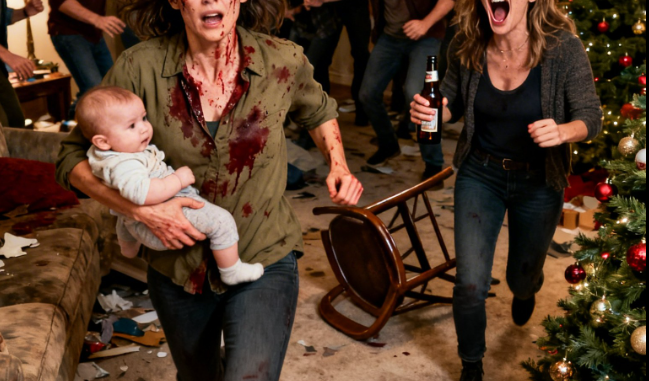

My Sister Offered to Feed My Newborn—Then I Found Him Turning Blue and Heard Her Laugh, “I Poisoned It.”
My name is Natalie. I’m twenty-eight, a military wife, and the mother of a baby boy named Garrett.
My husband, Russell, is a four-star general in the U.S. Army—a man people describe with words like unshakable and steel-nerved. He’s the type who can stand in a room full of chaos and make it quieter just by walking in. We met seven years ago when I worked as a civilian contractor on base. At first, we were cautious—two professionals staying within the lines.
Then those lines blurred into long talks after meetings, and those talks turned into a partnership built on respect and a strange kind of calm I didn’t know I needed until I had it.
We’ve been married five years. And Garrett was born six months before this incident—meaning he was three months old when everything happened.
arrow_forward_ios
Read morePause
00:00
00:19
01:31Mute
Powered by
GliaStudios
I replay that day in my head like a movie I never asked to see.
Every detail is bright and sharp, as if my mind decided pain should come in high definition.
It was a family gathering at my in-laws’ house—one of those loud, warm afternoons where everyone acts like they’re closer than they really are. The backyard smelled like grilled burgers and sun-warmed grass. Somebody had a speaker playing old country songs, the kind that make people sway with plastic cups in their hands and pretend they’re not watching each other.
Russell was in his element: shaking hands, listening, smiling politely, never too much. People gravitated toward him the way they do toward a fire when the air is cold—except Russell wasn’t warmth. He was certainty. An anchor. Even when he laughed, it was controlled, like he’d approved it first.
I wasn’t in my element.
I was three months postpartum, still exhausted in a way sleep didn’t fix. Still learning how to be a mom while also being the kind of wife people expected a general’s wife to be: composed, gracious, unbothered.
Garrett had been fussy all morning. The kind of fussy that makes you walk in circles, whispering, “It’s okay, it’s okay,” even though you’re not sure who you’re trying to convince.
I’d fed him before we arrived, checked his diaper twice, packed enough baby supplies to survive an apocalypse, and still—still—my chest stayed tight all day, like I was waiting for something to go wrong.
Maybe that’s motherhood. Or maybe that was my intuition trying to scream through the noise.
My sister, Alyssa, had arrived late, as usual.
Alyssa was older than me by two years, but she’d always carried herself like she was ten years older—like she’d been put on earth to evaluate everyone else’s choices. She’d always been sharp-tongued, always competitive. The kind of person who could compliment you and make you feel insulted at the same time.
When Russell and I got married, Alyssa didn’t say congratulations.
She said, “Must be nice to marry into power.”
When I got pregnant, she didn’t say she was happy for me.
She said, “I hope you’re ready to lose yourself.”
And when Garrett was born, she didn’t coo and soften like most people do.
She stared at him like he was proof of something she didn’t want to admit.
That day, she swept into the backyard in a bright dress that didn’t match anyone’s mood, sunglasses on, smile already loaded.
“Natalie,” she called, voice sugary. “There you are.”
I shifted Garrett on my hip and forced my face into something neutral. “Hey.”
She leaned in like she was going to hug me, then stopped short and reached for Garrett instead. “Let me see him.”
Garrett squirmed, tiny fists opening and closing.
Alyssa clicked her tongue. “He’s smaller than I thought.”
“He’s three months,” I said, too quickly. “He’s healthy.”
Alyssa hummed like she was unconvinced. “Sure.”
Russell appeared at my side, one hand resting lightly against my back. He didn’t need to say anything. His presence was a message.
Alyssa’s gaze flicked to him, and her smile sharpened.
“General,” she said, like she was addressing a judge. “How’s it feel, being perfect all the time?”
Russell’s expression didn’t change. “I’m not perfect, Alyssa.”
“Oh,” she said, laughing. “That’s right. You just play one on TV.”
He didn’t take the bait. Russell never took the bait. He’d been trained for bigger threats than my sister’s sarcasm.
He nodded once and walked away to greet someone calling his name.
Alyssa watched him go like she wanted to throw something at his back.
Then she looked at me, still smiling. “You okay?”
That question should’ve sounded like concern.
From Alyssa, it sounded like a test.
“I’m fine,” I said.
She leaned closer. “You look tired.”
“I have a newborn.”
“You have help,” she corrected. “And money. And a husband who can probably order the sun to rise.”
My fingers tightened around Garrett’s blanket. “He doesn’t order anything.”
Alyssa shrugged. “Whatever you have to tell yourself.”
Before I could respond, Garrett’s little face crumpled and he began to cry—sharp, desperate, the kind of cry that makes every nerve in your body fire at once.
I bounced him gently, shushing. “Hey, hey, it’s okay.”
Alyssa flinched. “God, that sound.”
“It’s a baby,” I said, fighting irritation.
She sighed like I was unreasonable. “Do you want me to take him? I can feed him. Give you a break.”
I blinked.
Alyssa never offered breaks. Alyssa offered judgments.
“I’ve got it,” I said automatically.
But Garrett’s crying escalated, and heads turned. People in the backyard glanced over with that mix of pity and annoyance adults get when a baby disrupts the vibe.
I felt heat crawl up my neck.
Alyssa tilted her head. “Natalie. Go breathe. Seriously. I’ll take him to the guest room, warm his bottle, feed him. You can come check in whenever you want.”
My instincts screamed no.
And then reality whispered: You’re being paranoid. She’s your sister. It’s a family gathering. Everyone’s watching. Don’t be dramatic.
My arms were tired. My brain was tired. My whole body was tired.
And before I could fully think it through, I heard myself say, “Okay. Just… okay.”
Alyssa’s smile widened—too fast, too pleased.
She reached for Garrett. “There we go.”
Garrett cried harder as she took him, his little arms flailing.
“Hey, baby,” I murmured, brushing his cheek with my fingertips. “It’s okay. Mommy’s right here.”
Alyssa adjusted him like he was a bag of groceries. “I’ve got him.”
She turned and walked toward the house.
I watched her go, my stomach twisting.
Russell returned, scanning my face immediately. “Where’s Garrett?”
“With Alyssa,” I said, hating how small my voice sounded. “She offered to feed him in the other room.”
Russell’s eyes narrowed for a fraction of a second. “Alyssa.”
“It’s fine,” I rushed. “I’ll check in a minute. I just… I needed a second.”
Russell didn’t argue, but his jaw tightened. “Don’t wait long.”
“I won’t.”
I tried to rejoin the gathering. I tried to smile at people telling me Garrett was beautiful, that I was glowing, that motherhood suited me.
I smiled until my cheeks hurt.
But my ears stayed tuned for my baby’s cries like a radio locked on one station.
A few minutes passed.
Then more.
The music kept playing. Someone laughed too loud. Plates clinked. A dog barked.
And I realized something that made my blood run cold:
I couldn’t hear Garrett anymore.
No crying.
No fussing.
Nothing.
I set down my drink so fast it sloshed. “I’m going to check on Garrett,” I said, mostly to myself.
I moved through the patio doors and into the house.
The inside was cooler, dimmer. The noise from the party dulled behind me like I’d stepped underwater.
I walked down the hallway toward the guest room, my heartbeat climbing with each step.
The door was cracked open.
I pushed it gently.
The room smelled faintly like baby powder and something floral.
Alyssa sat in the chair near the bed, one leg crossed over the other. There was a bottle on the small side table. She wasn’t holding Garrett.
My eyes snapped to the bed.
Garrett lay on his back on the blanket I’d packed, his little mouth slightly open.
And his skin—
His skin wasn’t the warm pink I knew.
It was… wrong.
A sickly color.
His lips were turning blue.
For a second, my brain refused to process it. Like if I didn’t understand, it couldn’t be real.
Then instinct took over like a tidal wave.
“Garrett!” I lunged forward, scooping him up. His body felt limp in a way that made terror slam into my chest.
I jerked him closer, searching his face, his chest, his breathing.
“Breathe—baby, breathe—” My voice broke into a sob. “Oh my God—Russell!”
I screamed his name like it could pull him through walls.
Alyssa didn’t move.
She didn’t jump up. Didn’t look shocked.
She just watched me, calm as a person watching TV.
“Russell!” I screamed again, stumbling toward the hallway with Garrett clutched to me. “Somebody help!”
Garrett’s head lolled slightly against my arm.
My knees went weak.
I felt myself tipping into panic so fast I could barely see.
And then I heard it.
A sound that did not belong in that room.
Laughter.
I turned, stunned, and saw Alyssa covering her mouth with one hand, shoulders shaking like she couldn’t hold it in.
I stared at her, my mind trying to find a sane explanation.
“Alyssa,” I choked. “Call 911—call—now!”
She laughed harder.
And then she said, bright and clear, like she was delivering a punchline:
“I poisoned his formula.”
The room tilted.
The walls seemed to move.
My ears rang so loudly I could barely hear my own screaming.
“What—” I gasped. “What did you say?”
Alyssa’s eyes shone with something ugly. “You heard me.”
I looked down at Garrett—my baby—his lips blue, his eyelids fluttering.
“No,” I whispered, the word tearing out of me. “No, no, no—”
Footsteps thundered in the hall.
Russell burst into the doorway, eyes sweeping from my face to Garrett’s body like a scan.
The shift in the air was immediate. Russell didn’t panic. He went cold. Focused.
“What happened?” he demanded.
I could barely speak. “He—he’s—Alyssa said—”
Alyssa leaned back in the chair, smiling like she’d been waiting for him. “I poisoned the formula,” she repeated, louder.
Russell’s face changed.
Not into rage.
Into something worse.
A kind of controlled fury that looked almost calm if you didn’t know what it meant.
He moved to me in two strides, taking Garrett gently but firmly, positioning him with the kind of care that screamed training—medical training, battlefield training, crisis training.
“Call 911,” Russell ordered, voice like steel. “Now.”
I fumbled for my phone with shaking hands.
Russell’s eyes flicked to Alyssa. “What did you put in it?”
Alyssa shrugged, still smiling. “Does it matter?”
Russell didn’t move his gaze away from her. “It matters if my son dies.”
Alyssa’s smile faltered for half a second—just enough to prove she understood the gravity and didn’t care.
I punched 911 with trembling fingers, barely able to see the screen.
“911, what’s your emergency?”
“My baby—” I sobbed. “My baby isn’t breathing right—he’s turning blue—please—”
Russell spoke over me, calm and precise, giving the address, describing the symptoms, demanding immediate response.
The operator’s voice sharpened into action. “Help is on the way. Stay on the line. Is the baby breathing?”
Russell checked Garrett’s chest, his airway, his response. “Shallow,” he said. “Intermittent.”
The operator began giving instructions, but my mind was too loud with panic to absorb them. I hovered, helpless, watching Russell work to keep our baby alive.
And Alyssa—
Alyssa sat there like she was watching a show.
I wanted to leap at her. I wanted to tear her apart with my hands.
But my body wouldn’t leave Garrett.
Nothing in me could move away from my baby.
People began crowding into the hallway—someone had heard yelling. My mother-in-law. An uncle. A couple cousins.
Their faces shifted from confusion to horror the second they saw Garrett’s color.
“What happened?” someone cried.
Russell didn’t look up. “Move back,” he ordered. “Give us space.”
Alyssa’s voice floated through the chaos, almost cheerful. “Natalie finally got what she deserved.”
My mother-in-law’s hand flew to her mouth. “Alyssa—what are you saying?”
Alyssa’s eyes locked on mine. “She thinks she’s better than everyone because she married a general,” she said, her voice suddenly sharp. “She thinks she’s untouchable. She thinks she can take up all the air in the room and we’re supposed to clap for her.”
I stared at her, shaking. “This isn’t about me,” I whispered. “That’s a baby.”
Alyssa’s face twisted. “It’s your baby.”
Russell’s head snapped up. “You will be silent,” he said, voice low.
Alyssa scoffed. “Or what? You’ll order me arrested?”
Russell didn’t blink. “Yes.”
The word landed like a gunshot.
Alyssa laughed—too loud, too brittle. “For what? A little mistake?”
People gasped again, louder this time, because even the ones who’d always defended Alyssa couldn’t pretend anymore.
The sirens hit the street outside a moment later—fast, urgent, cutting through the backyard party like a blade.
Within seconds, paramedics rushed in, pushing through the hallway with equipment and practiced speed.
“Infant?” one asked.
Russell stepped aside just enough to let them take Garrett, but stayed close like a shadow. “Three months,” he said. “Cyanosis. Intermittent breathing. Suspected poisoning.”
The word poisoning out loud made me nearly collapse.
A paramedic looked sharply at Alyssa. “Who said poisoning?”
Alyssa lifted her chin, almost proud. “I did.”
The paramedics didn’t respond to her. They responded to Garrett—oxygen mask, monitoring, quick movements, focused faces.
I followed them like I couldn’t stop, like gravity had attached me to my baby.
Russell grabbed my hand for one second. “Stay with me,” he said.
Then he turned to the nearest police officer who had arrived with the ambulance—because in our town, a call like this brought both.
Russell didn’t raise his voice.
He didn’t need to.
“My wife’s sister admitted to poisoning my infant son’s formula,” he said, each word precise. “She is in the guest room. Witnesses present.”
The officer’s expression hardened immediately. He looked at Alyssa like she’d turned into something not quite human.
“Alyssa,” my mother-in-law whispered, voice breaking. “Tell me you didn’t.”
Alyssa smiled at her. “Oh, I did.”
That was when my mother-in-law started crying—not for Garrett, not for me, but for the reality that her family had cracked open in a way it couldn’t be repaired.
Russell didn’t look at his mother. He didn’t look at anyone.
He looked at the officer. “Take her.”
The officer stepped toward Alyssa. “Ma’am, turn around. Put your hands behind your back.”
Alyssa blinked like she couldn’t believe consequences were real. “You can’t be serious.”
The officer didn’t blink back. “Hands behind your back. Now.”
Alyssa’s gaze shot to Russell, furious. “You’re really doing this.”
Russell’s face was blank. “You tried to kill my son.”
Alyssa’s smile vanished. “I didn’t try to kill him. I tried to scare her.”
I made a sound that wasn’t a word—more like an animal noise pulled from my throat.
“Scare me?” I choked. “He’s turning blue!”
Alyssa’s eyes flashed. “Good. Maybe you’ll finally learn you’re not special.”
The officer cuffed her.
Alyssa jerked, protesting, twisting her shoulders like she wanted to fight. “Let go of me! You can’t—do you know who my brother-in-law is?”
Russell stepped closer, voice like ice. “Do you know who my son is?”
Silence.
Not because Alyssa felt remorse.
Because even she understood that Russell’s restraint was the only thing keeping her from seeing a kind of anger she’d never survive.
The paramedics lifted Garrett onto a stretcher designed for infants and rolled him toward the front door.
I moved with them, sobbing, hand pressed to my mouth to keep from screaming.
“Ma’am,” a paramedic said gently, “you can ride with us.”
I nodded so fast my neck hurt.
Russell was already there, climbing in with the controlled urgency of a man who refused to lose.
In the ambulance, the world narrowed to the sound of machines and Garrett’s tiny, fragile existence.
His skin still looked wrong.
His little chest moved, but not like it should.
I kept whispering his name. “Garrett. Garrett, baby. Mommy’s here. Daddy’s here. Stay. Please stay.”
Russell sat beside the paramedic, his hand resting near Garrett’s blanket, not touching too much, just present—like he was lending Garrett his strength through proximity.
Russell’s face stayed calm, but his eyes…
His eyes looked like war.
At the hospital, everything moved fast and slow at the same time.
Doctors. Nurses. Bright lights. Questions firing at us like bullets.
“What happened?”
“What did he ingest?”
“How long ago?”
“Any allergies?”
“Any medical history?”
I tried to answer but kept dissolving into sobs.
Russell answered for both of us, voice steady, hands clenched.
“I don’t know the substance,” he said. “The suspect admitted to poisoning the formula. Infant is three months. Symptoms began within the hour.”
They took Garrett from my arms and disappeared through double doors into a pediatric emergency bay.
And then—there was nothing to do but wait.
Waiting is its own kind of torture.
Russell stood with his hands on his hips, staring at the doors like he could force them open with willpower.
I sat in a plastic chair, shaking so hard my teeth clicked.
I kept seeing Garrett’s blue lips.
I kept hearing Alyssa laugh.
And underneath it all, something else kept rising: a deep, sickening realization that the danger hadn’t come from outside our home.
It had come from family.
A police detective arrived within an hour, notebook in hand, face stern.
“Mrs. Parker?” he asked.
I nodded, barely able to lift my head.
He looked at Russell with a flicker of recognition. “General.”
Russell nodded once. “Detective.”
The detective’s eyes softened just a fraction. “Your sister-in-law is in custody. We’re processing the scene. We need statements. We need the formula, the bottle, anything involved.”
Russell didn’t hesitate. “You’ll have full cooperation.”
I swallowed, throat raw. “Is Garrett—”
The detective didn’t answer. He couldn’t.
A doctor finally came out.
Time stalled.
Russell stepped forward first. I stumbled up beside him, grabbing his sleeve like a lifeline.
The doctor’s face was serious but not hopeless, and I clung to that like oxygen.
“He’s stable,” the doctor said.
I nearly collapsed in relief so sharp it hurt.
“Stable,” I repeated, like the word might disappear if I didn’t say it.
“We intervened quickly,” the doctor continued. “He’s getting the support he needs. We’ll be monitoring him closely.”
Russell’s jaw flexed. “Will he live?”
The doctor held his gaze. “He’s fighting. And he’s responding.”
My knees finally gave out, and I sank back into the chair, sobbing into my hands—this time not just from terror, but from the overwhelming, shaky gratitude that he was still here.
Russell sat beside me, his arm around my shoulders, pulling me close. His voice dropped to my ear.
“I’m going to end this,” he said.
I looked up at him, eyes blurred. “What do you mean?”
His face didn’t soften. “I mean she will never come near you or our son again. Ever.”
Garrett remained in the hospital for days.
Days that felt like years.
I slept in a chair beside his crib in the pediatric unit, waking at every beep, every nurse’s footstep, every tiny sound Garrett made. I watched his chest rise and fall like it was the only thing keeping the world turning.
Russell split his time between the hospital and handling what came next—because what came next wasn’t just family fallout.
It was criminal.
It was consequences.
It was the sharp, public collapse of any illusion of “normal” we’d ever had.
The investigators questioned everyone at the gathering. Family members who’d heard the commotion, who’d seen Alyssa in the guest room, who’d watched her admit what she’d done.
Some of them tried to minimize it at first—because families do that. They sand down horror until it fits inside something they can live with.
But the facts didn’t sand down.
Alyssa’s admission didn’t vanish.
Garrett’s condition didn’t become a misunderstanding.
And the law, unlike family loyalty, didn’t care about excuses dressed up as love.
When I was finally well enough to give my statement without shaking so violently I couldn’t speak, a detective sat across from me with a recorder and asked me to describe everything.
I told him about the party. The crying. Alyssa volunteering. The silence that followed.
The way Garrett looked.
The way she laughed.
When I repeated the words—“I poisoned his formula”—my voice cracked like glass.
Russell sat beside me through all of it. Silent. Present. His hand resting on my knee, steadying me.
Afterward, in the hallway, I leaned against the wall and slid down until I was sitting on the floor, exhausted beyond exhaustion.
“I trusted her,” I whispered, numb with disbelief. “Even for a second. I trusted her.”
Russell crouched in front of me. His eyes were intense, but gentle where Alyssa had been cruel.
“You trusted family,” he said. “That does not make you guilty.”
I shook my head. “If he—if Garrett—”
Russell’s voice cut through. “He’s alive.”
Tears spilled down my face. “I hate her.”
Russell didn’t flinch from the word. “So do I.”
The day Garrett finally came home, he looked smaller than ever in his car seat—fragile, but breathing, pink-cheeked, alive.
I held him for hours, barely letting anyone else touch him, as if my arms could build a wall thick enough to stop the world.
Russell installed new locks that night.
Extra cameras.
A security system that chimed every time a door opened.
Some people might’ve called it paranoia.
I called it survival.
Alyssa’s arraignment happened soon after.
I didn’t want to go. The idea of seeing her again made my stomach twist.
But Russell said, “We will show up.”
Not for revenge.
For clarity.
For truth.
In court, Alyssa looked different—still polished, but not powerful. Her confidence had cracks now. The kind you get when your actions finally meet something stronger than your ego.
She saw me and smirked, like she expected me to shrink.
Then she saw Russell.
And her smirk died.
The judge read the charges. The words sounded clinical, almost sterile, like legal language was trying to contain something monstrous.
Alyssa’s attorney tried to frame it as “a misguided act,” “a family dispute,” “no intent to cause permanent harm.”
But the prosecutor didn’t play that game.
They stated plainly that Alyssa had admitted to poisoning an infant’s formula and that the infant had suffered a medical emergency requiring hospitalization.
And then the judge looked at Alyssa with the kind of disgust that can’t be argued with.
Alyssa’s eyes darted, searching for sympathy.
She found none.
Not in my face.
Not in Russell’s.
Not in the judge’s.
When the judge set conditions and ordered no contact, I exhaled a breath I felt like I’d been holding since that day in the guest room.
Outside the courthouse, the sunlight looked too normal.
Russell held Garrett’s car seat in one hand and my hand in the other.
I looked at my baby and whispered, “You’re safe.”
Russell’s voice was low. “She will never touch our family again.”
Weeks turned into months.
Garrett grew. He smiled. He learned to grab my finger with his whole fist like he was claiming me.
But I didn’t forget.
I don’t think a mother ever forgets the moment she thought her child was dying.
Sometimes, late at night, I’d wake up and check Garrett’s breathing, pressing my ear close to his chest just to hear the soft rhythm of life.
Russell would wake too, even if he pretended he hadn’t.
He’d wrap his arm around me and say, “He’s okay.”
And if I couldn’t stop shaking, he’d say it again.
Alyssa tried to send messages through relatives.
“I didn’t mean it.”
“It was a joke.”
“I just wanted to teach her a lesson.”
“She’s overreacting.”
“He’s fine now, isn’t he?”
Russell shut it down with the same calm he used in briefings and crises.
“No contact,” he told them. “If you bring her into our home through your mouth, you’ll join her outside of it.”
Some relatives got angry.
Some got quiet.
And some—quietly—finally admitted the truth.
That Alyssa had always been cruel.
That they’d always made excuses.
That the worst thing about monsters is how often they’re protected by people who don’t want to admit they exist.
One evening, months later, I sat in Garrett’s nursery rocking him as he dozed, his warm little body heavy against my chest.
His breathing was steady.
His skin was healthy.
His tiny fingers rested against my collarbone like he owned that spot.
Russell leaned in the doorway, watching us.
“Hey,” he said softly.
I looked up. “Hey.”
He stepped closer and brushed Garrett’s hair with one finger. “I need you to hear something.”
My throat tightened. “Okay.”
Russell’s eyes locked on mine. “You did not fail him.”
I blinked hard. “I—”
“You listened when something felt wrong,” Russell said. “You went to him. You saved him.”
Tears slid down my face.
Russell didn’t wipe them away. He just let them fall, like he understood some pain doesn’t need fixing—just witnessing.
“I’m sorry your sister did this,” he said. “But I’m proud of you.”
I swallowed, voice shaking. “I don’t feel strong.”
Russell’s mouth tightened. “Strength isn’t how you feel. It’s what you do while you feel it.”
Garrett stirred, opened his eyes, and made a tiny sound—half yawn, half squeak.
I laughed through my tears, pressing my lips to his forehead. “Hi, baby.”
Russell crouched beside the chair, his voice a promise. “No one harms our son and walks away from it.”
I nodded.
Because the ending wasn’t just that Alyssa got arrested.
The ending was this:
Garrett lived.
Our family drew a line that couldn’t be blurred.
And the woman who thought she could destroy us learned something she’d never believed before—
That consequences are real.
That love is fierce.
And that a mother’s instincts, once awakened, don’t go back to sleep.
THE END
Để lại một phản hồi