
The morning of the funeral arrived the way nightmares do—quiet, inevitable, and already too late to escape.
Outside, February wind shoved dead leaves along the curb and rattled the bare branches lining Maple Street. The sky was the color of dishwater, low and heavy, like it couldn’t bear to look down at what we were about to do.
I stood in our bedroom with my hands braced on the dresser, staring at myself in the mirror like I was trying to recognize who I’d become.
My face looked older than it had two weeks ago. My eyes were swollen and ringed purple. My skin had that dull, chalky tone grief gives you when sleep won’t come and food tastes like cardboard.
arrow_forward_ios
Read morePause
00:00
00:19
01:31Mute
Powered by
GliaStudios
Behind me, my husband Ethan moved like a ghost. He buttoned his black shirt wrong the first time, then cursed under his breath and started again. His fingers shook so badly he couldn’t get the last button through the hole.
On the bed sat a tiny white dress folded in tissue paper—one we’d bought for our daughter Lily’s Christmas concert last year, when life still made sense. Next to it lay her black tights and shoes, set out like we were preparing her for school.
Except we weren’t.
We were dressing her for her baby brother and sister’s funeral.
Ethan swallowed hard. “You ready?”
I laughed once, a sharp sound that didn’t belong in my throat. “No.”
He nodded like he understood. Like there was no such thing as ready.
From the hallway, Lily’s voice drifted in—small and steady, the way kids can be when adults are falling apart.
“Mom? I can’t find my other sock.”
I wiped my cheeks fast before either of them could see. My tears had started showing up without permission lately, like my body didn’t even consult me anymore.
“In the laundry basket,” I called, then softened my voice. “Honey, are you okay?”
There was a pause. Then: “I’m okay.”
I knew what that meant. It meant she was trying to be okay because she’d seen me not okay, and she thought that was her job.
I stepped into the hallway and found her kneeling on the carpet, one sock on, one in her hand. Her hair was brushed neatly back into a ponytail, but the ends still curled the way they always did, like she couldn’t help being herself even in the middle of heartbreak.
She looked up at me with those wide hazel eyes—Ethan’s eyes—and my chest folded in on itself.
“You’re beautiful,” I said, because I didn’t know what else to say that wouldn’t break us open.
She nodded like she’d expected that answer. “Do I have to talk today?”
“No,” I said quickly. “You don’t have to do anything you don’t want to.”
She stared down at her sock. “Grandma Diane is gonna be there, right?”
My stomach tightened so fast it felt like I’d swallowed a stone.
Ethan’s mother—Diane—had been a storm cloud over our lives long before we lost the twins. She had opinions like weapons and a talent for delivering them with a smile.
When I was pregnant the first time—with Lily—Diane had criticized the way I held my belly. Then the way I breathed through contractions. Then the way I fed my baby.
When I got pregnant with the twins, she’d been even worse. Everything I did was wrong. Everything I ate was wrong. Every doctor appointment was “unnecessary” unless she was invited.
And when the twins died in their sleep—when the unthinkable happened and my world caved in—Diane didn’t come to my side.
She came for my throat.
“It’s okay,” I told Lily, forcing my voice to stay calm. “Grandma Diane is going to be there, but Mommy and Daddy will be with you the whole time.”
Lily nodded, but her mouth pressed into a line.
“She hates you,” Lily whispered.
I froze.
“Lily,” I said softly, “that’s not—”
“She does,” Lily insisted, her little eyebrows knitting together. “She says it when she thinks I can’t hear.”
The floor felt like it tilted.
Ethan appeared behind me, his face already strained. “What did she say?”
Lily glanced at him, then back to me like she didn’t want to get him in trouble for asking. “She said… she said the babies wouldn’t have died if Daddy married someone else.”
Ethan went pale, like the blood drained out of him all at once.
I wrapped my arms around Lily so tight she squeaked. “Hey,” I murmured into her hair. “You don’t have to carry that. You hear me? That’s grown-up ugliness, not yours.”
Ethan’s jaw flexed. He looked like he wanted to punch a wall, cry, scream, or all three.
But today wasn’t about Diane.
Today was about two tiny caskets.
Two tiny names engraved on brass plates.
Two tiny lives that ended before they’d even started.
Noah and Nora Parker.
Eight weeks old.
We left the house an hour later, the three of us moving as one unit because if any one of us separated, I wasn’t sure we’d make it to the car.
The funeral home sat at the edge of town, brick and solemn, with a flag out front snapping in the wind. The parking lot was already half full. People from Ethan’s work. Neighbors. The moms from Lily’s school who’d hugged me in the grocery store and whispered, “I’m so sorry,” like speaking louder might break the sky open.
I spotted casseroles through the window—covered dishes lined up on tables, the classic American love language when there are no words big enough.
Ethan opened Lily’s door, then mine. His hand lingered on my shoulder, just long enough to remind me he was still here.
Inside, the air smelled like lilies and furniture polish. Soft instrumental music played from hidden speakers, the kind meant to soothe, as if anything could.
And then I saw them.
Two white caskets at the front of the room—small enough to make my brain reject the scene entirely.
The sight punched the breath out of me.
My knees went weak.
Ethan’s arm shot around my waist, holding me upright. “I’ve got you,” he whispered, voice raw.
I nodded, but it felt like lying.
Lily clutched my hand tighter, her fingers cold.
“Mom,” she said, barely audible, “are they really in there?”
I swallowed. “Yes, baby.”
Her chin trembled. “But they’re… they’re not gonna wake up.”
“No,” I whispered. “They’re not.”
Her face crumpled, and she pressed into my side, silent tears sliding down her cheeks.
People approached in a slow stream, offering hugs and murmured condolences. I accepted them like someone else operating my body. My mind kept drifting back to that morning—the morning I found the twins.
The way the world had split in two with one glance into their bassinet.
The way my scream sounded like it came from another woman.
I felt Ethan stiffen beside me.
I looked up.
Diane had arrived.
She wore a black coat with a fur collar, hair sprayed into a helmet, lipstick too bright for the room. Behind her walked Ethan’s younger brother, Mark, eyes down.
Diane’s gaze swept over me like a judge scanning a defendant.
Then she smiled.
It wasn’t a warm smile. It was the smile of someone who believed the universe was finally agreeing with her.
She walked up to Ethan first, pressed a dramatic kiss to his cheek, and whispered loudly enough for me to hear, “My poor baby. I tried to protect you.”
Ethan didn’t hug her back. His arms stayed stiff at his sides.
Diane turned to me.
For a second, I thought—maybe she’ll behave today. Maybe grief will make her human.
She leaned in close and said, softly, “This is what happens when you don’t listen.”
My vision narrowed.
Before I could respond, she patted my arm like I was a disobedient child and moved past me, heading straight toward the caskets.
Ethan’s hand tightened around mine. “Don’t,” he whispered. “Not today.”
I nodded, biting my tongue so hard I tasted blood.
The service began.
A pastor I barely knew spoke about God’s mysteries and how sometimes heaven needs angels more than we do. People nodded and dabbed at tears. Someone sniffled behind me.
I stared at the flowers on the caskets—tiny white roses, baby’s breath, pale blue ribbons. I kept thinking how those ribbons should have been on balloons at a first birthday party.
When the pastor invited us to come forward, my body moved on instinct. Ethan guided Lily and me to the front.
Up close, the caskets looked impossibly small.
I set my hand on Noah’s and felt the cold smoothness of the polished wood. My fingers shook so badly I couldn’t keep them still.
Ethan leaned down and whispered, “I’m sorry,” like he was apologizing to them for failing.
My throat closed.
And then Diane stepped up beside us.
She didn’t ask.
She didn’t wait.
She just inserted herself into our grief like she owned it.
She stared down at the caskets, shook her head slowly, and then—loud enough for half the room to hear—she said:
“God took them because He knew what kind of mother they had.”
The room went silent in a way that felt unnatural, like even the building itself had stopped breathing.
I turned so fast my neck snapped.
“What did you say?” My voice came out thin, disbelieving.
Diane’s eyes glinted. “You heard me.”
Ethan’s face tightened. “Mom—stop.”
But she kept going, righteous and cruel. “Two babies dead in their sleep? Healthy babies don’t just die unless—”
I felt something inside me tear.
It wasn’t sadness.
It was rage.
I burst into sobs, the kind that came from my bones, and I shouted, “Can you at least shut up on this day?”
Gasps rippled through the crowd.
Diane’s expression hardened, offended—as if I’d slapped her, not the other way around.
“How dare you talk to me like that,” she hissed.
Ethan stepped between us. “Mom, leave. Right now.”
Diane’s gaze flicked to him, then back to me with venom. “You turned my son against me,” she spat. “And now you’ve killed his children.”
I made a sound—something between a cry and a laugh, because the accusation was so insane it couldn’t fit in my brain.
“Stop,” I begged, tears pouring. “Please. Just stop.”
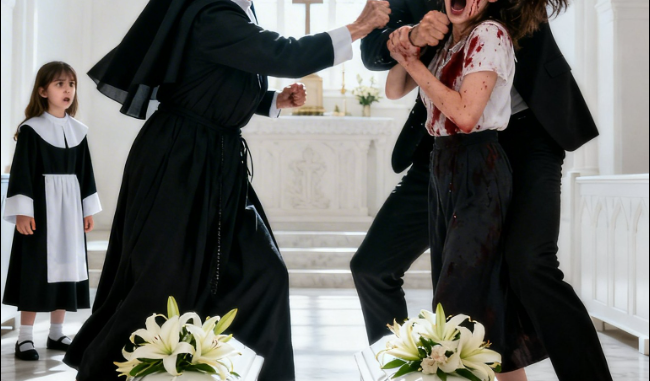
That’s when Diane raised her hand.
Before anyone could react, she slapped me across the face.
The crack echoed through the room.
My head snapped to the side. White-hot pain flared along my cheek.
I stumbled, shocked, and in that half-second of stunned silence, Diane grabbed a fistful of my hair at the back of my head.
I screamed.
She yanked my head forward and slammed my forehead down onto the top of Nora’s casket.
The wood thudded under my skull.
A burst of light exploded behind my eyes.
Diane leaned close, her breath hot and sharp with perfume and anger.
“You better shut up,” she growled, “if you don’t want to end up in there.”
My vision blurred. My hands clawed at her arm, trying to pull free. The room erupted—people shouting, chairs scraping, footsteps.
Ethan lunged forward, grabbing his mother’s wrist. “WHAT THE HELL ARE YOU DOING?”
Someone screamed Diane’s name.
But the clearest voice of all—high, furious, shaking with fear—came from my side.
“GET AWAY FROM MY MOM!”
Lily.
My daughter shoved forward, her little body wedged between Diane and me, her hands pushing at Diane’s coat like she was trying to move a mountain.
Her face was red and wet with tears, but her eyes were blazing.
“You’re evil!” Lily screamed, voice cracking. “You’re not allowed to hurt her! You’re not allowed!”
Diane recoiled like she’d been hit.
“How dare you—” Diane started.
Lily screamed louder, pointing a trembling finger at her. “YOU DIDN’T LOVE THEM! You just wanted to blame my mom! Everyone heard you!”
The room froze again, stunned by the force coming out of such a small child.
Lily’s chest heaved. “If God took them,” she sobbed, “it’s not because of my mom. My mom loved them the most!”
Ethan wrapped an arm around Lily, pulling her back gently, but she kept struggling, trying to get to me.
“Mom!” she cried. “Mom, are you okay?”
I lifted my head slowly, pain pulsing through my forehead. I tasted copper.
Ethan’s hands were locked around Diane’s wrists now, holding her back. His face was twisted in shock and disgust.
Mark finally moved, stepping in. “Mom—stop. Stop!”
A funeral director rushed forward. “Call the police,” he said sharply to someone near the back.
Diane tried to wrench free. “She provoked me!” she shrieked. “She’s unstable! Look at her!”
I stood up unsteadily, one hand pressed to my forehead, the other reaching for Lily.
My daughter flung herself into my arms, shaking.
“I’m sorry,” she sobbed. “I’m sorry I yelled. I just—she was hurting you and—”
I held her tight. “No, baby,” I whispered. “You were brave.”
Ethan turned his head toward Diane, voice low and deadly. “Get out.”
Diane’s eyes darted around, searching for allies, but the room was full of faces staring at her with open horror.
She sneered. “This family is rotten because of her.”
Then she looked at Lily, and something ugly twisted her mouth. “And you—don’t you ever speak to your grandmother like that again.”
Lily buried her face against me.
Ethan stepped forward, pulling Diane by the arm toward the exit. “You’re done,” he said. “You’re done with us.”
The police arrived within minutes. Two officers entered, hands resting near their belts, eyes scanning the scene.
People talked over each other, explaining, pointing.
The funeral director spoke calmly, guiding the officers toward Diane.
Diane put on a performance immediately—hands fluttering, voice trembling, tears appearing like a trick. “I was attacked,” she whimpered. “My daughter-in-law is hysterical, and she—”
“Stop,” Ethan snapped. “Just stop. They have witnesses.”
He looked at me, eyes glassy. “Megan,” he whispered. “I’m so sorry.”
I blinked, trying to keep my balance. My forehead throbbed in time with my heartbeat.
Lily clung to me like she was afraid I’d disappear.
One of the officers came over, voice gentle. “Ma’am, do you need medical attention?”
I nodded slowly. “I… I think so.”
Ethan stepped closer. “We want to press charges,” he said, voice shaking but firm. “She assaulted my wife. At my children’s funeral.”
The words sounded unreal even as he said them.
Diane’s face contorted. “Ethan! Don’t do this to your own mother!”
Ethan stared at her like he’d never seen her before. “You did this to yourself.”
They escorted Diane out past rows of stunned mourners, her heels clicking angrily on the tile until the doors shut behind her.
And then the room—still full of flowers and soft music and grief—felt like it had been poisoned.
The pastor cleared his throat, voice trembling. “We’ll… we’ll take a moment.”
But there was no moment big enough to hold what had just happened.
I looked down at the caskets.
My babies didn’t get peace even on the day we laid them down.
I pressed my palm to the smooth wood again and whispered, “I’m sorry.”
Not because Diane was right.
But because the world had let them go, and it was my job to protect them, and I couldn’t.
At the hospital, fluorescent lights buzzed overhead while a nurse cleaned the small cut at my hairline. The doctor said “mild concussion,” asked me to follow a finger with my eyes, asked if I’d lost consciousness.
Ethan sat beside the bed with Lily on his lap, both of them pale and stunned like they’d been hit by the same invisible truck.
“I should’ve stopped her sooner,” Ethan whispered, staring at the floor.
I reached for his hand. “You did stop her.”
His eyes filled. “She did it right in front of them. Right in front of—” His voice broke. He couldn’t say Noah and Nora’s names without falling apart.
Lily suddenly spoke, voice tiny. “Is Grandma Diane going to jail?”
Ethan swallowed. “I don’t know.”
“She should,” Lily muttered fiercely, and then immediately looked guilty, like she thought being angry made her bad.
I stroked her cheek. “You’re allowed to be mad,” I told her. “You’re allowed to feel whatever you feel.”
She nodded slowly. “I was scared,” she whispered. “When she pushed your head— I thought… I thought you were gonna die too.”
My heart cracked again.
I pulled her into me carefully, wincing at the throb in my forehead. “I’m here,” I whispered into her hair. “I’m not going anywhere.”
Ethan leaned in, resting his forehead against mine, careful not to press on the sore spot.
“She’s not coming near you again,” he said, voice hardening. “I swear.”
I believed him—because for the first time, I saw something in Ethan’s face I’d never seen when it came to his mother.
Not fear.
Not obligation.
Resolve.
The next few days blurred together: paperwork, phone calls, condolence texts that made my stomach churn, a funeral rescheduled because the first one had been hijacked by violence.
People asked if we were okay. I didn’t know how to answer that question anymore. Okay wasn’t a place we could reach.
Diane didn’t stay quiet.
She called Mark a dozen times, leaving voicemails that swung wildly between sobbing apologies and furious threats.
She posted vague messages online about “disrespect” and “ungrateful children.” She told anyone who would listen that I was unstable, that I’d “always been jealous” of her bond with Ethan, that my outburst proved I was unfit.
But she couldn’t erase what happened.
Not with a room full of witnesses.
Not with a funeral home incident report.
Not with the security camera footage the director said he’d already saved.
When Ethan told me the police had officially charged her with assault, I felt something strange.
Not relief.
Not victory.
Just a hollow, stunned emptiness.
Because none of it brought my babies back.
And none of it gave them the funeral they deserved.
A week later, we held a private graveside service instead—just me, Ethan, Lily, the pastor, and two close friends who stood at a respectful distance.
The wind was gentler that day. The sky was still gray, but it looked less cruel.
Two small headstones waited on fresh earth, engraved with their names and the dates that felt like a cruel joke—so short, so incomplete.
Lily held a small stuffed elephant in her hands, one Noah had never gotten to hold.
Ethan’s arm wrapped around my shoulders.
The pastor spoke softly. This time there was no spectacle. No shouting. No poison.
Just grief.
Just love.
When it was my turn, I stepped forward and knelt, the cold ground soaking through my black skirt.
“I don’t know how to do this,” I whispered. My voice shook. “I don’t know how to say goodbye to people I barely got to meet.”
My tears fell onto the grass.
“But I know you were loved. You were wanted. You were ours.”
Ethan crouched beside me, his hand gripping mine like he was anchoring himself.
Lily stepped forward next, clutching the elephant.
She placed it gently at the base of the stones.
“I’m sorry I didn’t get to teach you stuff,” she whispered. “I was gonna show you how to draw a unicorn. And how to make macaroni.”
Her lip trembled.
Then she lifted her chin, eyes shining.
“And I’m gonna protect Mom and Dad,” she said firmly, as if promising the twins something sacred. “I’m gonna do that forever.”
Ethan made a sound like a sob swallowed whole.
I pulled Lily into my arms, and for a moment, the three of us held each other in the cold cemetery air, a small living island surrounded by loss.
Diane tried to contact us again after the second funeral.
A letter arrived at the house in her familiar looping handwriting. Ethan brought it inside like it was radioactive.
He didn’t open it.
He dropped it into the trash with shaking hands.
“We’re done,” he said.
Later, when the restraining order hearing came, Diane showed up dressed in her best black suit, hair perfect, carrying a Bible like a prop.
She told the judge she’d been “provoked” and that she’d been “speaking from grief.”
The judge listened, expression unreadable.
Then the judge watched the footage.
Watched Diane slap me.
Watched her grab my hair.
Watched my forehead hit the casket.
Watched Lily step in front of me, screaming and crying, trying to protect her mother while adults stood stunned.
When it was over, Diane’s face had gone gray.
The judge granted the order.
Diane left the courtroom with her shoulders stiff and her mouth tight, but for once, she didn’t have a word to throw like a knife.
Outside, Ethan exhaled like he’d been holding his breath for years.
“I should’ve done this a long time ago,” he said, voice rough.
I leaned into him. “You did it now.”
He looked down at Lily, who was holding his hand in one fist and mine in the other.
He blinked hard. “Thank you,” he whispered to her.
Lily frowned. “For what?”
“For being brave,” Ethan said. “For loving your mom the way you do.”
Lily shrugged like it was obvious. “She’s my mom.”
And then she looked up at me, eyes steady.
“Mom,” she said, “that day in church… I wasn’t trying to be bad.”
I crouched to her level, ignoring the dizziness that sometimes still swam through my head. “You weren’t bad,” I said firmly. “You were a hero.”
Her eyes filled. “I just didn’t want you to die too.”
I kissed her forehead. “I know.”
Months passed.
Grief didn’t shrink, exactly. It just changed shape—like a stone you learn to carry without dropping it every second.
Some days, I could breathe.
Other days, I’d see a twin stroller in Target and have to abandon my cart in the aisle.
Ethan started therapy. I did too. We put Lily in a kids’ grief group where she drew pictures of two small stars and told a counselor she had “two babies in heaven.”
We made rules.
No contact with Diane.
No “family pressure” conversations from Mark.
No guilt.
Ethan told his mother’s side of the family, once and for all: “If you bring her up, we leave.”
Some people called it harsh.
I called it survival.
One evening in late summer, Lily came into the kitchen while I was washing dishes. Fireflies blinked outside the window like tiny signals in the dark.
She slid a piece of paper onto the counter.
“I wrote something,” she said.
I dried my hands and unfolded it carefully.
In childlike handwriting, it read:
Dear Noah and Nora,
I love you. I’m sorry you had to go.
I will tell you about school.
I will keep Mom safe.
Love, Lily.
My throat tightened.
Behind me, Ethan read over my shoulder and made a broken sound.
We didn’t say anything.
We just held Lily, right there in the kitchen, like our arms could make a shelter strong enough to stop the universe from taking anyone else.
On the twins’ first birthday—a day that should have meant cake and candles—we drove to the cemetery with a small bouquet of white roses and two blue pinwheels Lily picked out herself.
The sun was bright, the kind of day that felt insulting in its normalcy.
We stood before the headstones, the grass grown thick and green around them.
Lily set the pinwheels into the ground, one by each stone.
“Look,” she said softly as the wind caught them. “They’re spinning.”
Ethan’s hand found mine.
I stared at those spinning pinwheels and felt something I hadn’t expected.
Not happiness.
Not peace.
But a quiet, stubborn kind of love that refused to die.
“I’m still their mom,” I whispered.
Ethan squeezed my fingers. “Yes,” he said. “You are.”
Lily slipped her hand into mine. “And I’m still their sister,” she added.
I nodded, tears slipping down my cheeks, warm in the sunlight.
“Yes,” I whispered. “You are.”
We stood there a long time, watching the pinwheels turn, letting the wind do what it always does—move through us, around us, carrying what it can.
When we finally turned back toward the car, Lily looked up at me.
“Mom?”
“Yeah, baby?”
“If Grandma Diane ever comes back…”
Ethan’s jaw tightened, but he stayed quiet.
Lily’s face hardened with a determination that still amazed me.
“…I’ll scream again,” she said.
I knelt, pulling her into my arms.
I didn’t want her to have to be brave like that.
But I was grateful she was.
“I hope you never have to,” I whispered. “But I know you could.”
She nodded against my shoulder.
And together—me, Ethan, and Lily—we walked away from the graves, not healed, not whole, but still standing.
Still a family.
Still here.
THE END
Để lại một phản hồi