My name is Emma. I was twenty-nine years old when I finally understood exactly where I stood in my own family—a realization that didn’t arrive slowly or gently, but all at once, like cold water thrown directly into my face.
I’d carried the quiet understanding for years, the kind you don’t admit out loud because saying it makes it real: I was never the favorite. I was the one who “overreacted,” the one who “couldn’t take a joke,” the one who “made everything hard.” My sister, Valeria, was the golden child. My mother’s smile lived for her. My father’s patience existed for her.
And I was the one who learned how to stay small.
Even as an adult, even as a mother myself, I still caught myself doing it—lowering my voice before speaking, choosing soft words for sharp truths, smoothing conflict like it was my job. I had gotten so good at it that I once believed it was love.
Then I had my son.
Leo was three years old. He had hair the color of honey and a laugh that could change the weather in a room. He breathed loudly when he slept—little deep inhales through his nose, like he was trying to pull in the entire world so he wouldn’t miss anything.
That loud breathing used to make me smile.
Until the day my father decided it was an offense.
It was a Sunday when the line got crossed. A normal day, which is how these things always happen—right in the middle of normal, like life waits for you to relax before it breaks something.
We’d gone to my parents’ place for a “family lunch.” That’s what my mother called it. What it really meant was a performance: everyone pretending we were close, everyone pretending my father’s temper was “strong personality,” everyone pretending my mother’s laughter was “lighthearted” instead of cruel.
Leo had done what toddlers do—spilled juice, asked why the ceiling fan “ate air,” tried to climb onto the sofa like it was a mountain. My father had frowned at him all afternoon like Leo was a stain that wouldn’t come out.
“Your kid is wild,” my father muttered at one point, not quietly.
“He’s three,” I said, forcing a smile.
My mother laughed like I’d told a joke. “Oh, he’s just a boy,” she chirped, then turned to Valeria and added, “Not like when you were little. You were so calm.”
Valeria’s mouth curved into that satisfied half-smile she wore like perfume. “Mom says I was basically born mature.”
Leo dropped a toy car and it clattered on the tile. My father’s jaw tightened.
“Control him,” he told me, like Leo was a dog.
I swallowed the irritation, because I’d been trained to swallow. “Leo,” I said gently, “inside voice and gentle hands, okay?”
Leo nodded, then whispered dramatically, “Okay, Mommy,” as if he was in a spy movie.
It should’ve been funny. It was funny.
My father didn’t laugh.
He stared at Leo like the child was mocking him personally.
By the time we left, the sky was already turning gray. Leo was sleepy, his cheeks flushed from running around. I buckled him into his car seat, gave him his stuffed turtle, and kissed his forehead.
“Night-night breathing,” he whispered, which was his way of saying he was going to fall asleep fast.
I smiled despite everything. “I love you,” I whispered back.
My mother insisted we let my father drive us home “so you can rest,” because I was pregnant—seventeen weeks—and she’d suddenly decided my body was a public project. The truth was simpler: my father liked control, and my mother liked watching him take it.
Valeria slid into the back seat beside Leo like a queen taking her throne. She didn’t look at him. She just scrolled her phone.
I sat in the passenger seat, hands folded over my small bump, and told myself it would be forty minutes. Forty minutes of smiling silence. Forty minutes of survival.
My father pulled out of the driveway like he was angry at the road.
Leo dozed off within ten minutes. His breathing started—steady, louder than an adult’s, soft-snoring through his nose. I watched him in the rearview mirror and felt my chest loosen. He looked peaceful. Safe.
Then my father’s fingers tightened on the steering wheel.
“Is he… huffing?” he asked, voice sharp.
I blinked. “What?”
My father’s eyes stayed on the road, but the irritation in his face deepened. “That breathing. It’s obnoxious.”
“He’s asleep,” I said slowly, as if explaining gravity.
My mother chuckled from the seat behind me. “Oh, your father can’t stand noise.”
Valeria didn’t look up from her phone. She smirked and said, like it was nothing, “Just tape his mouth.”
The words were so casual, so nasty, that for a second I couldn’t find air.
“What did you say?” I asked.
Valeria finally lifted her gaze, bored. “Relax. It’s a joke.”
My father made a sound of agreement. Not laughter. Approval.
“He needs to learn,” my father muttered.
I felt my pulse rise. “He’s three.”
My mother laughed again. “Emma, you always make things so serious.”
I stared at the road ahead, at the passing streetlights, and realized I was sitting inside a moving box with people who didn’t see my child as a child. They saw him as an inconvenience.
Leo’s breathing got a little louder as the car hit a bump. His chest rose and fell in tiny deep rhythms.
My father’s jaw flexed. “Unbelievable.”
He turned the radio up, then immediately turned it down again as if the music offended him too.
“Dad,” I said carefully, “please. He’s just sleeping.”
My father’s voice cut through the car like a blade. “I said it’s unbelievable.”
My mother said, sing-song, “Maybe he has your drama lungs.”
Valeria giggled under her breath.
Something in me shifted. It wasn’t anger yet. It was a warning bell. A primal, animal awareness that the situation was tipping.
I turned in my seat slightly to look back at Leo. He was still asleep, mouth slightly open now, breathing soft but audible.
“Leo,” I whispered, hoping he’d adjust, hoping he’d quiet down because the adults around him couldn’t handle normal human sounds.
My father glanced at me. “Don’t you start coaching him in my car.”
“In your car?” My voice came out sharper than I intended.
That did it. My father hated being challenged the way fire hates water.
He slammed the brakes.
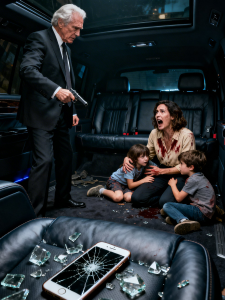
Not enough to crash, but enough to throw my body forward against the seatbelt and jerk Valeria’s phone out of her hand. It smacked the floor with a hard plastic crack.
Leo’s head bobbed in his car seat. His eyes fluttered open, confused and scared.
“Why stop?” Leo mumbled, voice thick with sleep.
My father turned his head just enough to show his expression—cold irritation, the face he used when he wanted to punish.
“Because you won’t shut up,” he snapped at a three-year-old.
My stomach dropped. “Don’t talk to him like that.”
My mother let out a laugh that made my skin crawl. “Oh my God, Emma, he’s fine.”
Valeria leaned forward, eyes bright now—enjoying it. “If he can breathe, he can listen.”
Leo’s lower lip trembled. “Mommy?”
I twisted in my seat. “Baby, it’s okay. You’re okay.”
My father’s voice rose. “See? This is your fault. You make him soft.”
I stared at him, shocked. “He’s a toddler. He’s supposed to be soft.”
My father made a harsh sound and pulled the car onto the shoulder. Gravel crunched under the tires.
He unbuckled his seatbelt with aggressive force. “I’m done,” he said, as if we’d all been inconveniencing him personally for years.
Then he reached back.
Not gently. Not carefully. Just reaching, as if Leo was an object he could rearrange.
I turned fully, panic flaring. “Don’t touch him!”
Valeria’s smile widened. “Oh, here we go.”
My father’s hand grabbed the edge of Leo’s car seat strap, yanking like he could “fix” the situation by force.
Leo started crying—small, startled sobs. “No! No!”
My heart hammered. “Stop! He’s strapped in. You’re going to hurt him!”
My mother’s voice was syrupy with mock concern. “Emma, you’re being hysterical.”
I fumbled my seatbelt latch, trying to turn, trying to get back there. “I’m not hysterical—get your hands off my child!”
My father snapped, “He needs discipline.”
Valeria leaned in and said, almost amused, “Seriously—just cover his mouth for a second.”
I don’t know what exactly my father did next, because it happened fast, and my brain has tried to blur it ever since. I remember Leo’s cries cutting off into a choking silence. I remember my father’s arm blocking my view. I remember my own scream ripping out of me like something being torn.
“STOP!”
My mother laughed again—then stopped laughing when Leo’s body went still.
Not relaxed. Not sleepy.
Still.
A horrible, unnatural stillness.
“Leo?” I gasped. “Leo!”
My father froze for half a beat, like his brain couldn’t compute consequence.
Valeria’s smile faltered. “He’s—he’s just—”
Leo didn’t answer. His eyes were half-open, unfocused. His little hands weren’t pushing at anything anymore. His head lolled slightly to one side.
The world narrowed to one point: my child’s face.
My voice became a sob. “Oh my God—Leo—Leo!”
My father withdrew his arm, suddenly uncertain. “He’s being dramatic,” he tried to say, but the words didn’t land.
My mother’s voice wobbled. “He’s… he’s asleep again.”
“No,” I choked. “No, he’s not.”
My hands were shaking so violently I could barely grip my phone. I hit the emergency call with my thumb and didn’t even realize I was crying until I heard the dispatcher answer.
“911, what’s your emergency?”
“My son—my son is unconscious,” I gasped. “He’s three. He’s not waking up. Please—please help me.”
The dispatcher’s tone went firm and fast, the voice of someone who’s held hundreds of strangers together through terror. “Okay, ma’am. Tell me your location.”
I looked out the windshield, vision swimming. “I—I don’t know—on the shoulder, near—” I saw a green sign. “Near Maple Ridge exit, westbound—please hurry.”
“Is he breathing?”
“I—he was—he was—” My throat tightened. I couldn’t form the words. I leaned toward the back seat, reaching for Leo’s cheek. His skin felt too pale, too quiet. “Leo, baby, wake up.”
Behind me, my mother hissed, “Emma, stop. You’re making it worse.”
And my father—my father said, loud enough for the dispatcher to hear, “This is what happens when you let a kid run your life.”
Valeria said, in a thin, panicked whisper that was still cruel, “Don’t say anything. Don’t—just… just shut her up.”
The dispatcher’s voice sharpened. “Ma’am, is someone there with you? Are you safe?”
I realized, in that moment, that the 911 call was recording everything. My father’s voice. My mother’s laughter. My sister’s suggestion.
Every word.
“I’m—” I swallowed hard. “I’m in the car with my parents. They—” I couldn’t even say it. “Please send help.”
“Help is on the way,” the dispatcher said. “Stay on the line. Do not hang up.”
My father slammed his hand against the dashboard. “You’re ruining us,” he snarled.
My mother’s tone turned sweet again—too sweet. “Honey, stop. You’re pregnant. Stress is bad.”
I stared at her like she was a stranger. “You laughed.”
Her eyes flashed. “I didn’t—”
“You laughed while he—” My voice broke. “While my baby—”
Valeria’s voice turned sharp, desperate. “Emma, stop talking! Hang up! You’re being dramatic!”
The dispatcher cut in, calm but commanding. “Ma’am, keep talking to me. I need you focused on your child.”
I was shaking so hard my teeth clicked. “Leo,” I whispered. “Please.”
Sirens, faint at first, began to rise in the distance—like the world finally noticing what was happening.
My father looked out the windshield, and something in his face shifted into fear. Not fear for Leo.
Fear for himself.
“Emma,” he said, voice suddenly low, controlled, “we can talk about this. You don’t need the police.”
The word police hit me like a bell.
I looked at Leo again. His chest moved faintly now—barely. A tiny breath that made me sob with relief and terror.
“You crossed a line,” I whispered.
My mother hissed, “You’re tearing the family apart.”
I laughed—one harsh sound that surprised me. “No,” I said. “You did.”
The first patrol car pulled up behind us, lights flashing blue and red across the inside of our vehicle like a warning from God.
Then the ambulance.
A paramedic ran to my door first, yanked it open, and asked, “Where’s the child?”
“Back seat,” I said, voice raw. “Please.”
They moved with practiced urgency—two paramedics in, one speaking gently, one checking Leo, one pulling equipment. I backed out of the passenger seat, knees weak, clutching my phone still connected to the dispatcher.
An officer approached the driver’s side, face already hard. “Sir,” he said to my father, “step out of the vehicle.”
My father’s voice went high with indignation. “This is ridiculous. My daughter is unstable—”
The officer didn’t blink. “Step out.”
My mother started crying immediately—real tears now, not dramatic ones. “Officer, it was an accident. She’s overreacting—”
Valeria jumped out of the back seat like she wanted to vanish. “Nobody did anything,” she said fast. “He just—he just fainted.”
The officer’s gaze flicked to my phone in my hand. “Ma’am, are you the one on the 911 call?”
I nodded, unable to speak.
He nodded once, like he’d already decided. “Okay.”
Paramedics lifted Leo carefully onto a small stretcher. His head lolled. His eyes fluttered but didn’t focus.
“Mommy?” he whispered faintly, and I nearly collapsed from relief.
“I’m here,” I sobbed. “I’m here, baby.”
A paramedic looked at me. “You’re coming with us.”
I started to follow, but my father’s voice rose behind me. “Emma! Get back here!”
The officer stepped between us immediately. “Sir, back up.”
My father bristled. “That’s my grandson!”
“And that’s her child,” the officer said flatly. “You will not approach.”
I climbed into the ambulance, shaking, and as the doors closed, I heard my mother’s voice, frantic: “Emma, please—don’t do this—”
I stared at the ceiling of the ambulance while the world rocked and sirens screamed, and I realized something with a clarity that hurt:
My parents weren’t scared for Leo.
They were scared of what would happen to them.
At the hospital, everything moved like a machine built to save lives. Nurses asked questions. Doctors examined Leo. A social worker appeared, gentle but firm. An officer took a statement. My hands wouldn’t stop shaking.
Leo drifted in and out, pale and confused, reaching for me.
I held his tiny hand and whispered, “You’re safe,” until my throat felt scraped raw.
In the hallway, I heard raised voices.
My father.
My mother.
Valeria.
Security.
They’d followed the ambulance, as if proximity gave them ownership of the situation.
I saw them through the glass doors near the nurses’ station—my father gesturing wildly, my mother crying, Valeria pacing like a caged animal.
Then security escorted them back.
And in that moment, something inside me—something I’d been carrying since childhood—finally stopped trying to protect them.
Because they didn’t protect me.
They didn’t protect my son.
The next morning, Leo was stable. Still tired, still monitored, but awake enough to eat a few bites of applesauce and lean his head against my shoulder.
When he whispered, “Mommy, I was scared,” I kissed his hair and fought the urge to scream until the hospital walls shook.
And that’s when my phone started ringing.
Nonstop.
Mom.
Dad.
Valeria.
Blocked numbers.
Unknown numbers.
Over and over, like the sound itself could bully me back into silence.
The nurse glanced at my screen and frowned. “Do you want me to call security?”
I swallowed and turned my phone face down. “Not yet.”
A voicemail came through anyway. My father’s voice, cold and furious:
“Emma. You better fix this. Your mother is sick. Your sister is pregnant. You’re going to ruin everything with your drama.”
Then my mother’s voice, sobbing like she’d been stabbed by injustice:
“Emma, please… please don’t tell them lies. You know your father didn’t mean it. You know he gets stressed. Please call me back.”
Then Valeria’s voice, sharp and venomous:
“If you think you’re going to take my parents away from me because your kid can’t behave, you’re insane.”
I listened to three voicemails and felt something settle into place—not rage, not grief.
Decision.
I didn’t call them back.
Instead, I spoke to the officer who came by that afternoon.
“I want to make a report,” I said quietly. “And I want protection.”
He nodded like he’d heard this a thousand times, like he already knew this wasn’t a one-time incident. “We have the 911 recording,” he said. “We’re pulling it now.”
I stared at him. “It caught everything.”
He met my eyes. “Yes, ma’am.”
A shiver went through me—not fear, but the strange relief of knowing the truth had witnesses. Not my words versus theirs. Not my “drama” versus their “jokes.”
Evidence.
That’s why they were calling nonstop.
They weren’t trying to ask if Leo was okay.
They were trying to get ahead of the story.
Because for the first time in my life, I wasn’t the only one who knew what my family really was behind closed doors.
By evening, a nurse brought me paperwork for a protective order request. The social worker sat with me while I filled it out, her voice gentle. “You’re doing the right thing,” she said.
I didn’t answer with gratitude. I answered with the truth.
“I should’ve done it sooner,” I whispered.
She nodded like she understood. “You did it when you could.”
That night, my father showed up again.
Not in the room—security stopped him at the entrance—but I heard him in the hallway, shouting.
“I want to see my grandson!”
A security guard’s voice stayed steady. “You need to leave.”
My father’s voice rose. “This is my family!”
And then the officer’s voice—hard, final: “Sir, you’ve been instructed to leave. If you don’t, you will be removed.”
My father yelled my name like it was a curse.
“EMMA!”
Leo flinched in the bed, eyes going wide.
I stepped into the hallway just far enough to be seen through the glass.
Not close enough to be touched.
My father’s face changed when he saw me—rage melting into a sudden attempt at charm.
“There you are,” he said, voice softer. “Come on. This is ridiculous. Let’s go home.”
I stared at him. “Home?” I repeated.
My mother appeared behind him, eyes swollen, voice pleading. “Emma, sweetie, please. We didn’t mean it. You know how he is.”
Valeria stood behind them with her arms crossed, eyes cold.
I felt my baby shift inside me—a small reminder that I had more than one child to protect.
I looked at my father and spoke clearly, loud enough for security and the officer to hear.
“You yelled at a three-year-old for breathing,” I said. “You crossed a line. You will not come near my child again.”
My father’s face hardened. “You’re overreacting.”
I nodded slowly. “You’ve said that my whole life,” I replied. “Now other people heard you too.”
My mother’s mouth opened, then closed.
Valeria’s expression tightened—fear flashing for a second behind her arrogance.
Because they all understood the same thing at once:
They couldn’t gaslight a recording.
The officer stepped forward. “Sir,” he said to my father, “leave now.”
My father’s eyes stayed on me, hate bright. “You’ll regret this.”
I didn’t flinch. “No,” I said softly. “You will.”
Security escorted them out, and the hallway went quiet again.
Leo’s small voice floated from the bed behind me. “Mommy?”
I turned back to my son, to his wide eyes, to the hospital bracelet on his tiny wrist.
“I’m here,” I whispered.
A week later, Leo came home with me—not to my parents’ house, not to any place they could find easily, but to a small apartment my friend had helped me secure. The locks were new. The curtains were thick. The air smelled like fresh paint and safety.
My parents’ calls slowed when their lawyer told them to stop. Not because they suddenly respected me, but because consequences finally spoke louder than my silence.
A court date was set. Statements were filed. The 911 recording was entered.
And for once, my family couldn’t rewrite the narrative with laughter.
On the first night in the new apartment, Leo fell asleep on the couch with his turtle tucked under his chin.
His breathing was loud again—steady, deep, innocent.
I sat on the floor beside him and watched his chest rise and fall until my eyes burned.
My baby kicked inside me, and I pressed my hand to my belly.
“I’m sorry,” I whispered—to both of them. “I thought keeping the peace was keeping you safe.”
Leo’s breathing didn’t change. He just slept.
And in that quiet, I made myself a promise I would never break again:
No more shrinking.
No more pretending cruelty is normal because it wears a family’s face.
No more laughing along to survive.
Because the day my father snapped at my toddler for “breathing too loud,” my mother laughed, and my sister suggested something unforgivable—
They didn’t just show me where I stood.
They showed me exactly who they were.
And this time, the whole world heard it too.
Để lại một phản hồi