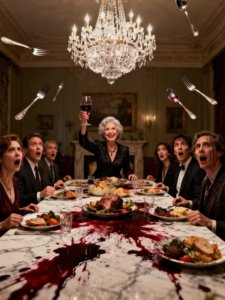
The laughter hit first.
It wasn’t loud—it was the kind that rippled through the room in controlled bursts, the kind people gave when they weren’t sure if they should laugh but did anyway to stay polite. Fourteen people sat around the table, forks midair, faces turned toward my mother at the head of the dining room. Her wine glass caught the light, and her smile—wide, rehearsed—didn’t waver for even a second.
“Look at my girls,” Mom said, voice warm as butter. “One daughter is a lawyer…”
She tilted her glass toward my sister.
“…and the other,” she continued, eyes sliding to me, “is still figuring it out.”
More laughter. Smaller this time. Some of it came with coughs, some with awkward smiles. Even my uncle Warren chuckled into his napkin like the joke had teeth and he didn’t want them aimed at him.
My sister, Tessa, didn’t laugh. She sat straight-backed in a navy blazer like she’d come from court and had forgotten to take the armor off. She held her fork like it was a pen and she was waiting to sign something.
I sat at the far end of the table, close enough to the kitchen to smell garlic and lemon, far enough from my mother to feel like I’d been seated in exile. My chair was the only one that wobbled, one leg shorter than the others. It tapped the floor every time I shifted, an irritating little reminder that I didn’t quite fit anywhere, even in my childhood home.
My mother—Marianne Caldwell—loved dinners like this. Loved the performance. Loved the way candles could soften people’s faces and make even a bitter truth look like a sweet anecdote.
Especially when the truth wasn’t sweet at all.
I forced a smile because I’d learned, long ago, that refusing to smile was taken as aggression in our house. Silence was interpreted as disrespect. Discomfort was treated like a personal attack.
So I smiled, even as my stomach tightened.
“Still figuring it out,” I echoed lightly, swirling water in my glass, pretending it was funny.
Mom beamed at me like she’d done me a favor. “Sweetheart, I’m just teasing,” she said, the words syrupy, the message sharp. “You know I love you. But you’re… what do we call it?” She tilted her head like she was searching for the right polite term. “A free spirit.”
Free spirit. That was the label she used when she wanted to make my failures sound charming. Like I was a bohemian artist instead of a woman who’d spent the last year dodging phone calls from collections agencies.
I wasn’t a free spirit.
I was broke.
And not in the cute, “I’m living on ramen while I chase my dream” kind of broke. I was the kind of broke that made your hands shake when you checked your bank app. The kind of broke that made you choose between gas and groceries. The kind that made you wake up sweating, hearing your name in a robotic voice: This is an attempt to collect a debt.
I hadn’t told anyone at this table how bad it had gotten.
Not because I wanted to hide.
Because I’d been trained to.
My mother’s version of love came with conditions: be impressive, be agreeable, be quiet about anything ugly. She kept our family’s reputation polished like silver. Anything that tarnished it got scrubbed away, even if it meant scraping skin.
So I’d become an expert at hiding my bruises.
But that night, my mother’s toast wasn’t the usual harmless cruelty. There was a new edge to it, a new satisfaction. She loved that Tessa had become what she could brag about. She loved that I—her other daughter—could be used as contrast.
She lifted her glass again. “To Tessa,” she said brightly. “My brilliant girl. And to… well.” She smiled at me like a cat watching a mouse. “To my other brilliant girl, who is bravely learning humility.”
The laughter returned, louder now, as if people had decided it was safe.
I heard my aunt Patricia say, “Marianne, you’re terrible,” but she was smiling too.
I watched my father—Tom Caldwell—keep his eyes on his plate. He always did. He acted like silence made him innocent.
My cousin Lila—twenty-three, freshly engaged, always perfect—leaned toward me and whispered, “It’s okay. She’s just like that.”
Like that.
As if cruelty was a personality quirk.
As if you were supposed to accept it the way you accepted that someone talked too loudly or chewed with their mouth open.
The candlelight flickered. Forks resumed their movement. Conversations restarted in small pockets, like the moment had passed.
But inside me, something had shifted.
Because under my napkin, in my purse, my phone buzzed with a notification I couldn’t ignore anymore.
Final Notice: Immediate Action Required
It was from a lender whose name made my throat close. A lender I hadn’t applied to. A loan I hadn’t taken out.
Not directly.
But it was in my name.
I’d gotten three of those notices in two months. Different companies. Different amounts. Same signature line at the bottom of every document they emailed when I demanded proof.
My signature.
Or something that looked like it.
At first, I’d been confused. Then panicked. Then furious. I’d filed disputes, filled out forms, sent copies of my ID, spent hours on hold listening to cheap piano music.
Every time, the answer came back the same:
The loan was authorized.
The signature matches the file.
The account was opened with verified information.
Information only my family had.
My social security number.
My birthdate.
My childhood address.
My mother’s maiden name.
The name of my first dog.
The answers to the questions banks ask when they want to confirm you’re you.
And suddenly, a memory came to me so clearly it made my skin prickle.
Me at sixteen, sitting at the kitchen counter, filling out scholarship forms.
My mother leaning over my shoulder, sweet as sugar, saying, “Write everything down. Your passwords too. In case we need them.”
I’d laughed. “Why would you need my passwords?”
She’d smiled without blinking. “Because I’m your mother.”
The buzz of my phone stopped. The room hummed with conversation again. The chicken was being passed. The wine was flowing.
My mother had moved on from the toast, basking in attention.
But I couldn’t.
Not anymore.
I looked at Tessa.
Her eyes were fixed on her plate, jaw tight. She didn’t look like she was enjoying Mom’s praise. She looked like she was enduring it. Like she’d learned that in this family, being the golden child meant you got the crown—along with the leash.
She caught my gaze and, for a fraction of a second, something flickered in her eyes.
A warning.
Or a plea.
Don’t do it here.
Don’t make this ugly.
But the thing about ugliness is—it doesn’t care where you are when it rises.
It doesn’t wait for a better moment.
It comes up like bile.
And if you keep swallowing it, it burns you alive.
My mother laughed at something my uncle Warren said, and the laugh—bright, practiced—hit my nerves like sandpaper.
Before I could talk myself out of it, I set my fork down.
The sound was small.
But it was enough.
My mother’s eyes slid to me, still smiling. “What is it, honey?”
Fourteen faces shifted subtly. People didn’t want drama, but they were always hungry for it.
I took a breath. “You said I’m still figuring it out,” I said, voice steady.
Mom’s smile widened. “Yes, sweetheart. It’s just a joke.”
“It’s funny,” I said. “Because I’ve been trying to figure out something else.”
My father’s hand paused mid-cut on his steak.
Tessa’s shoulders stiffened.
Mom tilted her head. “Oh?”
I felt my heartbeat in my fingertips. “Yeah,” I said. “I’ve been figuring out who signed the loans in my name.”
The air changed.
Not slowly.
Instantly.
Like someone had turned off the music.
Forks froze. Chewing stopped. Even the candles seemed to flicker less.
My mother’s smile held for one second too long.
Then it faltered.
“Loans?” Aunt Patricia repeated weakly, like she hadn’t heard.
Uncle Warren blinked. “What loans?”
My mother laughed—one sharp note. “Sweetheart,” she said lightly, “what are you talking about?”
I didn’t blink. “I’m talking about the personal loans that have been opened under my name in the last year. The ones I never applied for. The ones I’m being chased for.”
My father’s face drained of color. He looked up for the first time all evening.
Tessa’s fork trembled slightly in her hand.
My mother’s laugh became softer, more controlled. “Oh, come on,” she said. “This is not the time for—”
“Who signed them?” I asked.
My voice didn’t rise.
It didn’t need to.
The question itself was a blade.
My mother’s eyes glittered. “Are you accusing me?” she asked, still trying to sound amused, but the warmth had vanished.
“I’m asking,” I said.
My father’s voice came out hoarse. “Honey…” he started, like he could stop me with that single word.
I turned to him. “Did you know?” I asked.
His mouth opened. Closed. He looked at my mother like she held the remote control to his spine.
That answer was enough.
My mother set her wine glass down slowly. The clink was loud in the silence.
“This is embarrassing,” she said quietly. Not I’m sorry. Not What happened? Not Let’s fix this.
Just: This is embarrassing.
She turned her eyes to the table, smile returning in a smaller, sharper form. “Everyone, please,” she said. “My daughter is going through a difficult phase. Financial stress can cause paranoia.”
Paranoia.
The word made my stomach twist.
Tessa’s head snapped up. “Mom,” she said sharply.
My mother glanced at her. “Not now.”
Tessa’s voice was controlled, but I could hear rage under it. “Don’t call her paranoid.”
My mother’s eyes flashed. “Tessa,” she warned.
And just like that, the dynamic snapped into view like a diagram.
Mom at the center, controlling the narrative.
Dad as the silent witness.
Tessa as the decorated soldier.
Me as the cautionary tale.
I felt my hands shake, but my voice stayed steady. “They have my information,” I said. “They used my social security number. They used our old address. They used the security answers.”
Aunt Patricia’s face tightened. “Marianne,” she whispered, uneasy.
My mother’s expression hardened. “I don’t know what you want me to say,” she said. “You’ve always been irresponsible, sweetheart. Maybe you forgot you took them out.”
A few people actually laughed—tiny, nervous sounds—because Mom had framed it as a joke again. She was trying to put the mask back on.
But the mask had cracked.
I reached into my purse and pulled out my phone. My fingers were clumsy, but I found the email thread I’d saved. I slid it across the table toward my uncle Warren, because he was closest and because he was the one who always acted like he was the “rational” one.
“Read it,” I said.
Warren hesitated, like touching it would infect him.
Then he picked it up and scrolled.
His eyebrows rose. “Jesus,” he muttered.
My mother’s face tightened. “Warren,” she said, still smiling, “don’t indulge this.”
But he kept reading.
Aunt Patricia leaned in to look over his shoulder.
Then my cousin Lila leaned too.
Then my grandmother—Nana Ruth—who had been quiet the whole night, leaned forward with slow, careful movement like she could smell a lie.
Her voice was soft. “Marianne,” she said. “What is this?”
My mother’s jaw flexed.
I watched her calculate.
Then she chose offense.
“How dare you,” she snapped at me, the warmth gone completely now. “How dare you hijack this dinner with your… accusations.”
“I’m not hijacking anything,” I said. “You toasted me as a beggar.”
My mother’s eyes widened slightly, like she’d forgotten what she said. Or like she couldn’t believe I’d repeated it out loud.
“I didn’t say beggar,” she hissed.
“You implied it,” I said. “You always do.”
Tessa finally put her fork down. “Mom,” she said, voice trembling, “did you do this?”
Mom’s face whipped toward her. “Don’t be ridiculous.”
Tessa’s eyes were wet. “Answer her.”
My mother stared at Tessa like she was betrayal made flesh. “After everything I sacrificed for you,” she said, voice low and dangerous, “you’re going to turn on me?”
There it was.
The hook she used on all of us.
Sacrifice.
Guilt.
Control.
My father cleared his throat. “Maybe we should…” he began, but his voice trailed off.
No one listened to him anyway.
Nana Ruth’s hands gripped her napkin, twisting. “Marianne,” she said again, louder now, “did you open loans in your daughter’s name?”
My mother’s mouth tightened into a thin line. She looked around the table, at all the faces staring at her, and for a moment, her composure wavered.
Then she laughed.
A short, brittle laugh. “You people,” she said. “You have no idea what it takes to keep a family afloat.”
My blood went cold.
That wasn’t denial.
That was justification.
Tessa’s face went white.
I felt my voice come out quieter. “So you did.”
My mother lifted her chin. “We were in trouble,” she said sharply. “Do you think money just appears? Do you think your father’s business runs on good intentions?”
My father flinched at the mention of his business.
Uncle Warren frowned. “Tom,” he said, looking at my dad now. “What trouble?”
Dad’s eyes flicked toward the kitchen, toward the hallway, toward anywhere that wasn’t the table. “It was… complicated,” he muttered.
“Complicated,” Nana Ruth repeated, disgusted. “So instead you stole from your child?”
My mother slammed her hand on the table. Glasses jumped. A spoon rolled and clinked against a plate.
“STOP calling it stealing!” she snapped. “It was family.”
I laughed once, sharp and bitter. “Family,” I said. “You mean the family you use like a costume?”
The room erupted into overlapping voices.
Aunt Patricia gasped, “Marianne, how could you?”
Uncle Warren cursed under his breath.
My cousin Lila whispered, “Oh my God,” like she’d just seen a car crash.
My mother pointed at me, eyes wild. “You owe us,” she hissed. “We raised you. We fed you. We paid for your school—”
“And now you want me to pay you back with interest?” I said.
My father looked up, startled. “Interest?” he repeated.
Tessa turned toward him. “Dad,” she said, voice shaking, “you didn’t know about interest?”
My mother’s eyes flicked to him—too fast, too telling.
Dad’s mouth opened. “Marianne…”
She snapped, “Don’t.”
But it was too late. The cracks were spreading.
Nana Ruth pushed her chair back, standing slowly, trembling with fury. “You used your daughter’s name,” she said, voice thick. “You saddled her with debt. For what? So you could keep throwing dinners like this? So you could keep pretending?”
My mother’s face twisted. “We didn’t have a choice.”
“You always have a choice,” Nana Ruth spat.
Tessa’s hands were clenched. “How much?” she whispered.
My mother glared at her. “Don’t ask.”
Tessa’s voice rose, breaking. “HOW MUCH?”
My mother’s lips parted. She hesitated.
Then, like she was ripping off a bandage, she snapped, “Seventy-eight thousand.”
The room went dead again.
Even the children—two little cousins at the far end—stopped whispering.
Seventy-eight thousand.
The number sat on the table like a corpse.
I felt my vision blur for a second. “Seventy-eight…” I whispered. “You put seventy-eight thousand dollars in my name.”
My mother’s eyes were bright with anger and something else—fear. “It wasn’t all at once,” she said quickly. “It was spread out. And we were going to pay it back.”
“When?” I asked, my voice shaking now.
My mother’s silence answered.
Tessa’s face crumpled. “You,” she breathed, staring at Mom like she was seeing her for the first time. “You ruined her life.”
My mother whipped toward her. “Don’t be dramatic. Nobody’s life is ruined.”
I laughed again, but it sounded like a sob. “I can’t rent an apartment,” I said. “I can’t get a credit card. I can’t even get approved for a phone plan without a deposit. I’ve been living with roommates who don’t know why I flinch when the mail comes.”
My father’s hands were shaking. “Marianne,” he said, voice thick, “tell me you didn’t—”
My mother turned on him like a snake. “Don’t you dare,” she hissed. “Don’t you sit there acting innocent. You let me do what I had to.”
Dad’s face twisted. “I didn’t know—”
“You knew enough,” Nana Ruth snapped at him.
The arguments exploded.
It wasn’t just yelling.
It was years of resentment finally ripping through the wallpaper.
Uncle Warren stood, pointing at my dad. “Tom, what the hell have you been doing? You always acted like you had it together.”
Dad shouted back, “You don’t know what it’s like! You don’t know what pressure is!”
Aunt Patricia began crying, saying, “Marianne, I defended you for YEARS.”
My cousin Lila whispered to her fiancé, “We’re leaving,” as if fleeing a burning building.
Tessa’s voice cut through, shaking but fierce. “Give her the paperwork,” she demanded.
My mother scoffed. “You think you can threaten me with your little law degree?”
“My law degree isn’t little,” Tessa snapped. “And what you did is identity theft.”
The word hit like a slap.
Identity theft.
My mother’s face went pale for the first time. “Don’t you dare,” she whispered.
Tessa stood too. “You dare,” she said. “You dared when you signed her name.”
My mother’s hands trembled around her glass. “I’m your mother,” she said, voice low. “You wouldn’t send your mother to jail.”
Tessa’s eyes filled with tears, but her jaw stayed hard. “You sent her into a financial prison,” she said, pointing at me. “Why should you walk free?”
That was the moment the “perfect” image truly died.
Not when I asked the question.
Not when the number came out.
But when my mother’s gaze shifted from anger to panic and she realized she couldn’t control Tessa anymore.
And when I realized I wasn’t alone at the table.
My mother’s composure broke in flashes—her voice rising, her hands shaking, her smile vanishing completely.
“You ungrateful girls,” she snarled. “After everything—after everything I did to make sure you had opportunities—”
“You did it for you,” I said, quietly.
She froze.
I continued, voice shaking but clear. “You did it so you could be the mother with the lawyer daughter. The mother with the perfect family. You didn’t care who you crushed as long as you got to raise a glass.”
My mother’s lips trembled. “You don’t understand,” she whispered.
“Explain it,” Nana Ruth said. “Explain how you can look at your child and ruin her.”
My mother’s eyes darted around the table again, desperate for allies.
But people were shifting away from her now, like her shame had heat.
Even my father looked like he might vomit.
And then—because disaster loves to add one last disgusting touch—the roast pan slipped from someone’s hands in the kitchen doorway.
It hit the floor with a wet crash.
Grease splattered across the tile.
The smell of burnt fat filled the air.
A child gagged.
It was absurd and awful and fitting.
Our family’s secrets had finally spilled out, and now even dinner was ruined.
My mother stared at the mess like it offended her more than the debt.
Then she turned back to me, eyes blazing. “If you report this,” she said, voice shaking with threat, “you will destroy this family.”
I looked at her, my heart pounding, and realized something terrifyingly simple:
The family she wanted to protect… wasn’t real.
It was a story she told.
And she was willing to sacrifice me to keep telling it.
Tessa stepped beside me. Her shoulder touched mine—warm, solid.
“We’re already destroyed,” Tessa said softly. “She’s just finally telling the truth.”
My mother stared at her. “Tessa…”
Tessa’s voice broke. “I loved you,” she whispered. “But I won’t help you hurt her.”
My mother’s mouth opened like she wanted to say something sharp, something controlling, something that would pull the leash tight again.
But Nana Ruth beat her to it.
“Get out,” Nana Ruth said, voice trembling but firm. “Out of my house.”
My mother blinked. “Mother—”
“Don’t call me that,” Nana Ruth snapped. “Not tonight.”
My father stood too, but he looked lost, like someone had pulled the floor out from under him. “Ruth, please,” he murmured.
Nana Ruth pointed toward the door. “Both of you,” she said. “I will not have thieves at my table.”
My mother’s face crumpled. For a split second, she looked like she might cry.
Then the mask snapped back on.
Fine. Cold. Proud.
She picked up her purse with shaking hands and lifted her chin. “You’ll regret this,” she whispered, not to Nana Ruth—directly to me.
Then she walked out.
My father hesitated, eyes flicking from Nana Ruth to me to Tessa.
He opened his mouth like he wanted to apologize.
But he didn’t.
He followed my mother out like he always did—silent, obedient, complicit.
The door slammed.
The sound echoed through the house like a gavel.
For a long moment, nobody moved.
The candles flickered. Grease cooled on the floor. Wine sat untouched in glasses.
And my mother’s toast—her cruel little joke—hung in the air like a stain.
Then Nana Ruth exhaled shakily and sat down, her hands trembling.
“I didn’t know,” she whispered.
Tessa sank into her chair, tears falling silently.
I sat too, my body suddenly heavy, as if the truth weighed more than I could carry.
Aunt Patricia reached for my hand and squeezed it. “Sweetheart,” she said, voice shaking, “we’re going to help you.”
Uncle Warren nodded stiffly. “We’ll figure this out,” he said, though he looked like he wanted to punch a wall.
Tessa wiped her face and looked at me. Her voice was barely a whisper. “I’m sorry,” she said. “I should’ve seen it sooner.”
I swallowed hard. “You were surviving too,” I whispered back.
Nana Ruth leaned forward, eyes fierce through tears. “We will hold them accountable,” she said. “Whatever it takes.”
And in that moment—surrounded by stained tablecloths and ruined dinner and the aftermath of a family cracking open—I felt something I hadn’t felt in years.
Not safety.
Not peace.
But something close.
Support.
Reality.
The truth, ugly and raw, had finally been spoken out loud.
And now it couldn’t be shoved back into silence.
Outside, the night was cold. The porch light cast a pale glow on the driveway where my parents’ car had been.
They were gone.
But their consequences were not.
I looked down at my phone again, at the “Final Notice” glaring from the screen.
For the first time, I didn’t feel like running from it.
I felt like facing it.
Because my mother had built her perfect life on a lie.
And now, with one question, I’d pulled the foundation out from under her.
The table had frozen.
But I hadn’t.
And neither had Tessa.
And whatever came next—police reports, lawsuits, screaming phone calls, broken relationships—we would finally be living in the real world.
Not the one my mother rehearsed for company.
The one where actions had consequences.
The one where the truth, once spoken, could finally start to heal what silence had rotted.
Để lại một phản hồi