The call came in like a whisper that somehow broke glass.
“Dad… I’m at the hospital.”
For a second, my brain tried to place her voice on a map—home, school, a friend’s car. Anywhere but the place she said next.
“Uncle Derek pushed me off the dock… but he’s telling them I slipped, and the police believe him.”
The words didn’t just land. They split something. A seam I didn’t know was still holding.
“Slow down,” I said, though my own voice wasn’t steady. “Honey—where are you? Are you hurt?”
There was a shuddering inhale, like she’d been trying not to breathe too loud in case the world punished her for it.
“St. Mercy. In Bayfield. My wrist—” She swallowed. “My head. And he’s here, Dad. He’s in the hallway. He’s… he’s telling them I was being dramatic.”
I was already moving. The apartment keys clattered off the counter. I didn’t remember grabbing my jacket. I didn’t remember if I locked the door. I only remember the animal part of me—the part that existed before reason—pulling the car keys from the bowl like they were oxygen.
“Listen to me,” I said, voice low and hard, like I could build a wall out of sound. “You stay where you are. You don’t talk to anyone without me. Do you hear me?”
“They already talked to me,” she whispered. “A cop came in. He was nice at first, and then Derek said something and his face changed.”
That did it. That made my hands go cold on the steering wheel.
“Lila,” I said, “look at me.”
“I can’t,” she choked.
“Then listen. I’m coming. I’m on my way. I don’t care what anyone believes right now. I believe you.”
The sob that came out of her sounded like someone had stolen her air and she was trying to steal it back.
“Okay,” she managed. “Okay.”
When she hung up, the silence in my car felt too loud, like the world was daring me to doubt her. But there wasn’t any room in me for doubt. There hadn’t been since the day she was born and my life rearranged itself around the fact that this small human existed and needed protection.
Bayfield was two hours away, a lake town that lived on postcards and summers, the kind of place where everyone knew everyone else’s business and called it community. It was where my family’s cabin sat—half-rotting pine boards and stubborn memories—where my mother still insisted we all gathered each July like we were the kind of family who fit neatly into a frame.
It was also where Derek had made himself king.
Derek was my older brother by three years, but it always felt like more. He had the smile that made doors open. The laugh that made men slap him on the back. He was the guy who volunteered at the firehouse, donated to charity drives, hosted the annual “Dock Days” barbecue. In Bayfield, Derek wasn’t just a person.
He was a reputation.
And reputations in small towns were like weather. People accepted them without question.
By the time I pulled into St. Mercy’s, my knuckles ached from gripping the wheel. The ER entrance smelled like disinfectant and stale coffee and fear. I walked in with my jaw clenched so tight my teeth felt too sharp.
The waiting room TV was muted. A toddler played with a plastic truck, oblivious to the heaviness in the air. A man with a bandaged hand stared at the floor like it had wronged him.
Then I saw her.
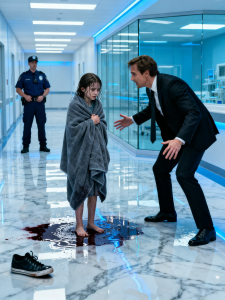
Lila sat in a wheelchair near the nurses’ station, her hair damp and tangled like she’d been dragged through water and panic. A white brace wrapped her wrist. There was a bruise at her temple, darkening into something ugly. Her eyes found mine and crumpled.
“Dad,” she said, and the way she said it—like the word was a life raft—nearly took my knees out.
I crossed the room in three steps and crouched in front of her, careful not to touch too hard, not to make anything worse.
“Hey,” I said. “I’m here. I’ve got you.”
Her lower lip trembled. She tried to hold it still and failed.
“They think I’m lying,” she whispered, and the shame in her voice hit me like a punch. “They keep saying, ‘Are you sure?’ like I imagined my own body flying.”
“I know,” I said. “I know. But you’re not alone now.”
Her eyes flicked past me, to the hallway.
“He’s there,” she said.
I followed her gaze and saw him—Derek—leaning against the wall like he was waiting for a table at a restaurant. He wore a navy polo shirt, clean as a lie. His hair was perfect. His arms were folded, relaxed.
When he noticed me looking, he smiled.
Not a real smile. The kind that said You’re late.
“Cal,” he called, pushing off the wall. “Buddy. Man, what a night.”
He started toward us like this was a reunion and not a crime scene.
I stood so fast the chair legs scraped. I put myself between him and my daughter without thinking.
His eyes slid over Lila’s bruises, then back to me, smooth as oil.
“Listen,” he said, lowering his voice like we were about to share a secret. “She slipped. That dock’s been slick since the storm. You know how she is—always running, always—”
“Don’t,” I said.
He blinked once. “Don’t what?”
“Don’t talk about her like she’s not sitting right here.”
Lila’s fingers clenched the armrest of the wheelchair. Her face went pale in that particular way that meant she was trying not to be sick.
Derek lifted his hands in surrender. “Okay. Okay. I’m not trying to start something. I’m just saying—people get hurt at the lake all the time. It’s an accident.”
I looked at his hands. There was a fresh scrape across his knuckle, already scabbing.
“Funny,” I said. “Because she says you pushed her.”
His smile didn’t disappear. It sharpened.
“Cal,” he said gently, “she’s upset. She’s scared. I get it. But you know Lila. She’s got… imagination. When she panics, she—”
“Stop,” Lila croaked.
Derek’s eyes slid to her with a patient, pitying look that made my stomach twist.
“Sweetie,” he said, “I know it felt like someone pushed you. It was dark. You lost your footing. And then you hit the water and got scared—”
“I felt your hands,” she said, voice rising, cracking. “On my shoulders. You shoved me. You told me to ‘mind my place.’”
There it was. The part he wasn’t expecting to come out in public.
Derek’s jaw tightened so quickly I almost missed it. He glanced toward the nurses’ station, toward the security guard, then back at us.
“Okay,” he said quietly. “We don’t need to do this here.”
I stepped closer, forcing him to back up an inch.
“We’re doing it right here,” I said. “Because you don’t get to corner her in a hallway later. You don’t get to rewrite this like you rewrite everything.”
For a moment, something ugly flashed behind his eyes. Then it was gone, replaced by the easy, wounded expression he wore like a uniform.
“Cal,” he said, “you’re upset. I get it. But accusing me—your brother—of assault? That’s… that’s serious.”
“It is,” I said. “That’s why I’m not leaving.”
A nurse approached, clipboard in hand, eyes flicking between us like she was deciding whether to call security.
“Sir,” she said to Derek, polite but firm, “you’ll need to wait in the lobby.”
Derek’s smile returned instantly. “Of course. Sorry. Emotions are high.”
He gave Lila a look as he turned away—quick, almost invisible, but I saw it.
It wasn’t pity.
It was warning.
When he disappeared around the corner, Lila collapsed forward, pressing her forehead to my shoulder like she couldn’t hold herself upright anymore.
“He’s going to do it again,” she whispered into my jacket. “He’s going to make everyone think I’m crazy.”
“No,” I said, though the word felt like a vow I didn’t yet know how to keep. “He won’t.”
A police officer came in ten minutes later. Mid-thirties. Clean uniform. A face that had learned to look sympathetic on command.
“Mr. Blake?” he asked.
I stood. “Yes.”
“I’m Officer Hanley,” he said. “We spoke with your daughter earlier. We also spoke with Derek Blake.”
Hearing my brother’s name come out of a stranger’s mouth made my blood heat.
Hanley continued, “From what we’ve gathered, your daughter fell from the dock at your family cabin. Mr. Blake pulled her out and called for help.”
Lila made a sound, small and strangled.
“That’s not what happened,” I said.
Hanley held up a hand. “Sir, I understand emotions are running high. But we need facts.”
“Facts?” I said, and I hated how sharp my voice sounded, but I couldn’t soften it. Not now. “The fact is my daughter says she was pushed.”
Hanley’s eyes flicked to Lila, then away, like he didn’t want to meet her gaze too long.
“Miss Blake,” he said gently, “earlier you mentioned there was an argument.”
“Yes,” she said, voice trembling but steadier now that I was beside her. “Because I saw something. And when I told him I was going to tell Grandma—he got angry.”
Hanley’s pen paused. “What did you see?”
Lila swallowed. “He was in Grandma’s room. In her safe. And he had papers—”
“Lila,” I said softly. “Slow. One thing at a time.”
She nodded, tears pooling again. “I went to the cabin to grab my charger. It was late. I heard voices upstairs, so I went up, and Derek was in Grandma’s room. He had the safe open. He was taking something out. When he saw me, he slammed it shut and told me to get out. He was… different. Like he didn’t have the smile on.”
Hanley’s expression hardened into something that said family drama.
“And then you went to the dock?” he asked.
“He followed me,” Lila said. “I went out because I needed air. He came after me and said I didn’t understand anything and that if I ‘stirred trouble’ I’d regret it. I told him to back off. I told him I was calling you. He grabbed my phone. I tried to take it back. And then—”
Her voice broke. Her eyes squeezed shut.
“And then,” I said for her, “he pushed you.”
She nodded, sobbing silently.
Hanley exhaled. “Mr. Blake says she was upset and stormed out. He says she slipped when she stepped too close to the edge.”
“Of course he does,” I said.
Hanley looked at me with practiced patience. “Sir, we also spoke to two neighbors who came over when they heard shouting. They said they saw Derek helping her out of the water.”
I stared at him. “So because they saw him after the fact, that proves he didn’t put her there?”
Hanley’s mouth tightened. “I’m saying it complicates things.”
Lila’s hands shook in her lap.
“Officer,” I said, forcing my voice lower, “look at her bruises.”
Hanley glanced.
“No,” I said, stepping aside so the overhead light caught the mark on her upper arm. “Look. That’s fingers. That’s not a dock plank. That’s a grip.”
Hanley leaned in despite himself. The bruise was already blooming, the shape unmistakable—four dark ovals and a deeper smear where a thumb had pressed.
Lila flinched as the air moved near it.
“I didn’t fall onto that,” she whispered. “He grabbed me.”
Hanley’s gaze flicked away again, like he didn’t want to admit what he was seeing.
“I’ll note it,” he said finally. “But I need more than bruises.”
“Then get the dock,” I said. “Get the scene. Get forensics if you have to. There’s probably—”
“Sir,” Hanley interrupted, “this isn’t a homicide.”
“Not yet,” I snapped before I could stop myself.
The room went still. Even Hanley looked taken aback.
I took a breath, forced myself to unclench.
“My daughter is in a hospital bed,” I said, quieter. “And you’re telling me the town hero’s version is cleaner, so that’s what you’re going with. I’m telling you: she didn’t slip. She was shoved.”
Hanley’s eyes narrowed, like he didn’t appreciate being told his job.
“I’m telling you,” he said, “we’ll follow evidence.”
“Good,” I said. “Because I’m about to bring you some.”
They admitted Lila overnight for observation because of the head injury. They wrapped her wrist, ran scans, checked her pupils with bright lights that made her wince. I stayed in a hard plastic chair beside her bed, listening to the hospital sounds—beeping monitors, distant footsteps, someone crying behind a curtain.
Around midnight, when her breathing evened out and her eyes finally closed, I walked out into the hallway and called my mother.
She answered on the third ring, voice groggy. “Cal? What’s wrong?”
“Lila’s in the hospital,” I said.
Silence. Then: “What?”
“She says Derek pushed her off the dock.”
There was a pause long enough for me to hear my mother swallow.
“That’s—” she began, and stopped. “Cal, Derek would never—”
“Mom,” I said, and my voice shook now, because I was tired and furious and scared. “Please don’t do that. Not tonight. Not when my kid is bruised and strapped to a hospital bed.”
My mother exhaled, and I pictured her sitting up in her own bed at the cabin, surrounded by quilts and denial.
“What happened?” she asked.
I told her. All of it. The safe. The argument. The grip-shaped bruise. The cop who already looked convinced.
When I finished, my mother’s voice was quiet. “Derek said she slipped.”
I closed my eyes. “Of course he did.”
“Cal,” she said, and there was something strained under her tone, “you know Derek’s been under pressure. With the cabin. With the… paperwork.”
“What paperwork?” I asked.
Her silence was answer enough.
“Mom,” I said slowly, “what paperwork?”
“It’s nothing,” she said too fast. “Just… the will. We’ve been updating things. You know, with my health.”
My stomach dropped. “And Derek’s involved.”
“He’s helping,” she insisted. “He’s always helped.”
Help. That word in our family had always meant control.
“I’m coming to the cabin,” I said.
“You can’t,” she said sharply. “It’s late. And Derek—”
“Derek doesn’t get to decide where I go,” I said, and hung up before she could argue.
At 5:30 a.m., I left the hospital long enough to drive to the cabin. The sky over the lake was bruised purple, the water still, like it was pretending nothing had happened. The dock jutted out from the shore, gray boards slick with dew.
I stood at the end of it and tried to imagine my daughter here—barefoot or in sandals, her phone in her hand, Derek’s shadow behind her.
I crouched and ran my fingers along the boards. Damp, cold. I moved toward the ladder where swimmers climbed out, scanning for anything out of place.
Near the edge, I saw a scuff mark—a dark smear where something rubber had dragged. A shoe, sliding, but not in the clean straight line of a slip. More like a sudden pivot, a stumble forced sideways.
A few inches from that was a small, bright thing against the gray wood.
A rhinestone.
My daughter’s necklace had a cheap charm she loved—some little starburst she’d bought at a gas station because she said it looked like a “tiny sun.” One of the stones had fallen out before, and she’d been upset about it.
I picked it up carefully, like it could cut me.
Not proof. Not enough for a court. But it was something that whispered the truth the way bruises did.
When I looked up, I saw a set of footprints on the dock where the dew still held them. Two sizes: one smaller, one larger. The larger ones came close behind the smaller ones. Too close.
A dock didn’t make you walk that way.
A person did.
I heard the cabin door open behind me.
“Cal,” my mother called.
I turned. She stood on the porch in a robe, her hair a soft gray cloud around her face. She looked older than she had the last time I’d seen her, like the night had taken a bite out of her.
“I didn’t know you were coming,” she said.
“You knew,” I said. “You just didn’t want it.”
Her eyes flicked to the dock, then back to me. “Where’s Lila?”
“At the hospital,” I said. “Because someone pushed her.”
My mother’s face tightened. “Cal—”
“Stop,” I said, holding up a hand. “Just stop. I’m not doing the ‘Derek’s a good boy’ song this time.”
Before she could respond, the screen door behind her creaked and Derek stepped out, wearing jeans and boots like he’d been awake for hours. He carried a coffee mug, calm as Sunday.
“Brother,” he said, like my arrival was a nuisance and a joke. “Didn’t expect you so early.”
I didn’t answer. I walked past my mother and onto the porch until I was close enough to see his eyes clearly.
“I found this,” I said, and held up the rhinestone.
His gaze dropped to it. A flicker—so quick—crossed his face.
Then he smiled. “Aw. Lila’s little necklace thing? Guess it fell out when she—”
“When you shoved her,” I said.
My mother gasped softly. Derek’s smile stayed in place, but his jaw moved.
“Cal,” he said gently, “I know you’re upset. But you’re out of line.”
“Out of line,” I repeated. “Like you were out of line in Mom’s safe?”
My mother stiffened. “Cal—”
Derek’s eyes sharpened now. “What did she tell you?”
“She told me enough,” I said. “So here’s what’s going to happen. You’re going to stay away from my daughter. You’re going to stop talking to the police. And you’re going to tell me what you were doing in that safe.”
Derek laughed once, low. “You’re really doing this.”
“Yes,” I said. “I am.”
He set his mug down. Slowly. Like he was choosing a different kind of conversation.
“Cal,” he said, voice dropping, “you’ve always had this… thing. This need to be the hero. But you weren’t here. You haven’t been here. You don’t understand what I’ve been carrying.”
I stepped closer. “Don’t talk like you’re the victim.”
He leaned toward me, and for the first time the smile didn’t reach his eyes at all.
“I’ve been taking care of Mom,” he said quietly. “I’ve been keeping this place together while you play your little city life. And now your daughter comes in here, snooping around, making accusations—”
“She’s a kid,” I said. “She’s family.”
“So am I,” he hissed.
My mother stepped between us suddenly, hands up like she could physically stop a storm.
“Enough,” she said, voice trembling. “Both of you. Derek, go inside.”
Derek’s eyes stayed on mine. “You really think anyone’s going to believe her over me?” he murmured. “In this town?”
Something in me went still.
That was the real Derek. The one he kept under the charm. The one who assumed the world would bend because it always had.
I turned away from him and looked at my mother.
“Mom,” I said, “tell me the truth. Is Derek changing your will?”
My mother’s eyes filled with tears that she refused to let fall. “He’s… helping,” she whispered again, like the word could save her from admitting more.
Derek gave a small, satisfied shrug behind her.
I nodded slowly. “Okay,” I said. “Then I’m helping now too.”
I left before Derek could say another slick thing. Back at the hospital, Lila was awake, pale, eyes too bright.
“You went to the cabin,” she said, immediately.
“I did,” I admitted. “I found your necklace stone.”
Her hand flew to her throat instinctively. “I knew it was missing.”
“And I saw marks on the dock,” I said. “But I need more. I need something the police can’t shrug off.”
She stared at the blanket. “I had something,” she whispered.
“What?”
“My phone,” she said. “I hit record. Not on purpose. I was shaking, and I—my thumb hit it. And then he grabbed it and… he threw it. It hit the rocks.”
My heart sank. “It’s gone?”
She shook her head slowly. “I don’t know. But—” Her eyes lifted to mine. “I have my watch.”
“Your watch?”
She lifted her uninjured arm. The smartwatch sat on her wrist, the screen dark.
“It asked if I fell,” she said. “That thing it does. It buzzed and said ‘hard fall detected.’”
I stared at it like it was a lifeline.
“Does it save that?” I asked.
“I think so,” she whispered. “It has time stamps.”
I didn’t waste another second. I called the nurse, asked for a social worker, asked for a patient advocate—anyone who could help us pull data without Derek worming into the process. I called Officer Hanley and told him to come back with someone who understood technology.
When he arrived, he looked annoyed.
“What is it now?” he asked.
Lila lifted her arm. “My watch recorded it,” she said. “The time. The impact. And I can show you my heart rate. It spiked before I hit the water. Because I was scared. Because someone was behind me.”
Hanley hesitated, then stepped closer.
A tech from the department—young, curious—came in and helped extract the fall detection log and motion data. They printed it out. Time: 11:46 p.m. A sudden forward acceleration and impact. Then a sharp drop and irregular movement—consistent with entering water.
Hanley frowned, reading.
“That doesn’t prove a push,” he said.
“No,” I said. “But it proves it wasn’t a casual slip. And it proves the timeline Derek gave you is wrong.”
Lila swallowed hard. “And I wasn’t drinking,” she added. “He told you I was drinking.”
Hanley’s eyes flicked to her chart. He looked uncomfortable.
A doctor, overhearing, stepped in. “Her bloodwork doesn’t indicate alcohol,” the doctor said flatly. “And the bruising pattern on her arm is consistent with a forceful grip.”
Hanley’s face changed—not dramatically, but enough. The certainty cracked.
Still, he tried to hold onto his old story. “Even so—”
“Call the neighbors again,” I said. “Ask them what they heard, not what they saw after. Ask them if they heard Derek yelling first.”
Hanley stared at me like he didn’t like being directed, but he also didn’t like being wrong in front of a bruised teenager and a doctor.
He nodded once, stiff. “We’ll follow up.”
By afternoon, the follow-up started to drag truth into the room like a reluctant animal.
One neighbor admitted they’d heard Derek shout, “You’re not ruining this for me,” before the splash. Another admitted Derek had been angry all week about “papers” and “money” and “Cal being useless.” A third said they’d seen Derek throw something toward the rocks—something rectangular—right before he went down to the water.
A search team went back to the shore line. Two hours later, a deputy walked into Lila’s room holding a sealed evidence bag.
Inside, cracked but recognizable, was Lila’s phone.
Hanley stood at the foot of the bed, eyes no longer patient. Now they were wary, like he’d realized the “nice guy” story had teeth.
“We’re sending it for data recovery,” he said.
Lila’s breath hitched. “He’s going to say I broke it myself.”
“Let him,” I said, voice steady now in a way it hadn’t been all night. “He’s running out of places to put the truth.”
That evening, Derek showed up again. This time he didn’t swagger. He moved like someone walking into a room where the air had changed.
He didn’t get past the nurses.
And when he demanded to see my daughter, a security guard stepped in front of him and said, “Not happening.”
From down the hall, I watched him argue. I watched his hands move—too sharp, too controlled. I watched his face tighten when he realized charm wasn’t working.
Then his eyes found mine.
For a second, the mask slipped completely.
And I saw something I’d spent my whole life trying not to see.
Fear.
Two days later, the data recovery pulled a file from Lila’s phone. It wasn’t perfect. The audio was muffled, cracked, full of wind and movement.
But Derek’s voice was unmistakable.
“You think you’re going to tell her?” he snapped.
Lila’s voice, shaking: “Get away from me.”
Derek, low and furious: “Mind your place.”
Then a grunt, a gasp, the sound of fabric tugging—followed by the sudden roar of water swallowing everything.
Hanley listened to it twice in a small room at the station while I stood behind him, arms crossed so tight I could feel my pulse in my elbows.
When it ended, he exhaled slowly.
“We’re bringing him in,” he said.
In Bayfield, news moved faster than justice. By the time Derek was arrested, people already had opinions. Some whispered Lila was “troubled.” Some said “family business should stay private.” Some looked at me like I’d brought shame to the town.
But then the facts started to spread the way facts do when they’re too solid to ignore.
The audio. The watch log. The bruising. The neighbors’ changed statements. The recovered phone.
And Derek’s reputation—so carefully built—began to crack like ice in spring.
The day Derek was arraigned, my mother sat in the courtroom with her hands folded so tightly her knuckles were white. She didn’t look at him. She didn’t look at me.
She looked at Lila.
When the judge spoke Derek’s name and listed the charges, my mother finally turned, eyes wet, voice barely audible.
“I’m sorry,” she whispered. “I’m so sorry. I didn’t want to believe—”
Lila’s face tightened like she was trying to hold a door shut against years of hurt.
“I didn’t want this,” she whispered back. “I just wanted you to be safe.”
My mother’s breath shuddered.
And in that moment, I understood something that made my anger both sharper and sadder: Derek hadn’t only pushed my daughter off a dock.
He’d pushed all of us—slowly, quietly—into a version of reality where he was always right, and anyone who challenged him was unstable, ungrateful, dramatic.
He’d been doing it for years.
We just hadn’t called it what it was until it left bruises that couldn’t be explained away.
That night, back at the cabin, I stood on the porch while the lake went dark and calm below, pretending again to be innocent.
Lila sat beside me with her wrist in a brace, her head still tender, her eyes still too old for her face.
“Do you think he hates me?” she asked suddenly.
I stared out at the water for a long moment.
“I don’t think this was about you,” I said. “Not really. I think you were just the first person who didn’t flinch.”
She rubbed her thumb along the edge of her brace. “I was so scared.”
“I know,” I said. “But you called me. And that matters. You didn’t let him own the story.”
She leaned her shoulder against mine, careful, like she didn’t want to hurt either of us by trusting too hard.
“I thought no one would believe me,” she whispered.
I swallowed the tightness in my throat.
“I believe you,” I said again, because some promises need repeating. “And I’m going to keep believing you, even when it’s inconvenient. Even when it’s messy.”
Down by the dock, the boards were still slick with dew, still ordinary, still pretending. But I knew better now.
Places don’t hurt you on their own.
People do.
And sometimes the hardest part of saving your child isn’t fighting a stranger.
It’s admitting the monster already knows your name.
Để lại một phản hồi