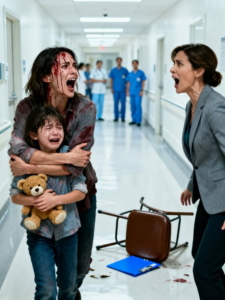
My name is Jolene Harper, and six months ago, I found out the daughter I raised for six years wasn’t mine.
But motherhood doesn’t live in DNA. It lives in the nights you stay awake watching a tiny chest rise and fall, in the little fingers that cling to your shirt when the world feels too big. It’s in whispered bedtime stories, in cereal bowls and school pickups and scraped knees. For six years, I was a mother. I am a mother.
And that’s what made the truth so unbearable—because the truth wasn’t just a betrayal. It was a theft of time, of trust, of identity.
The first crack appeared in a place that should’ve been harmless: a group photo.
It was a picture from Kindergarten Orientation, a bunch of kids sitting cross-legged on a rug with an exhausted teacher behind them. Someone had snapped it fast, catching laughter and missing teeth and hair bows that never sat straight. I saved it because my daughter—my Evie—was in the front row with her chin lifted like she already owned the world.
That night, I posted it in our private mom group, the one I’d joined when the girls were newborns. Back then it had been a lifeline: midnight feeding questions, diaper rash tips, the kind of solidarity you cling to when your body still feels like a stranger.
Within minutes, my best friend Marissa commented.
There she is—my mini-me
I stared at the words and felt something small and strange tighten behind my ribs.
Mini-me.
I’d heard Marissa say it before, usually half-joking, usually with a laugh that made everything sound lighter than it was. But the way she said it now—possessive, tender, almost hungry—hit different.
Then I looked back at the photo.
At Evie’s face.
Her eyes were the color of dark honey, the same as mine. That’s what I’d always held onto when anyone said she didn’t look like me. But it wasn’t the eyes that made my stomach go cold.
It was her smile.
Evie had a tiny, crooked dimple on her left cheek. It appeared only when she laughed hard, and it made her look like she was keeping a secret.
Marissa had that same dimple.
Not kind of.
Not “oh, maybe.”
The exact same left-cheek notch, in the exact same place, like nature had signed her name.
I zoomed in until the pixels turned grainy.
Then I did something I still hate admitting.
I scrolled through Marissa’s photos.
We’d been friends since we were fifteen—shared mascara, shared secrets, shared a thousand cheap coffees in parking lots while we cried about boys who didn’t deserve us. I knew her face better than I knew my own sometimes.
But I’d never… compared.
Not like that.
I found an old picture from before the girls were born—Marissa in a denim jacket, laughing, head tilted back. The dimple was there, sharp and bright.
Then I found another photo, years later, of Evie laughing on our porch swing, and it was there too.
A matching signature.
A sinking, breathless certainty crawled up my throat.
“Dan?” I called, my voice too thin.
My husband appeared in the doorway, towel over his shoulder, hair damp from the shower. “Yeah?”
I held my phone out with shaking hands. “Does she… does Evie look like Marissa to you?”
Dan’s face tightened the way it did when he didn’t want to step on a landmine. He took the phone, studied the photo, then forced a chuckle.
“She’s six, Jo. Kids look like everyone. She’s got your eyes.”
“That’s not what I asked.”
His smile faded. “Jolene.”
I hated the way my name sounded like a warning.
I leaned forward, lowered my voice, like the walls might hear. “It’s her dimple.”
Dan stared a second longer, then handed the phone back like it burned. “Marissa’s her godmother. Of course you’re seeing her in Evie. That’s… it’s normal.”
But it wasn’t normal.
Not the way my stomach twisted. Not the way my mind started flipping through memories like a frantic librarian.
Because once you notice one wrong detail, you start seeing all the others.
Evie’s hair wasn’t like mine—mine was straight and stubborn, always had been. Evie’s hair curled softly at the ends, exactly like Marissa’s. Evie’s laugh wasn’t mine either. Mine was loud and messy. Evie’s laugh had that breathy hitch Marissa did when she was really amused.
I’d always chalked it up to nurture. To spending time together. To kids copying the people they loved.
But nurture didn’t carve dimples into bone.
That night, after Dan fell asleep, I pulled out the old baby box from the closet. The one I only opened on birthdays, when nostalgia felt safe.
Inside were hospital bracelets, newborn footprints, a tiny hat Evie wore home.
I held the bracelet in my palm and tried to read the faded ink.
HARPER, BABY GIRL.
My hand shook with relief.
Then I flipped it over and saw the second sticker, half-peeled, like it had been applied twice.
Under the Harper label, a corner of another name peeked out.
I pressed my fingernail under it.
Dan’s voice snapped in my head: Don’t.
But my fingers didn’t listen.
I peeled carefully until the old label showed through.
And I saw it.
LANE, BABY GIRL.
Marissa’s last name.
The room spun.
My heart slammed like it was trying to break out of my chest and run.
I sat on the carpet with the bracelet in my hands, staring until my eyes blurred.
Six years of birthday cakes.
Six years of scraped knees and school crafts.
Six years of “Mama” whispered against my neck when nightmares came.
And underneath it all, a label I wasn’t supposed to see.
I didn’t sleep.
In the morning, I told Dan we needed a maternity test.
He stared at me like I’d asked him to set the house on fire.
“Jo,” he said slowly, “that’s… that’s insane.”
“I found a label,” I whispered. “Under her hospital bracelet. Marissa’s name.”
Dan went pale, the way he did when fear finally found him.
“That doesn’t mean—”
“It means something,” I cut in. “And I need to know what.”
We argued in the kitchen while Evie ate cereal at the table, humming to herself, blissfully unaware that her entire universe was cracking.
Dan kept his voice low, careful. “If you do this, you can’t un-know the answer.”
“I already can’t,” I said, and my voice broke on the last word.
It took three weeks to get the lab appointment and another two for results.
Five weeks of pretending.
Five weeks of kissing Evie’s forehead and smiling at her school stories while my insides screamed.
Marissa texted like everything was normal.
Can’t wait for movie night!
Evie still obsessed with unicorns?
Tell my girl I love her.
My girl.
Every time she wrote it, my hands got colder.
The results arrived on a Monday.
Dan and I sat at the dining table like we were waiting for a verdict.
I opened the email with fingers so numb they barely worked.
The report was polite, clinical, brutally clean.
Probability of maternity: 0%.
I stared until the letters stopped making sense.
Dan let out a sound I’d never heard from him before—half gasp, half grief.
“No,” he whispered. “No, no…”
I scrolled down like a person possessed.
Probability of paternity (Daniel Harper): 0%.
Dan’s face went gray.
He grabbed the laptop, refreshed the page, as if the internet might apologize and change its mind.
“It’s wrong,” he said, voice ragged. “It has to be wrong.”
But it wasn’t wrong.
Because deep inside me, I already knew.
Evie wasn’t ours.
She never had been.
I pressed my hands to my mouth to keep from screaming.
And in that moment, I thought the worst thing was the switch.
I was wrong.
The worst thing was what came next.
Two days after the results, Marissa showed up on my porch at 2 a.m.
It wasn’t like her.
Marissa was a daylight person—loud, bright, always arriving with coffee or drama, never with quiet desperation.
But there she was, hair damp, mascara smeared, eyes wild.
And behind her, half-hidden in the shadows, stood a little girl.
A girl about Evie’s age, wrapped in an oversized hoodie, her face pale under the porch light.
My stomach dropped.
Because I recognized her.
Not from my life.
From my mirror.
She had my nose. My chin. Dan’s straight eyebrows.
She looked like someone had taken our wedding photo and pulled a child out of it.
Marissa’s voice trembled. “Can I come in?”
I didn’t move. My whole body felt locked.
The little girl coughed—thin, wet, rattling.
Marissa flinched at the sound like it was an accusation.
“What is this?” I whispered.
Marissa swallowed hard. “Jolene… I need you to help me.”
The little girl lifted her head, eyes heavy, confused.
And something inside me—something primal—lurched toward her.
She looked at me like she was trying to remember a dream.
“Hi,” she whispered, voice scratchy.
My throat closed.
Dan stepped up behind me, hand on my shoulder like he was bracing me.
Marissa’s eyes flicked past me, into my house, and landed on the framed photo in the entryway—Evie on her first day of kindergarten, smiling big.
I saw hunger flash across Marissa’s face.
Not love.
Want.
Then she looked at the sick little girl at her side and her expression hardened into something else—something that looked like guilt trying to become anger so it wouldn’t feel weak.
“She’s yours,” Marissa blurted.
The words hit the porch like a gunshot.
Dan’s hand tightened on my shoulder.
The little girl blinked slowly, like she didn’t understand the language.
Marissa’s voice cracked. “She’s yours. Okay? I can’t— I can’t do this anymore.”
My knees threatened to give out. “What do you mean she’s mine?”
Marissa’s mouth twisted. “I mean… your baby. The one you were supposed to take home. The one I… the one—”
She stopped, breath heaving, eyes shining like she was about to cry but refused.
Then she shoved a backpack into my hands.
It was small, pink, worn at the straps.
Inside, I could feel the weight of something—bottles? paperwork?
The girl coughed again, harder, and bent slightly at the waist, hand pressed to her chest.
I stepped forward without thinking, my hand reaching for her forehead.
Her skin was hot.
She stared at me, wide-eyed, like my touch was both terrifying and familiar.
“Sweetheart,” I whispered, “what’s your name?”
The girl hesitated, then said softly, “Lila.”
My breath caught so hard it hurt.
Lila.
That was the name Dan and I had chosen in the hospital, back when our future felt simple.
We’d said it out loud once—just once—over Evie’s newborn head.
I’d assumed we’d changed our minds.
We hadn’t.
Someone had just… taken the name with the child.
Dan’s voice came out broken. “Marissa… what did you do?”
Marissa’s face twisted with panic. “Don’t act like I’m the only monster here. You two have everything—house, husband, stability—”
“That doesn’t answer the question,” I snapped, my voice suddenly sharp.
Marissa’s jaw trembled. “I switched them,” she whispered, like saying it quietly might make it less real.
The porch light buzzed overhead.
Somewhere down the street, a dog barked once, then went quiet.
I couldn’t hear anything except my own blood.
“You—” I tried to speak, but the word wouldn’t form.
Marissa stepped forward, tears spilling now, anger collapsing into raw fear. “I didn’t mean for it to go like this. I didn’t. I was scared. I was alone. My mom was drinking again, and I had nothing, Jo. Nothing. And you… you were so ready to be a mom.”
Dan’s voice shook with fury. “So you stole our baby.”
Marissa flinched. “I gave your baby a chance!” she screamed, then immediately glanced at Lila like she regretted it.
Lila’s eyes lowered.
The shame in that tiny movement made my vision blur with rage.
“Why is she sick?” I demanded, swallowing hard. “What happened to her?”
Marissa’s mouth tightened. “She—she got diagnosed last year. Some immune thing. It’s expensive. It’s—” She made a helpless, disgusted gesture. “It’s endless.”
Dan’s hands curled into fists. “So you’re dumping her here.”
Marissa snapped, “Don’t say it like that!”
“What do you call it?” I whispered.
Marissa’s gaze flicked inside again, toward Evie’s picture.
Then she said, small and cold, “I’m doing what’s best.”
It took me a second to understand.
Then it hit me with sick clarity.
She wasn’t bringing Lila back out of remorse.
She was returning the “problem.”
And she was coming for Evie—the healthy girl, the one I’d raised.
My voice turned to ice. “You’re not taking her.”
Marissa blinked fast. “Jolene—”
“She is my daughter,” I said, and my whole body shook as I spoke. “And you don’t get to abandon one child and steal another like you’re switching purses.”
Marissa’s face hardened again, like she’d been waiting for this. “She’s mine.”
Dan stepped forward. “Get off our property.”
Marissa lifted her chin. “Fine. Call the cops. Explain to them how you somehow ended up with my baby and a bracelet with my name on it.”
Dan froze.
And I realized—horrified—that Marissa had planned it.
She’d walked into my life with a backup story.
With paperwork.
With a way to make me look like the thief.
Lila coughed again, smaller now, like she didn’t have the strength for more.
My heart shattered and welded itself into something else at the same time.
I looked at Lila, at her pale cheeks, at her eyes that matched mine so closely it felt like being haunted.
Then I looked at Marissa.
“You can leave,” I said quietly. “But she stays.”
Marissa’s eyes widened. “Jo—”
“I’m calling an ambulance,” I said, voice steady. “And CPS. And the police. And a lawyer. And if you try to take Evie, I will make sure the whole world knows exactly what you did.”
Marissa stared at me like she didn’t recognize the girl she used to share fries with.
Then she did something unforgivable.
She stepped backward.
She pushed Lila gently toward me like she was handing over a suitcase.
And she walked away into the dark without looking back.
Lila stood on my porch, swaying slightly, clutching her backpack straps like it was the only anchor she had.
I knelt in front of her, fighting tears.
“Hi, Lila,” I whispered. “I’m… I’m Jolene.”
Lila studied my face like she was searching for something missing.
Then she leaned forward and rested her forehead against my shoulder.
It wasn’t a hug.
It was a surrender.
And I held her like I’d been waiting six years to do it.
By sunrise, the house felt like it belonged to strangers.
Dan sat at the kitchen table staring at Lila’s medical folder—pages of tests, diagnoses, prescriptions. Words like “chronic” and “immune compromise” and “ongoing treatment.”
Evie wandered in rubbing her eyes, hair sticking up, still half asleep. “Mom? Why is there a girl on the couch?”
I swallowed so hard my throat burned.
Lila lay under a blanket on our couch, cheeks flushed, eyes closed. She looked like a child trying to disappear.
“Evie,” I said gently, “this is Lila. She’s… she’s going to stay with us for a while.”
Evie blinked, then smiled the way kids do when something seems like an adventure. “Okay! Can she have waffles?”
Dan made a sound that might’ve been a laugh or a sob.
For a moment, I thought maybe we could hold the world together with waffles and bedtime stories.
Then my phone rang.
Unknown number.
I answered with shaking hands.
A woman’s voice, crisp and professional. “Mrs. Harper? This is Attorney Caldwell. I represent Marissa Lane. I’m calling regarding the immediate return of Ms. Lane’s biological child.”
My stomach dropped.
“Excuse me?” I managed.
“You currently have physical custody of a child belonging to my client,” Caldwell continued. “We are prepared to seek emergency relief through the court. You have until noon to arrange a voluntary transfer.”
My hands went numb around the phone. “You mean Evie.”
A pause. Then: “Yes.”
I looked across the kitchen at Evie, who was now climbing into a chair, swinging her legs, asking Dan if waffles came with sprinkles.
My chest tightened so hard I couldn’t breathe.
“No,” I said, voice low. “Tell your client no.”
Caldwell’s tone sharpened. “Mrs. Harper—”
“She abandoned a sick child on my porch,” I snapped, and the words came out like broken glass. “She admitted she switched them. She—”
“Do you have proof?” Caldwell asked coolly.
I froze.
Because the truth is, in that moment, I had heartbreak.
I had a peeled label.
I had a confession spoken in the dark.
But proof?
Proof is what courts eat for breakfast.
Caldwell sighed, like she was bored. “If you refuse, my client will file for emergency custody. I suggest you consider the consequences.”
The line went dead.
I stood there shaking.
Dan rose slowly. “We’re getting a lawyer. Now.”
And that’s how the next months began:
With two little girls in my house—one I’d raised with my whole heart, one I’d lost without knowing—and a legal war that treated them like evidence.
The court process didn’t feel like justice.
It felt like being skinned alive in public.
Marissa filed first, claiming I’d “wrongfully retained” her child. She didn’t mention the switch in her petition. She didn’t mention Lila.
She painted herself as a concerned mother trying to recover her daughter from a friend who “became unstable.”
I wanted to vomit when I read it.
Our lawyer, Ms. Patel, was calm in a way that saved me. She didn’t flinch at the chaos. She asked for documents, dates, messages. She told me not to speak to Marissa directly.
“She’ll try to provoke you,” Patel warned. “She’ll want you to look irrational.”
“She made me irrational,” I whispered.
Patel nodded once. “Then we’ll make you look truthful.”
We got DNA tests done through the court—official, indisputable.
Evie was Marissa’s biological daughter.
Lila was mine and Dan’s.
The judge ordered temporary custody arrangements while the case unfolded.
Temporary.
A word that made me want to scream.
Because nothing about this felt temporary inside my chest.
Marissa demanded Evie be transferred to her immediately.
I demanded Lila receive the medical care she’d been missing while Marissa “handled” it.
And in the middle were two children who didn’t understand why adults were suddenly measuring love in paperwork.
Evie cried the first time she had to go to Marissa’s for a supervised visit.
She clung to my shirt with both hands, face pressed to my stomach, trembling. “Mom, don’t make me go,” she whispered.
I held her tight, fighting tears. “It’s just a visit, baby.”
“But she’s not my mom,” Evie sobbed. “You’re my mom.”
Behind us, Marissa stood stiff and smiling for the social worker, as if this was all an unfortunate misunderstanding.
She crouched and opened her arms. “Come here, sweet pea.”
Evie flinched.
Marissa’s smile tightened.
In that moment, something shifted in me. A hard clarity.
Marissa hadn’t just swapped babies.
She’d swapped roles.
And now she wanted to swap them back like rewinding a movie.
But children aren’t movies.
They’re not props.
They’re not punishments.
They’re not do-overs.
Lila didn’t cry during those weeks.
She was quieter than Evie, more watchful. She sat at the edge of rooms like she’d learned that being noticed could be dangerous.
At night, she woke coughing, feverish, breathing too fast.
I slept on the floor by her bed more times than I can count, one hand on her blanket so she’d feel me there.
One night, when her cough finally eased, she whispered, barely audible, “Are you going to send me back?”
My chest cracked.
I brushed hair off her forehead, tears burning my eyes. “No,” I whispered. “Never.”
Lila blinked slowly, then whispered, “Okay,” like she didn’t fully believe me but wanted to.
And I realized something painful:
Marissa hadn’t only stolen my baby.
She’d taught her that love could disappear.
The hearing that changed everything happened in late October.
The courthouse smelled like old carpet and coffee. The kind of place where emotions go to be flattened into procedure.
Marissa wore a cream blouse and a cross necklace like she was auditioning for sainthood.
I wore a simple navy dress and tried not to shake.
Dan sat beside me, jaw clenched, his hand gripping mine like an anchor.
Evie was with my mom, not allowed in the courtroom.
Lila was at the pediatric clinic down the street, getting an infusion that cost more than my car. Ms. Patel had argued for an emergency order forcing Marissa to contribute.
Marissa’s attorney objected.
Marissa rolled her eyes.
Like my child’s illness was a billing inconvenience.
The judge, a woman with sharp eyes and no patience for performances, called the case.
Marissa’s attorney spoke first, all polished sympathy.
“My client seeks reunification with her biological daughter,” Caldwell said smoothly. “Mrs. Harper has acted inappropriately by refusing transfer. We request immediate custody.”
Ms. Patel rose. Calm. Precise. “Your Honor, this case is not about biology alone. This case is about deception, endangerment, and the best interest of two children.”
Marissa’s chin lifted, offended.
Patel continued, “We have evidence Ms. Lane deliberately switched newborns at the hospital, then abandoned Mrs. Harper’s biological child when she became ill.”
Caldwell scoffed. “Allegations.”
Patel nodded as if she expected that. “Then let’s discuss facts.”
She presented the bracelet label. The peeled sticker. The name underneath.
Marissa’s eyes flickered.
Patel presented the DNA results.
Caldwell tried to pivot—“Even if an accident occurred at the hospital—”
Patel cut in, “It was not an accident.”
Then she asked the judge for permission to play an audio recording.
My throat tightened.
Because I’d forgotten about the voicemail.
The night Marissa left Lila on my porch, after she walked away, my doorbell camera had captured everything—video, audio, her confession, her words.
We’d been so overwhelmed we hadn’t even checked it until days later.
Ms. Patel pressed play.
Marissa’s voice filled the courtroom, raw in the porch-light hum:
“I switched them. I switched them because you have everything and I had nothing—”
A murmur rippled through the gallery.
Marissa’s face drained of color.
Caldwell shot up. “Objection—”
The judge raised a hand. “Overruled. Continue.”
The recording played on.
“She got sick and I can’t— I can’t do this—”
Then my voice, shaking but fierce:
“You’re not taking her.”
Then Marissa again, cold:
“She’s mine.”
The recording ended in the sound of her footsteps walking away.
The courtroom went silent in a way that felt like oxygen had been removed.
Marissa’s attorney swallowed hard, trying to recover. “Your Honor, even if my client made mistakes—”
“Mistakes?” Ms. Patel echoed softly. “Your Honor, may we call our first witness?”
Patel called the hospital’s records manager.
She testified about standard procedure—bracelets, checklists, discharge protocols.
Then Patel asked, “Is it possible for two newborns to be switched without staff involvement?”
The manager hesitated. “Not under normal circumstances.”
“Under abnormal circumstances?” Patel pressed.
The manager admitted there had been one missing security log entry that night—an alarmed door briefly opened near the nursery.
Marissa’s eyes darted.
Patel then called the nurse on duty that night.
A woman named Renee, older, tired, hands shaking as she took the oath.
I watched her face and recognized guilt.
Patel asked gently, “Did Ms. Lane speak with you privately on the night of the births?”
Renee’s voice barely held steady. “Yes.”
Caldwell objected again. Overruled again.
Patel continued, “Did she offer you money?”
Renee closed her eyes. “Yes.”
A shocked sound escaped someone in the gallery.
Marissa’s face went rigid, lips tight.
Patel’s voice stayed calm, almost kind. “What did she ask you to do?”
Renee’s eyes filled with tears. “She said… she said she needed her baby to have a chance. She said Mrs. Harper would be a better mother. She begged. Then she… she offered cash. I—” Her voice broke. “I was stupid. I was broke. I thought… I thought it would be fine.”
Dan’s hand crushed mine.
I felt like I was falling through the floor.
Patel asked softly, “So you assisted in switching the identification bands.”
Renee nodded, crying now. “Yes.”
Marissa exploded out of her seat. “You liar!”
The bailiff barked, “Sit down!”
The judge’s voice cut through like steel. “Ms. Lane, you will control yourself or you will be removed.”
Marissa’s chest heaved, eyes wild.
And then, as if panic had burned away her filter, she screamed the line that ended her case.
“I DID IT FOR HER! SHE WAS SUPPOSED TO HAVE A BETTER LIFE!”
The courtroom froze.
Even Caldwell looked like she’d been slapped.
Marissa stood trembling, tears streaming now, but not with remorse—with fury at being seen.
Patel didn’t smile.
She simply turned to the judge. “Your Honor, I believe Ms. Lane has just confirmed intent.”
Marissa’s breath hitched, as if she realized too late what she’d done.
The judge leaned forward, eyes sharp. “Ms. Lane,” she said, voice dangerously calm, “did you intentionally arrange for newborn children to be switched?”
Marissa’s mouth opened.
Closed.
Opened again.
Her gaze flicked—toward me, toward Dan, toward the exit, like she wanted to run.
Finally, she whispered, “Yes.”
A sound went through me—half grief, half relief, like a storm finally breaking.
The judge exhaled slowly. “Thank you.”
Then she looked at Ms. Patel. “Proceed.”
Patel didn’t waste the moment.
She presented Lila’s medical records. The missed appointments. The gaps. The notes from specialists.
Then she asked the question that turned Marissa’s confession into a moral crater.
“Ms. Lane,” Patel said, “when did you first learn Lila was ill?”
Marissa’s jaw tightened. “Last year.”
“And when did you stop taking her to recommended treatments?”
Marissa’s eyes flashed. “I did what I could.”
Patel’s tone stayed even. “Did you abandon her on Mrs. Harper’s porch at 2 a.m.?”
Marissa’s voice rose. “I left her where she’d be taken care of!”
Patel nodded once. “And did you immediately seek to remove Evie—who has been raised by Mrs. Harper since birth—from the only mother she has ever known?”
Marissa’s face contorted. “She’s mine!”
Patel let the silence hang, then asked quietly, “Why do you want Evie now?”
Marissa blinked hard. “Because… because she belongs with her real mother.”
Patel tilted her head. “Or because she is healthy.”
Marissa’s eyes flared. “That’s disgusting.”
Patel’s voice stayed soft, but it cut. “Is it?”
Marissa opened her mouth, then shut it again.
And the truth—ugly, undeniable—filled the courtroom without anyone needing to say it out loud.
Marissa wanted the child who was easy to love.
And she wanted to discard the child who was expensive.
I felt something inside me go perfectly still.
Not numb.
Focused.
Survival, Now.
Only this time it wasn’t about danger at a door.
It was about protecting two little girls from the same kind of abandonment.
The judge called a recess.
When we returned, she didn’t waste words.
“This court recognizes biological parentage,” she said. “But biology does not erase six years of parenting, attachment, and stability. This court also recognizes serious misconduct, including intentional deception and child endangerment.”
Marissa sat stiff, eyes glassy.
The judge continued, “Effective immediately, temporary physical and legal custody of both children will remain with Mrs. Harper and Mr. Harper pending further proceedings and recommendations. Ms. Lane will have supervised visitation only, contingent on compliance with child support and medical support orders.”
Marissa’s face twisted. “No—”
The judge’s gaze sharpened. “Ms. Lane, you are fortunate this court is not the only institution evaluating your actions.”
Marissa went pale.
Because she understood what that meant:
Criminal court.
Charges.
Consequences that couldn’t be appealed with tears.
I didn’t feel victorious.
I felt like I could breathe for the first time in months.
Dan’s hand trembled in mine.
Ms. Patel leaned close and whispered, “This is a good order.”
I nodded, but my eyes burned.
Because “good” didn’t bring back the years I lost with Lila.
And “good” didn’t erase the trauma Evie carried in her small body when she whispered, You’re my mom.
Outside the courthouse, reporters gathered—someone had leaked the story.
“Mrs. Harper!” a woman called. “How do you feel about raising a child who isn’t biologically yours?”
I turned slowly, holding my coat tight around myself like armor.
“My daughters are my daughters,” I said, voice steady. “And the only person who treated them like objects is the one who tried to steal them.”
Then I walked away.
Life didn’t become simple after court.
Lila’s illness didn’t vanish because a judge signed an order.
Evie didn’t stop having nightmares.
Some nights she crawled into my bed and curled against me, whispering, “Don’t let her take me.”
I’d stroke her hair and whisper, “No one’s taking you.”
Other nights, Lila woke coughing and panicked, convinced she was going to be sent away again.
I’d sit beside her, one hand on her back, and whisper, “You’re home.”
And slowly—so slowly it felt like watching paint dry—trust began to grow again.
Not because everything was fixed.
But because we showed up.
Over and over.
Like mothers do.
One afternoon in December, the girls sat on the living room floor building a blanket fort. Evie bossed the pillows into place like an architect. Lila held the flashlight, her cheeks fuller than they’d been months ago, eyes brighter.
Evie giggled and said, “We’re sisters forever.”
Lila hesitated, then whispered, “Even if… even if we’re mixed up?”
Evie shrugged like it was the least important thing in the world. “You’re still my sister. Also you make better grilled cheese than Dad.”
Dan, in the kitchen, protested loudly. “Hey!”
The girls dissolved into laughter.
I leaned against the doorway and pressed my hand to my mouth, overwhelmed by a sudden, sharp tenderness.
Because out of all this cruelty, something true had survived.
They were sisters.
Not by paperwork.
By shared toys and whispered secrets and the way Evie naturally scooted closer when Lila’s cough sounded rough.
In January, we went back to court for the final hearing.
Marissa appeared thinner, eyes hollow. She’d been charged—Renee had cooperated, and the hospital had turned over records. The criminal case moved slowly, but it moved.
Marissa didn’t look at me this time.
She didn’t perform.
She just sat like someone waiting for a door to close.
The judge reviewed the psychological evaluations, the custody reports, the medical plan for Lila, the attachment assessment for Evie.
Then she spoke.
“This court finds that remaining with the Harpers serves the best interest of both children,” she said. “Mrs. Harper and Mr. Harper have demonstrated consistent care. Ms. Lane has demonstrated profound unreliability and a willingness to place her own needs above her children’s safety.”
Marissa’s shoulders trembled.
The judge continued, “Therefore, this court grants permanent legal custody to the Harpers. Ms. Lane’s parental rights will be subject to separate proceedings and may be terminated upon further review.”
A sound left Marissa’s throat—half sob, half rage swallowed.
I didn’t celebrate.
I didn’t smile.
I just closed my eyes and let the weight of it settle into my bones.
Afterward, as we were leaving, Marissa’s attorney approached Patel to speak.
Marissa followed behind, hands shaking.
For a second, she looked up at me.
Her eyes were red, exhausted, stripped of all the charm she used to wear like a mask.
“I didn’t think you’d fight this hard,” she whispered.
I stared at her.
“I didn’t think you’d do it at all,” I replied.
Marissa swallowed. “She was supposed to have a better life,” she said again, like a mantra she’d carved into herself to survive her own guilt.
I looked at her, really looked. Not at the friend I thought I had, but at the woman she’d chosen to be.
“A better life doesn’t start with theft,” I said quietly. “And it doesn’t end with abandonment.”
Her chin trembled. “I loved her.”
“Which one?” I asked, and my voice didn’t shake.
Marissa flinched like I’d slapped her.
She opened her mouth, then shut it, tears spilling.
And in that silence, I got my final answer.
I turned and walked away.
Because my daughters were waiting.
That night, I tucked Evie into bed first.
She wrapped her arms around my neck and held on tight. “We don’t have to go back there, right?”
“No,” I whispered into her hair. “We’re staying here.”
Evie pulled back, her eyes searching mine. “Even though you didn’t… you know… make me?”
The question broke my heart and rebuilt it at the same time.
“I made you,” I said softly. “I made you every day. With lunches and bedtime stories and love. That’s how mothers make their kids.”
Evie’s mouth wobbled, then she smiled. The dimple appeared.
And for the first time, it didn’t feel like a threat.
It felt like proof that love can grow in unexpected places.
Then I went to Lila’s room.
She was half-asleep, stuffed bunny under her chin, breathing a little rough but steady.
When she saw me, her eyes opened wider.
“Am I staying?” she whispered.
I sat on the edge of her bed and took her hand. It was warmer than it had been months ago.
“Yes,” I said. “You’re staying.”
Lila’s eyes filled with tears she tried to blink away.
“I’m sorry I got sick,” she whispered.
My breath caught.
Oh, baby.
I leaned down and kissed her forehead, gentle as a promise.
“You don’t ever apologize for being alive,” I whispered. “Do you hear me?”
Lila nodded, tears slipping anyway.
Then she asked, voice tiny, “Do you love me?”
I swallowed hard. “With my whole heart,” I said.
Lila’s shoulders relaxed like she’d been holding herself tight for years.
She closed her eyes, still holding my hand.
And I sat there until her breathing smoothed, until the fear in her face softened into sleep.
In the quiet of the hallway, I leaned against the wall and let the tears come.
Not the helpless tears from the day I got the DNA results.
Not the furious tears from the porch.
These were the kind that come when you’ve been holding up something heavy for too long and finally set it down for a second.
Because the truth had exploded in court, yes.
But the real explosion—the one that mattered most—was inside me:
The part of me that used to believe love was safe by default had been destroyed.
And in its place was something harder, clearer, stronger.
A mother who knew that love is action.
Love is showing up.
Love is fighting when someone says you shouldn’t.
Love is protecting two little girls from a world that tried to turn them into a transaction.
I walked back into our bedroom where Dan was sitting on the edge of the bed, staring at the wall like he was trying to memorize how to breathe again.
He looked up when I entered, eyes red.
“We did it,” he whispered.
I nodded. “We did.”
Dan swallowed hard. “Do you ever think about what we lost?”
I thought of six years.
Six years of Lila’s first steps, first words, first giggles—experienced in someone else’s house.
Six years of Evie’s life built on a lie.
I thought of Marissa’s face when she walked away from Lila on my porch.
I thought of the bracelet label, half peeled, like the universe had left me a breadcrumb.
“Yes,” I admitted. “I think about it all the time.”
Dan’s voice cracked. “And what do you do with it?”
I took a deep breath.
“I put it where it belongs,” I said softly. “In the past. And then I get up tomorrow and I make breakfast. I pack lunches. I tell our girls they’re safe.”
Dan’s eyes filled with tears again. “They are safe.”
I nodded, and my voice turned steady.
“They’re safe,” I repeated. “Because they’re home.”
And for the first time since the group photo—since the dimple, since the label, since the lab report—my chest loosened like it had finally accepted the truth:
Motherhood wasn’t in blood.
It was in the choice to stay.
To fight.
To love them through the mess somebody else made.
I turned out the lights and climbed into bed beside my husband.
Down the hall, two little girls slept under the same roof, breathing in the same steady rhythm of belonging.
And I promised myself—quietly, fiercely—that no one would ever turn their lives into a crime scene again.
Not while I was still standing.
Để lại một phản hồi