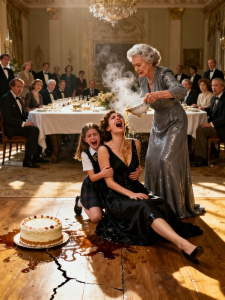
At the Anniversary Party, They Called My 8-Year-Old “a Cousin’s Slave”—Then Claimed Our $280,000 Trust Was Theirs, Until One Violent Slip Exposed the Forgery

The invitation arrived in a cream envelope with gold script, the kind of paper my mother liked because it made everything look like it belonged in a magazine—even when the people inside it were falling apart.
When I held it up to the kitchen light, the paper felt thick and smooth and expensive. The letters looked like they’d been pressed into the cardstock with a little promise: This will be elegant. This will be civilized. This will be worth dressing up for.
My mother’s name—Elaine Carter—sat at the top like a crown. Beneath it: 40th Anniversary Celebration. Beneath that: a date, a time, and the venue—The Hawthorne House, a restored estate with chandeliers and a lawn that never dared to have a brown spot.
It would have been easy to toss the invitation into the trash and keep my peace. I’d done it before. I’d skipped baby showers and brunches and “just family” dinners that always ended with my throat tight and my stomach sour.
But my son, Micah, saw the envelope and his eyes lit up the way kids’ eyes do when they think fancy paper means something magical.
“Is that for us?” he asked, climbing onto a chair to see.
“It’s for Grandma’s party,” I said carefully.
Micah grinned. “Is there cake?”
My husband, Daniel, looked up from rinsing dishes and gave me that look—gentle, wary, like he could already feel the tension traveling up my spine.
“You don’t have to go,” he said quietly. Not a command. An offering.
I stared at the gold script and felt the old push-pull: the part of me that wanted to disappear from my mother’s orbit forever, and the part of me that was tired of raising Micah in a world where my family got to rewrite reality without consequences.
“We’ll go,” I heard myself say.
Daniel’s eyebrows lifted. “Okay,” he said, as if he didn’t trust the sound of those words yet. “But we set boundaries.”
I nodded, though I knew boundaries in my family were treated like jokes.
Micah bounced in his seat. “Can I wear my blue shirt with the buttons?”
“You can,” I said, smiling at him even as my chest tightened. “You’ll look handsome.”
He beamed.
And because he beamed, I told myself I could survive one night. One polished room. One round of smiles sharp enough to cut.
I didn’t realize, as I slid the invitation back into its envelope, that my mother hadn’t invited us for the anniversary at all.
She’d invited us for a performance.
And she expected us to play the roles she’d assigned: her golden child, my perfect cousin, the obedient adults, the grateful kids—and me, the one who should keep my head down and accept whatever was handed out.
The Hawthorne House looked like wealth pretending to be history.
A circular driveway curved around a fountain that smelled faintly of chlorine. Valets in black suits waved people toward the entrance. The front doors were propped open, and warm light poured out like butter.
Micah held my hand tightly as we walked in, his fingers small and warm, his eyes wide.
“It’s like a castle,” he whispered.
“It’s a house,” Daniel murmured, though he said it with a smile meant for Micah.
Inside, the air was heavy with perfume and roasted meat and something floral that felt too sweet to breathe deeply. A string quartet played in the corner, their bows moving like they’d been trained to ignore every awkward conversation in the room.
My mother spotted us immediately.
Elaine Carter—champagne hair, pearl earrings, smile practiced and perfect. She swept toward us in a tailored navy dress that hugged her body like she’d signed a contract with it.
“There you are,” she said, kissing my cheek with lips that smelled like lipstick and power. “Finally.”
Finally, as if we’d been late to our own judgment.
She bent down and kissed Micah’s forehead. “And here’s my handsome boy.”
Micah smiled shyly. “Hi, Grandma.”
My mother’s gaze flicked to Daniel. “Daniel,” she said, warm enough to sound kind, cool enough to maintain hierarchy.
“Elaine,” Daniel replied politely.
My mother’s eyes slid back to me. “You look… fine,” she said, like it was the best she could do.
I forced a smile. “Happy anniversary.”
“Oh, it’s a big night,” she said, and something in her tone felt like a warning disguised as pride. “Everyone’s here.”
I scanned the room. My aunt and uncle. My cousins. My mother’s friends who always complimented my hair while mispronouncing my name. And there—near the bar—my cousin Sloane, holding a champagne flute like she’d been born with it in her hand.
Sloane was twenty-nine, beautiful in the way that made other people feel unfinished. She wore a cream satin dress with a slit up the thigh and a smile that looked like she’d already won something.
When her eyes met mine, she lifted her glass slightly as if to say: Oh, you came.
Micah tugged my hand. “Can I go see the desserts?”
“Not yet,” I said. “Stay close.”
My mother clapped her hands softly. “Alright—before dinner, we need a few hands in the side room,” she announced, turning to me as if it was obvious. “You can help, can’t you?”
Not would you like to.
Not are you able to.
Just: You can help. The assumption that my body belonged to her event.
Daniel stepped in calmly. “We just arrived.”
My mother’s smile tightened. “It’s nothing. Just placing name cards and moving a few gift bags. It’ll take five minutes.”
And then she looked at Micah. “Micah, sweetheart, do you want to be a big helper too? Sloane has her hands full.”
Micah’s face brightened. “I can help!”
Before I could answer, Sloane appeared beside us, perfume first, smile second.
“Micah!” she sang, too loud. “Perfect timing. Come on—I need someone quick.”
Micah glanced at me, asking permission without words.
I opened my mouth. Daniel’s hand found the small of my back, grounding me.
“I’ll come with him,” I said.
Sloane’s smile widened. “Oh, it’s just a few things. He can handle it. It’ll be good for him.”
The way she said it—good for him—made my skin prickle.
Micah looked between us, eager and trusting. “It’s okay, Mom. I can do it.”
My mother’s eyes sharpened. “Let him,” she said softly, the kind of softness that meant don’t embarrass me.
I swallowed. “Okay,” I said to Micah, leaning down. “Only for a few minutes. And you don’t carry anything heavy.”
Micah nodded solemnly and followed Sloane toward a side room.
Daniel’s jaw tightened. “We should watch,” he murmured.
“We will,” I said, but my mother was already steering me away.
“Come,” she said. “You can fix the place settings. You always had an eye for detail.”
It was a compliment with a leash.
The side room was smaller, crowded with gift bags, extra chairs, and a long table stacked with place cards. Sloane stood at one end, barking orders at two teenage cousins who looked bored. And there, in the middle of it all, was Micah—standing on tiptoe, reaching for a tray of rolled napkins that was too high for him.
“Careful,” I called, moving toward him.
Sloane glanced at me with annoyance. “He’s fine.”
Micah managed to pull the tray down, but it tilted, and a stack of napkins slid toward the edge.
Sloane sighed dramatically. “Micah, come on. It’s not that hard.”
Micah’s cheeks flushed. “Sorry.”
I stepped in and steadied the tray. “He’s eight,” I said evenly.
Sloane’s eyes flicked over me like I was lint. “Yeah, and he’s got two hands.”
One of the teenage cousins snorted.
Sloane handed Micah a bundle of silverware wrapped in ribbon. “Take these to the dining room. Put one at each setting.”
Micah hugged the bundle against his chest. “Okay!”
He turned, and the ribbon snagged on a chair. The bundle shifted. A fork slipped free and clattered onto the floor.
The sound was sharp in the quiet room.
Micah froze, eyes wide.
Sloane’s laugh was small and cruel. “Wow.”
I bent to pick up the fork. “It’s fine.”
Sloane tilted her head toward the teenagers, voice loud enough to carry. “See? This is why people hire help.”
My spine went cold.
Micah stared at her, confused. “I’m helping.”
Sloane smiled sweetly at him. “Exactly. Like the help.”
Micah blinked. “What’s ‘help’?”
Sloane’s eyes glittered. “You know. Like… a cousin’s slave.”
The words hit the room like something thrown.
Micah’s face changed instantly—confusion turning into hurt even before he fully understood the meaning. Kids don’t need definitions to recognize disrespect. They feel it in tone. In laughter. In the way adults look away.
My vision tunneled. I felt Daniel step beside me, fast and quiet.
“What did you say?” Daniel asked, voice dangerously calm.
Sloane’s expression didn’t shift. “Oh my God. It’s a joke. Relax.”
Micah’s lower lip trembled. “Mom…”
I crouched to his level, ignoring Sloane. “You are not anyone’s slave,” I said softly, firmly. “You are kind, and you are helpful, and nobody gets to speak to you like that.”
Micah swallowed hard. “Okay.”
Daniel stared at Sloane. “Apologize.”
Sloane rolled her eyes. “To a kid? He’ll forget in five minutes.”
My hands shook, but my voice stayed steady. “He won’t. And neither will I.”
Sloane’s smile sharpened. “Don’t be dramatic. This family has bigger things to discuss tonight than your… feelings.”
My mother’s voice floated from the doorway, bright and fake. “Everything alright in here?”
Elaine stepped in, taking in the scene—Micah’s face, my crouched posture, Daniel’s rigid stance. Her eyes flicked to Sloane, then back to me.
She chose the wrong side instantly.
“Don’t start,” she murmured at me, as if I was the problem.
I stood slowly, taking Micah’s hand. “We’re done helping,” I said.
My mother’s smile stayed in place, but her eyes flashed. “It’s one comment. We have guests.”
I looked at her. “He’s eight.”
My mother’s lips tightened. “Go wash up before dinner.”
Not concern. An order.
Sloane smirked, satisfied.
Micah squeezed my hand harder, as if he could anchor himself to me.
I leaned down and whispered to him, “Stay with us. No more errands.”
Micah nodded, eyes glossy.
And as we walked out, I heard Sloane say under her breath, amused, “God, she’s so sensitive.”
My mother didn’t correct her.
That was the moment something inside me stopped trying.
Not loving them. Not hoping. Just trying.
Dinner was served under chandeliers that made everyone’s skin look smoother than real life.
The tables were arranged with perfect symmetry. Candles flickered. Wine glasses caught the light. A photographer floated around taking “candids” that looked staged.
Micah sat between Daniel and me, shoulders tense. He ate quietly, barely tasting anything. Every time someone laughed too loudly, he flinched.
I kept my hand on his knee under the table like a promise.
Halfway through the meal, my mother stood, tapping her glass with a spoon.
The room quieted instantly. She loved this part—the attention, the controlled silence.
“Thank you all for coming,” Elaine began. “Forty years is… a lifetime.” She smiled at my stepfather, who stood to kiss her cheek. Applause. More smiles. More pretending.
Then my mother’s gaze swept the room and landed on me like a spotlight.
“And tonight,” she continued, “we’re also honoring something else—family legacy.”
My stomach tightened.
She gestured toward the far end of the room. A man stood up in a dark suit—silver hair, polite smile. I recognized him with a jolt.
Mr. Hargrove.
My late grandfather’s attorney.
Daniel’s fingers tightened around his fork. “Why is he here?” he whispered.
I didn’t answer because my throat had closed.
My mother beamed. “As many of you know, my father—God rest him—created a trust. A family trust. To support the next generation.”
My heart thudded.
That trust had been discussed in quiet fragments after Grandpa died—$280,000 set aside for Micah, intended for education and stability. Grandpa had adored Micah. Called him “my little compass.” Said he wanted Micah to have choices.
Sloane sat across the table from us, smiling like she was about to open a gift.
My mother continued, voice sweet. “There’s been some… confusion. Some assumptions.”
My face went cold.
“And I want to clear it up,” she said, lifting her chin. “That trust isn’t for everyone. It’s for the family members who stayed loyal. Who stayed close. Who didn’t… drift away.”
My ears rang.
She turned slightly, and her hand landed on Sloane’s shoulder like a coronation.
“The trust,” my mother announced, “will be administered for Sloane.”
A wave of murmurs rippled through the room.
Daniel’s chair scraped back slightly. “What?” he hissed.
Micah looked up at me, confused. “Mom?”
I stared at my mother, unable to breathe. “That trust is for Micah,” I said, voice shaking despite myself. “Grandpa—”
My mother cut me off with a smile that could’ve frozen water. “Your grandfather made many plans. I’m the executor. Mr. Hargrove is here to explain.”
Mr. Hargrove cleared his throat, looking uncomfortable. “There has been a… recent amendment—”
“Recent?” Daniel snapped, loud enough that heads turned.
My mother’s eyes flashed warning. “Daniel.”
Mr. Hargrove adjusted his papers. “A codicil was filed—”
I heard my own voice, thin and sharp. “Filed by who?”
My mother’s smile didn’t move. “By me. With legal guidance.”
Across the table, Sloane lifted her wine glass and sipped slowly, eyes locked on Micah like she was enjoying watching a child’s world shrink.
And then—because cruelty loves an audience—Sloane spoke.
“Well,” she said brightly, “I guess the trust wasn’t yours after all.”
Micah’s face tightened. “What trust?”
I put my hand on his shoulder. “It’s grown-up stuff,” I whispered, but he was already reading the room, the tension, the way adults were watching him like he was part of the argument.
My mother’s voice rose. “Some people feel entitled to money they didn’t earn.”
Daniel stood fully now, chair tipping back. “That money was left for our son.”
My mother’s smile vanished. “Your son is not my responsibility.”
The words were so clean, so absolute, that they sliced through the room.
Micah’s eyes filled. “Grandma?”
Elaine didn’t even look at him. She looked at me. “This is what happens when you come back only when you want something.”
My hands shook. “I didn’t come back for money. You invited us.”
My mother’s lips curled. “Because you needed to understand your place.”
I felt Daniel move, like he might explode. I squeezed his hand—not yet—because something was happening in my chest that felt clearer than anger.
It felt like recognition.
This wasn’t about loyalty.
This was about control.
And she’d used my child as the easiest lever.
The fight didn’t start with shouting.
It started with a glass.
Sloane set her champagne flute down too hard, and it clinked sharply. Then she stood up, swaying slightly—she’d been drinking more than she should, her cheeks flushed with confidence.
“Honestly,” she said, loud enough for the whole room, “if Micah needs money, maybe he should work for it. He’s already good at being—what did I call him earlier?”
My blood went hot.
Daniel’s voice turned lethal. “Don’t.”
Sloane smiled. “A cousin’s—”
I stood so fast my chair screeched. “Stop.”
Sloane laughed. “Oh, come on. Everyone’s thinking it. Your kid follows directions so well.”
Micah made a small sound, like a whimper he tried to swallow.
Something in me snapped—not into screaming, but into cold action.
I turned to Mr. Hargrove. “Did my grandfather sign that amendment?”
Mr. Hargrove hesitated. My mother’s eyes narrowed.
“He did not personally sign—” Mr. Hargrove began, then stopped as Elaine’s glare sharpened into a command.
Daniel leaned forward. “Answer.”
Mr. Hargrove swallowed. “The codicil was submitted with… a witnessed signature.”
I stared at him. “Whose witness?”
Before he could speak, my mother reached across the table and slapped his papers down like she owned them. “This is not the time.”
The gesture knocked a serving platter—something creamy and hot—off balance. It slid, tipped, and dumped onto the tablecloth in a thick beige flood. People gasped. Sauce splattered onto sleeves and napkins. The smell was instantly disgusting—warm dairy and garlic and panic.
My mother recoiled, furious, as if the mess had attacked her.
Sloane laughed loudly. “Oh my God.”
And then it happened—fast, stupid, violent.
Sloane reached across the table for Mr. Hargrove’s folder, fingers grabbing at the papers. “Let me see that,” she demanded, drunk and entitled. “If it’s mine, I want to—”
Daniel moved at the same time, grabbing the folder from the other side. “Don’t touch it.”
Sloane yanked harder.
The folder tore.
Papers flew out like startled birds—fluttering down into spilled sauce, sliding onto the floor, sticking to shoes.
The room erupted into shouting—my aunt screaming, someone knocking over a chair, glasses tipping and smashing. Wine spilled, dark and sour, mixing with the creamy sauce into a nauseating puddle that spread across the white linen like rot.
Micah started crying quietly, trying to wipe his face with his napkin.
“Micah,” I whispered, pulling him against me. “Look at me. Look at me.”
But he was staring at Sloane, terrified, because Sloane had stepped back and now her heel was planted on a document on the floor.
A document with a bold header.
NOTARY ACKNOWLEDGMENT
My brain sharpened.
I leaned down, ignoring the chaos, and snatched the paper from under her heel.
Sloane shrieked. “Hey!”
My fingers were slick with sauce, but I held the page up to the light.
The notary stamp was smeared—like it had been pressed twice, clumsily. The witness names were typed, not handwritten. And in the signature block where my grandfather’s name should’ve been, the signature looked… wrong.
Not just shaky.
Wrong in shape. Wrong in flow. Like someone copying from memory.
Daniel’s voice boomed over the shouting. “Give me that!”
I handed it to him, and he stared, jaw tightening.
My mother lunged toward us, slipping slightly on the wet floor where sauce and wine and broken glass had turned the dining room into a hazard. She caught herself on the table edge, knocking over another dish. Something green—beans, maybe—spilled and slid into the mess, making the smell worse.
“Stop!” Elaine screamed, no longer elegant, no longer composed. “That’s private!”
Sloane reached for my wrist, nails digging. “Give it back!”
Daniel shoved her hand away. “Don’t touch my wife.”
Sloane screamed like she’d been assaulted. She grabbed a nearby bread basket and flung it—wildly, stupidly—across the table. Rolls bounced and rolled into the sauce puddle like little sponges.
Someone shouted. Someone shoved someone else. A chair toppled. Glass crunched underfoot.
And then—like the universe couldn’t stand the lie anymore—Mr. Hargrove’s briefcase popped open when it hit the floor, spilling its contents.
Among them: an envelope.
Cream. Thick. Sealed.
Stamped with the same gold script as the invitation.
Elaine froze.
So did I.
Because that envelope wasn’t random.
It had my grandfather’s handwriting on it.
Shaky, but familiar.
FOR MICAH. OPEN IF ANYONE TRIES TO CHANGE MY WISHES.
The room went silent in a way that felt unreal, like someone had cut the sound.
My mother’s face drained of color.
Daniel’s breath hitched.
Sloane stared at the envelope, confused.
I bent down slowly and picked it up, my hands trembling. My fingers were still slick with sauce. I wiped them on my dress without caring.
Elaine stepped forward sharply. “Put that down.”
“No,” I said.
Elaine’s voice turned venomous. “You can’t just—”
Daniel cut her off, voice low and shaking with rage. “Yes, she can. It’s addressed to our son.”
Sloane scoffed. “That could be fake.”
Mr. Hargrove’s voice cracked. “It’s not.”
Elaine snapped toward him. “You—”
Mr. Hargrove straightened, and for the first time all night he looked like an attorney again, not a nervous guest. “Elaine, I told you not to do this.”
Elaine’s eyes widened. “Don’t you dare—”
Mr. Hargrove swallowed. “Your father left that in my custody. He anticipated… pressure.”
The word pressure sounded gentle compared to what Elaine had done.
My hands shook as I opened the envelope. Micah clung to my side, crying silently, his face pressed into my hip.
Inside was a letter. And beneath it—copies. Copies of the trust documents, notarized properly, with my grandfather’s actual signature, dated long before any “amendment.”
I read the first line, and my throat closed.
My dear Micah, it began.
My vision blurred. I forced myself to keep reading.
If you are reading this, it means someone decided money mattered more than love. I’m sorry they did that to you. This trust is yours—$280,000 set aside for your education, your home, your future. Your mother and father will protect it until you are old enough to decide what kind of man you want to be. No one else gets to take it. Not for loyalty. Not for punishment. Not for control. Love is not a leash.
A sound came out of me—half sob, half laugh.
Daniel’s hands covered his mouth.
Elaine stood rigid, eyes locked on the paper like it was a weapon pointed at her.
Sloane blinked rapidly, her drunk confidence evaporating. “Mom?” she whispered, suddenly young. “What is this?”
Elaine’s voice shook. “It’s manipulation.”
Mr. Hargrove’s voice was steady now. “It’s your father’s intent. And it is legally binding.”
The room buzzed—whispers, gasps, people stepping back like they didn’t want Elaine’s lie to splash on them.
Sloane’s face twisted. “You said it was mine.”
Elaine’s mask cracked completely, and what was underneath was not a grieving daughter or a loving mother.
It was a woman who hated losing.
“I said what I needed to say,” Elaine hissed.
Sloane looked like she’d been slapped.
Micah lifted his head slightly, eyes red. “Grandpa wrote me a letter?”
My chest squeezed so tight it hurt. I knelt beside him, ignoring the mess and the broken glass and the sauce soaked into my dress.
“Yes,” I whispered. “He did.”
Micah sniffed hard. “He wanted me to have it?”
“Yes,” I said. “Because he loved you.”
Micah’s face crumpled, grief and relief tangling together.
Elaine made a sharp sound—furious, choking. “This is humiliating.”
Daniel stared at her. “Humiliating? You tried to steal from your grandson.”
Elaine’s eyes flashed. “I tried to keep it in the family.”
I stood slowly, letter in hand. “Micah is the family.”
Elaine’s lips trembled. “You always do this,” she spat at me. “You always make me the villain.”
I looked at the room—at the stained tablecloth, the spilled wine, the broken plates, the bread rolls soaking in sauce, the faces of relatives who suddenly didn’t know where to look.
“No,” I said quietly. “You do that all by yourself.”
Sloane started crying—angry tears. “So I don’t get anything?”
Mr. Hargrove exhaled. “Sloane, you have your own trust fund from your father’s side. This one was never yours.”
Elaine’s eyes widened—betrayed even by her own golden child’s confusion.
Micah tugged my sleeve. “Can we go home?”
“Yes,” I said instantly. “We’re going home.”
Daniel wrapped an arm around Micah and kissed the top of his head. “We’re leaving,” he said, loud enough for everyone.
Elaine stepped forward, desperate now. “If you walk out, don’t come back.”
I paused at the doorway, letter still in my hand.
I looked at Micah—his small shoulders, his damp eyelashes, the way he leaned into Daniel for safety.
Then I looked back at my mother.
“I’m not coming back to be punished,” I said. “And my son is not coming back to be used.”
Elaine’s face twisted. “You’re tearing the family apart.”
I shook my head. “You did. We’re just finally naming it.”
And then we walked out.
Behind us, the party didn’t recover. You could feel it collapsing—the way lies collapse when they’re exposed under chandeliers. The way people scramble for excuses and dignity. The way silence turns from polite to condemning.
Outside, the night air felt cold and clean, like the world had rinsed itself.
Micah climbed into the back seat and wiped his face with his sleeve. “Mom,” he whispered, voice small. “What does ‘slave’ mean?”
My heart shattered and re-formed in the same breath.
I turned in my seat to face him. “It’s a word people use when they want to make someone feel small,” I said gently. “But it’s not who you are. And nobody gets to call you that. Ever.”
Micah nodded slowly. “Okay.”
Daniel started the car, hands steady. “We’ll talk to Mr. Hargrove tomorrow,” he said. “And we’ll make sure everything is locked down.”
I stared out the windshield at the glowing windows of the Hawthorne House. From the outside, it still looked perfect—warm lights, elegant silhouettes, wealth and celebration.
From the inside, I knew it was a mess—stained, broken, reeking of spilled wine and exposed intentions.
My phone buzzed before we even reached the end of the driveway.
A text from Elaine.
You’re ungrateful. You always ruin everything.
I didn’t reply.
For the first time in my life, I didn’t feel the need to defend myself to her.
Because my grandfather’s letter was still warm in my hand, and it said what my mother never could:
Love is not a leash.
And as Daniel drove us home, Micah asleep in the back seat with his cheek against the window, I realized something else:
They hadn’t just tried to steal $280,000.
They’d tried to steal my son’s sense of belonging.
But their lie had slipped in the mess they created—sauce, glass, shouting, and all.
And in the end, the loudest thing in that glittering room wasn’t the violence.
It was the truth, finally read out loud.
Để lại một phản hồi