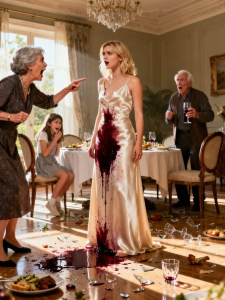
“She Threw a Fork at Thanksgiving and Called Me ‘the Help’—So I Clocked In, Set My Price, and Walked Out Mid-Turkey”

Thanksgiving always smelled like two things in my sister’s house: butter and performance.
The butter was real. A whole stick would vanish into mashed potatoes like it had never existed. But the performance—well, that was something else. That was Diane’s specialty. Diane could turn a Tuesday into a photo shoot and a family meal into an event. She had a ring light in her pantry. She had seasonal hand towels that said things like Gather and Grateful while she barked orders like a general.
And every year, somehow, I ended up being the one doing the actual work.
Not the “I brought a pie” work. Not the “I set the table” work.
The deep, sweaty, apron-stained kind of work that starts when it’s still dark outside and ends when you’re wiping turkey grease off cabinet handles because nobody else noticed they were slick.
I told myself it was tradition. I told myself it was love. I told myself it was just how families functioned—one person carried the weight, everyone else carried a wine glass.
Then my niece threw a fork at my head and called me “the help.”
And I did.
I got to Diane’s house at 7:12 a.m. because she’d texted at 6:03 a.m., “Door’s open. I’m in the shower. Turkey is thawed. Don’t panic.”
She always said “don’t panic” like she wasn’t the reason my left eye twitched every holiday.
The driveway was already crowded with Diane’s life: her SUV, her husband Mark’s shiny truck, a stack of flattened Amazon boxes leaning against the garage like a cardboard wall. Inside, the house was too warm and smelled faintly of cinnamon spray—an artificial attempt at comfort.
I found Diane in the kitchen wearing a silk robe and holding her phone up toward the window for better lighting.
“Okay, say it again,” she said, not looking at me. “Tell them what you’re grateful for.”
She was filming a story. Of course she was.
I set my tote bag down—knives, spices, a thermometer, my own apron because Diane’s were always decorative and useless. “Good morning.”
Diane’s eyes flicked to me. “Perfect. Just in time. Can you start the stuffing? And the potatoes? And maybe chop onions? Madison hates big onion pieces. Oh—and don’t use the cheap butter, use the European one.”
“Morning to you too,” I said.
She waved a hand like I’d said something adorable. “I’m grateful for family,” she cooed into her camera. “Even when they stress me out. Love you guys!”
Then she ended the video and immediately turned into Diane 2.0—the version who didn’t smile.
“Okay, listen,” she said. “We’re doing the table in the dining room but we’re plating in the kitchen island. And no one touches the gravy boat until I take pictures.”
I stared. “No one touches the gravy boat.”
“It’s crystal,” she said, like that explained everything. “Also, don’t let Dad near the deviled eggs again. Last year he double-dipped on camera.”
I didn’t have the energy to remind her that Dad double-dipped because he’d been shaking from low blood sugar after nobody fed him breakfast because Diane “wasn’t ready to serve yet.”
I just tied my apron and opened the fridge.
The turkey was “thawed” in the way a rock is “softened” if you leave it in the sun for ten minutes. It was still half-icy, sitting in a roasting pan like a cold, pale boulder.
I took a breath. “Diane.”
“What?” she snapped, already tapping her phone.
“This turkey isn’t thawed.”
“It’s fine,” she said. “You’ll figure it out. You always do.”
There it was. The unspoken contract we’d been living under for years. Diane created the chaos, and I cleaned it. Diane wanted the moment, and I made the meal.
I opened the pantry, scanning for stock. I found three cans, all expired. I found cranberry sauce, twelve cans, because Diane had panic-bought them during some influencer recipe phase.
I started anyway.
I chopped onions while the house slowly woke up. I softened butter. I toasted bread cubes. I did the things my hands could do without thinking, the muscle memory of someone who’d been trained in domestic survival.
By 9:30, the kitchen was a battlefield of prep bowls, sticky measuring spoons, and a growing mound of vegetable scraps that Diane would later complain “smelled.”
Diane floated in and out, filming segments.
“Guys, my sister is literally saving Thanksgiving,” she said at one point, pointing the camera at me.
I didn’t look up. “Mm-hmm.”
“Say hi!” she sang.
I kept chopping. “Hi.”
The camera lingered. Diane’s tone got sharper. “Smile.”
I forced my mouth into something that could technically be categorized as a smile, if you were generous.
She finally moved on.
At 10:15, my niece Madison came downstairs.
Madison was seventeen and stunning in the way that made adults forgive her automatically. Thick hair, perfect skin, long lashes that looked like they belonged in a commercial. She wore a matching lounge set that cost more than my monthly car payment and carried her phone like it was an organ.
She walked into the kitchen, took one look at the clutter, and wrinkled her nose.
“Ugh,” she said. “It smells like… onions.”
“Yes,” I said, not looking up. “Because onions are present.”
Madison perched on a barstool and started scrolling. “Mom, did you order the charcuterie board? The one shaped like a leaf? I posted the poll and everyone voted leaf.”
Diane popped up instantly. “It’s coming at noon.”
Madison nodded like a CEO approving a budget. Then her eyes flicked to me. “Are those my potatoes?”
“They’re everyone’s potatoes,” I said.
Madison’s mouth tightened. “Just don’t make them lumpy. Lumpy potatoes are disgusting.”
I glanced at her. “Then you’re welcome to make them yourself.”
Madison stared at me like I’d spoken in another language. Diane laughed lightly, the way you laugh when you want to defuse but also want to punish later.
“Kayla,” Diane warned softly. “Just… let it go.”
Let it go. The family motto. Let it go when Madison was rude. Let it go when Diane treated me like staff. Let it go when Mark disappeared upstairs “to watch football” while I washed dishes.
Let it go.
I did, mostly. I had practice.
Around noon, the house filled up.
My dad arrived first, carrying a bottle of cheap wine like it was an offering. He kissed my cheek and whispered, “You okay?”
“Yep,” I lied, because I didn’t want to ruin his day.
Then my brother-in-law Mark’s brother arrived with his loud laugh and a tray of store-bought cookies. Then my aunt came with a casserole nobody ate but everyone pretended to love. Then more cousins, more coats, more shoes by the door, more voices stacking on top of each other.
Diane loved it. Her eyes lit up. She became a hostess, floating and hugging, introducing, posing people by the fireplace for photos.
Meanwhile, I was in the kitchen, basting a turkey that finally made it into the oven two hours late, sweating over the stove, and trying not to let the gravy scorch.
At 2:30, Madison started complaining about hunger.
“Why is this taking so long?” she said loudly from the living room. “It’s literally 2:30.”
Diane called back, “Almost ready!”
I muttered under my breath, “Almost ready is a lie you tell people when you’re trying not to scream.”
Mark wandered into the kitchen, opened a beer, and leaned against the counter like he was inspecting my work.
“Smells good,” he said.
I didn’t respond.
He took a sip. “You know, you should open a catering business. You’re basically doing it already.”
I stared at him. “Yeah. For free.”
He laughed like that was funny, then wandered away.
At 4:11 p.m., we finally sat down.
The dining room table looked like a magazine spread. Diane had layered tablecloths. There were tiny pumpkins and gold chargers and name cards with calligraphy that said things like Blessed and Joy. She’d even put little sprigs of rosemary at each setting like we were dining in Tuscany.
The food looked good because I’d made it good. Turkey, potatoes, stuffing, green beans, gravy, rolls, cranberry sauce, deviled eggs, and Diane’s precious crystal gravy boat in the center like a crown.
Everyone praised Diane.
“This is beautiful,” my aunt sighed.
“Diane, you outdid yourself,” Mark’s brother said.
Diane smiled, pleased. “It’s all about family.”
I sat down at the far end of the table, exhausted. My hands smelled like onions no matter how many times I washed them.
We started passing dishes.
Madison took a tiny portion of turkey and made a face. “This is dry.”
“It’s not dry,” Diane said, laughing too quickly. “It’s perfect.”
Madison stabbed her turkey with her fork. “It’s dry.”
I looked at her plate. She’d taken one thin slice from the very edge. The part most likely to be drier. Because she needed something to complain about, like oxygen.
I poured gravy into the boat and started to pass it.
Madison reached for it first. Then stopped.
“Is this gluten-free?” she asked, loud enough for the entire table.
I blinked. “It’s gravy.”
“That doesn’t answer my question.”
Diane jumped in. “It’s fine, sweetie.”
Madison leaned back and sighed dramatically. “Okay. I guess I’ll just suffer.”
My dad tried to lighten it. “When I was your age, we ate whatever was put in front of us.”
Madison’s eyes flicked to him like he was a stray animal. “That explains a lot.”
A few people chuckled nervously.
And then—because Madison could never let a moment go unclaimed—she looked straight at me.
“Hey,” she said, waving her fork like a tiny weapon. “Can you bring me more potatoes? The good ones. Not the lumpy ones.”
“I’m sitting down,” I said, keeping my voice calm. “The bowl is right there.”
Madison’s mouth twisted. “I’m not reaching over everyone.”
I held her gaze. “Then ask someone else.”
There was a pause. The kind that makes the air feel heavier.
Madison’s face sharpened. She looked at Diane, then back at me, and her voice got loud and clear like she wanted it recorded.
“Why are you acting like you’re not the help?”
Silence hit the table like a dropped tray.
My aunt’s fork froze halfway to her mouth. My dad’s eyes widened. Diane’s face went pale and then flushed.
Madison smirked, pleased with herself, and flicked her wrist.
The fork left her hand.
It wasn’t a full-speed throw like a movie. It was a careless, entitled toss, the way you toss something you don’t respect.
But metal is still metal.
The fork clinked off my water glass, splashed water onto my lap, and skittered across the table, knocking into the gravy boat.
The gravy boat wobbled.
For one terrifying second, it balanced.
Then it tipped.
A thick wave of brown gravy poured across the white tablecloth, spreading fast, soaking into linen, dripping off the edge onto the hardwood floor with a wet slap.
People gasped. Someone yelped. Diane made a sound like she’d been stabbed.
Madison stared at the mess and then, unbelievably, laughed.
“Oh my God,” she said, like it was hilarious. “Oops.”
I looked down at the gravy pooling near my plate, dripping toward my knees, and something inside me went very still.
Not rage.
Not tears.
Just… a switch flipping.
I picked up my napkin and dabbed my lap.
Then I looked up at Madison and smiled.
Not a polite smile. Not a fake “family” smile.
A calm, sharp smile that made her pause for the first time all day.
“You’re right,” I said.
Diane blinked. “Kayla—”
I held up one finger, still smiling. “No. Let her finish her thought. I’m the help.”
Madison’s smirk returned, triumphant. “Finally.”
I nodded. “Okay.”
Then I did something no one at that table expected.
I pushed my chair back, stood up, and walked to the kitchen.
Behind me, voices erupted.
“Madison!” Diane hissed. “What is wrong with you?”
Madison snapped back, “It was a joke!”
Mark’s brother muttered, “That wasn’t a joke.”
My dad said, quietly, “Enough.”
I didn’t stop. I didn’t turn around.
I went into the kitchen, opened Diane’s junk drawer, and pulled out a pen and notepad.
Then I sat at the counter like I was at a job.
Because apparently, I was.
I started writing.
When Diane stormed in, her face was red and furious, she stopped short.
“What are you doing?” she demanded.
I didn’t look up. “Clocking in.”
“You’re being ridiculous.”
I kept writing. “Let’s see. Grocery run: three hours. Prep: five hours. Cooking: nine hours. Cleanup so far: two hours.”
Diane stared. “What is that.”
“An invoice,” I said pleasantly. “Because help gets paid.”
She let out a high, disbelieving laugh. “Oh my God. You’re seriously doing this right now? On Thanksgiving?”
“You mean the Thanksgiving where your daughter threw a fork at me and called me ‘the help’?” I glanced up, still smiling. “Yes. I’m doing it right now.”
Diane’s voice rose. “She’s a kid!”
“She’s seventeen.”
“She didn’t mean it!”
“She meant it enough to say it loudly and throw silverware.”
Diane’s eyes darted to the dining room like she wanted backup. “You’re embarrassing me.”
I set the pen down carefully. “Diane, you embarrassed yourself when you let this become normal.”
Her mouth opened. “Excuse me?”
I stood, body aching, but my voice stayed steady. “Every year you ‘need’ me. Every year you tell everyone you did it. Every year you film the table while I’m sweating in here like I’m running a restaurant.”
“That’s not fair—”
“Oh, it’s fair,” I said. “It’s just finally being said out loud.”
From the dining room, we heard a crash—someone knocked over a bowl trying to mop gravy with napkins. Then another voice yelling, “Watch your feet!”
Diane flinched. “The table is a disaster! Come help fix it!”
I nodded. “Sure.”
Diane’s shoulders dropped in relief for half a second. Then I added, “My rate is $45 an hour. Holiday pay is time-and-a-half. And I require basic respect.”
Diane stared at me like I’d sprouted horns. “Are you insane?”
I tilted my head. “No. I’m employed, apparently.”
Her face twisted. “You can’t do this to me.”
I walked past her toward the dining room. “I’m not doing anything. I’m responding to how you’ve treated me.”
When I entered the dining room, the scene looked like a food commercial that had been attacked.
Gravy streaks ran across the tablecloth. Napkins were everywhere, brown and crumpled. Someone had stepped in gravy and left footprints across the floor. The crystal gravy boat lay on its side like a dead bird.
Madison was sitting back, arms crossed, watching the chaos like entertainment.
My dad stood with a paper towel roll, looking defeated. My aunt was on her knees, wiping, grimacing.
Mark’s brother was trying to mop with a dish towel, making it worse.
Diane followed me in and pointed dramatically. “See? This is what happens when you—”
I held up my hand. “Okay.”
Everyone paused.
I walked to the head of the table and looked around at my family—people I loved, people who also loved convenience.
Then I looked at Madison.
“Since I’m the help,” I said calmly, “I’ll do what help does.”
Madison smirked. “Good.”
I nodded. Then I turned to Diane. “Where’s the checkbook?”
Diane blinked. “What?”
“Checkbook,” I repeated. “Or Venmo. Either works.”
The room went dead quiet again, but this time it wasn’t shock.
It was realization.
My dad let out a low whistle. “Oh.”
Diane sputtered. “Kayla, stop.”
I kept my tone cheerful, almost customer-service sweet. “Also, ‘help’ doesn’t get forks thrown at them. That’s a workplace safety issue.”
Mark’s brother coughed, trying not to laugh.
Madison’s smirk faltered. “You’re being dramatic.”
I nodded. “Maybe. But here’s the thing: help can quit.”
Madison rolled her eyes like she didn’t believe I had that power.
I turned and walked back to the kitchen.
And then I started packing up.
Not everything. Just what was mine.
The pies I’d baked the night before—pumpkin and pecan—still sitting on the counter because Diane wanted “a photo moment” before serving them. My serving utensils. My good knife. The container of homemade cranberry relish I’d made because Diane only had twelve cans of the gelatinous stuff.
I put them in my tote bag.
Diane followed me, voice climbing. “What are you doing?!”
“Leaving,” I said.
“You can’t leave! Everyone’s here!”
“Exactly,” I said. “Witnesses.”
She grabbed my arm.
Not hard, but hard enough.
Pain flared in my shoulder—old tendonitis from too many years of carrying more than I should.
I looked down at her hand on me.
Then back up.
“Let go,” I said quietly.
Diane’s face was a storm. “You are ruining my holiday.”
I leaned in, voice low and steady. “You ruined it when you taught your daughter I was beneath her.”
Diane’s hand dropped like she’d been burned.
Behind us, voices erupted again—Madison yelling, “She’s crazy!” and my dad shouting, “Madison, stop!” and Mark stomping in, confused, demanding, “What the hell is going on?”
Everything blurred into noise.
Someone knocked over a chair. It scraped loud. A plate clattered to the floor and shattered—thankfully just a cheap one Diane used “for kids,” but it still sent shards skittering.
The smell got worse—gravy, turkey, spilled wine someone had set down in panic. A sour edge of something rotting from the trash can because nobody had taken it out and now it was full of turkey packaging and wet paper towels.
It was gross. Real. Not curated.
Madison stomped into the kitchen, phone raised, recording.
“Say it again,” she snapped, eyes bright. “Say you’re leaving.”
I looked directly into her camera and smiled.
“Yes,” I said. “I’m leaving.”
Madison’s mouth opened in triumph—until I added, “Because I’m not your help.”
Her face twisted. “You’re such a victim.”
I turned to Mark. “You can carve the turkey. You have hands.”
Mark raised his beer like that was a defense. “Hey, I didn’t—”
I cut him off. “You did. You let it happen.”
Then I looked at Diane. “If you want me at family dinners, I show up as family. I sit down. I eat. I get treated like a human.”
Diane’s voice cracked. “So you’re just going to abandon us in the middle—”
“Yes,” I said. “Because you abandoned me years ago. You just called it ‘help.’”
I picked up my tote bag and walked toward the door.
Diane followed, crying now, anger and fear mixed. “Where are you going?”
I paused at the doorway and looked back at the kitchen—at the mess, the spilled gravy, the broken plate, Madison filming like it was content.
Then I looked at my dad.
He stood there holding paper towels, eyes tired.
I softened just a little. “Dad, I love you. But I’m done being treated like labor.”
His eyes shimmered. He nodded once. “I understand.”
Madison scoffed. “Unbelievable.”
I stepped out.
Cold air hit my face like freedom.
I walked to my car, heart hammering, hands shaking now that adrenaline had permission.
Inside the house, I could still hear shouting, chairs scraping, someone saying, “Who’s going to serve dessert?”
Not my problem.
For the first time in years, not my problem.
I drove ten minutes to my friend Renee’s apartment.
Renee was the kind of friend who didn’t need a holiday to feed people. Her Thanksgiving was always a little messy and a lot honest. She’d invited me weeks ago, casually, when I’d mentioned Diane’s “schedule.”
“If you need a place to escape,” she’d said, “I’ll have a plate.”
I hadn’t expected to actually take her up on it.
But when she opened her door and saw my face, she didn’t ask questions first.
She just took the tote bag from my hand and said, “Come in.”
Her apartment smelled like roasted garlic and laughter. Two other friends were there, sitting on the floor around a coffee table covered with mismatched dishes. Someone had brought tamales. Someone had brought mac and cheese with a crust so golden it looked illegal. There was a turkey, but it was smaller, like a humble offering instead of a centerpiece demanding worship.
Renee looked into my bag and saw the pies. “Oh, honey,” she said softly. “We’re about to have the best dessert in the building.”
And then—because my nervous system was still buzzing—I started laughing.
Not cute laughter. Not social laughter.
The kind that comes out of you when you realize you survived something you didn’t even admit was hurting you.
Renee handed me a glass of water. “Tell me.”
So I did. The fork. The help. The gravy flood. The filming. The way Diane grabbed my arm like she could physically keep me in my role.
Renee’s friend Malik shook his head. “A fork? That’s wild.”
Another friend, Jess, wrinkled her nose. “And she called you the help? In your own family?”
I nodded, and suddenly the tears hit. Quiet, unstoppable, more relief than sadness.
Renee put a hand on my shoulder. “You didn’t deserve that.”
I wiped my face and took a shaky breath.
Then I ate.
I ate like a person who didn’t have to earn her seat at the table.
And the pie tasted like something I’d forgotten existed: dignity.
My phone blew up an hour later.
Diane: Answer me.
Diane: This is insane.
Mark: You embarrassed Diane.
Madison: LOL you really left.
My aunt: Call your sister. She’s hysterical.
Then, finally, my dad: I’m proud of you. Come by tomorrow if you want.
That text made my chest ache.
I didn’t respond to Diane. Not that night. Not while my body was still shaking from the aftershock.
I slept on Renee’s couch, wrapped in a blanket that smelled like laundry detergent and safety. I woke up to the sound of someone making coffee and the feeling of not being on duty.
The next day, I went to my dad’s.
He hugged me longer than usual.
“I should’ve stopped it sooner,” he said quietly.
I swallowed. “I should’ve stopped it sooner too.”
He nodded. “Your mother would’ve—”
“Don’t,” I said gently. “I can’t handle imagining her watching that.”
Dad’s eyes got wet. “She’d have thrown the fork back.”
That made me laugh, and it felt good.
Diane didn’t talk to me for two weeks.
Then she called.
Her voice was tight, controlled, like she was doing damage control in her own mind.
“Madison didn’t mean it,” she said first.
I didn’t rise to the bait. “Did you?”
Silence.
Then Diane exhaled. “No.”
“Did you stop her?”
Silence again, longer.
“I… tried,” Diane said, and we both knew that wasn’t true.
I kept my voice calm. “If you want me at your house, I come as a guest. I don’t cook the whole meal. I don’t clean up after everyone. I don’t get treated like staff.”
Diane’s voice cracked. “She’s just—she’s going through a phase.”
“Then parent her,” I said. “Because the phase is cruelty.”
Diane didn’t answer.
A week later, Madison texted me.
It wasn’t an apology. Not really.
It was one line: Mom says I have to say sorry.
I stared at it.
Then I typed back: You don’t “have to” say anything. But you do have to live with who you chose to be.
No response.
Two months later, I heard Madison had to do community service for school. Diane tried to spin it like it was “character building.” I didn’t comment.
On Christmas, Diane hosted again—smaller, quieter. She hired catering.
When I arrived, she looked nervous, like she expected me to punish her.
I didn’t.
I just set my coat down, walked to the table, and sat.
Madison was there, stiff and silent. She didn’t look at me.
Diane hovered. “Do you need anything?”
I smiled, genuinely this time. “Yeah.”
She leaned in like she was ready to fetch.
I said, “A chair. I’m good.”
And I stayed seated.
The catered food was fine. Not as good as mine, but fine. The point wasn’t the flavor.
The point was that nobody mistook my presence for permission to use me.
Near the end of the night, Madison walked past me toward the kitchen. She paused, like she was fighting something inside her.
Then, without looking me in the eye, she muttered, “Sorry. About… the fork.”
It wasn’t poetic. It wasn’t warm. It was small and awkward.
But it was real enough to count as the first brick in a rebuilt boundary.
I nodded once. “Don’t do it again.”
She nodded back, almost imperceptibly, and walked away.
Diane exhaled behind me like she’d been holding her breath since Thanksgiving.
And in that moment, I realized the best revenge wasn’t screaming or breaking something or humiliating anyone.
It was refusing to play the role they wrote for you.
My niece called me “the help.”
So I showed them what help actually is:
A person with limits.
A person with value.
A person who can walk out, leaving the mess exactly where it belongs.
Để lại một phản hồi