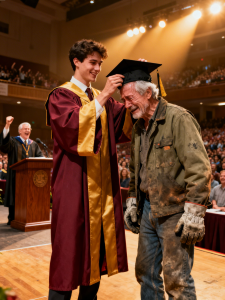
My Stepfather Ruined His Body to Pay for My PhD—Then the Dean Recognized Him at Graduation and Revealed Why a “Missing Legend” Was Hiding as a Laborer

For most of my life, my stepfather smelled like cement dust and quiet decisions.
Not the dramatic kind of quiet—no mysterious silences, no brooding stares into the distance. Just the steady, ordinary quiet of a man who woke before dawn, ate two eggs standing at the counter, and came home with his hands cracked and raw like the world had been sandpapering him down.
His name was Hector Alvarez.
To the people who hired him, he was “Al”—because shortening someone’s name is easier than learning their story. To my mother, he was Hector when she was angry and “mi amor” when she was relieved. To me, he was just… Dad, eventually. Not at first, not for years. But the word had a way of arriving when it was earned.
I grew up in a small house where the walls were thin and the bills were loud. My biological father was a faint, distant shape—postcards once a year, promises that dried up like puddles in August. My stepfather was the opposite: solid, present, and aching.
When I told Hector I wanted a PhD, he didn’t laugh.
He didn’t ask what it would cost.
He didn’t ask what it would “get me.”
He just wiped his hands on his jeans, looked at me like I’d said something sacred, and said, “Good.”
That was it. Just one word, heavy with meaning.
Later that night, he sat across from me at the kitchen table, shoulders hunched, rolling a pencil between his fingers like it was a tool he could build something with.
“I’m just a laborer,” he said, voice rough. “But knowledge commands respect.”
Then he pointed that pencil at me. “And you? You’re going to have it.”
I didn’t understand then what he meant by “respect.” I thought he meant admiration. A title. A chair at the front of a room.
I didn’t realize he meant survival.
The first year of graduate school nearly broke me.
Not the coursework. Not the lab hours that blurred into sunrise. Not the professors who spoke in jargon like it was oxygen.
What nearly broke me was money.
Tuition. Rent. Books. Conference fees. Printing costs. The constant, low-level panic of knowing you’re one emergency away from collapsing.
I worked two jobs. I applied for scholarships. I ate ramen until I hated the smell. I borrowed money from friends I shouldn’t have borrowed from.
And every time I tried to talk about taking a break, Hector would sit on the edge of my bed, the mattress squeaking under his weight, and say, “No.”
Not cruelly. Not controlling.
Like a man refusing to let a bridge collapse while someone was halfway across it.
“Pride doesn’t pay bills,” I told him once, tears hot in my eyes.
Hector nodded, as if I’d said something wise. “Correct,” he said. “That’s why we don’t use pride. We use work.”
He worked construction and concrete finishing. He mixed cement in summer heat that made the air shimmer. He lifted bags that weighed almost as much as I did. He came home with dust in his hair and grit in the lines of his palms.
Sometimes he’d sit in the bathtub and soak his hands in warm water, staring at the cracks like he was studying a map of his own sacrifices.
And always, always—he saved.
Not with neat bills tucked into envelopes. With crumpled, sweaty cash folded into squares and hidden inside an old coffee can above the fridge.
Every few months he’d pull it down, count it on the table, then push it toward me like he was handing over a weapon.
I would protest. I always did.
He’d always cut me off the same way.
“Take it,” he’d say. “If you don’t, you insult my work.”
So I took it. And I carried the weight of that money like it was made of stone.
When I finally got the call that my dissertation was accepted—after revisions and more revisions and one night where I stared at my laptop so long my eyes felt like they’d turned to ash—I drove straight to my mother’s house.
I didn’t even park properly. I ran inside.
Hector was at the kitchen sink, washing his lunch container, sleeves rolled up, forearms corded with muscle and age.
“I did it,” I choked out.
He turned slowly, water still running, and I watched his face change.
His eyes widened first, then softened. His mouth trembled slightly, as if he was fighting a smile too big for his own control.
He turned off the faucet and dried his hands on a towel like he had all the time in the world.
Then he nodded once.
“Good,” he said.
That one word again.
Then, quietly, he added, “Now we go to the graduation. And we sit. And we listen. And we let them clap for you.”
I laughed through tears. “You mean they clap for us.”
Hector shook his head. “No. They clap for you. You earned the knowledge. I just carried the bags.”
He said it like it was obvious.
Like it was nothing.
Graduation day arrived with the kind of bright spring sunlight that makes everything look cleaner than it really is.
The campus auditorium was packed. Parents in fancy outfits. Families with balloons. Students in robes that felt too heavy. The air smelled like perfume, hairspray, and the sharp edge of anxiety.
My mother had insisted on buying a new dress. She cried while doing her makeup, repeating, “I can’t believe it,” like she needed to say it aloud to make it real.
Hector didn’t own a suit.
Not a real one.
He had a pair of dark slacks he wore to funerals and church. He had a white shirt that had been ironed so many times the fabric looked tired.
The night before, my mother had called a cousin, then returned with a suit in a garment bag like it was contraband.
“It’s your Uncle Mateo’s,” she whispered, as if borrowing clothing was illegal. “It’s a little big, but it’ll work.”
Hector stared at the garment bag as if it contained something dangerous.
“I don’t need—” he began.
My mother snapped, “Yes, you do. This is your daughter’s day.”
Hector flinched at the word daughter—not because he didn’t want it, but because it still surprised him when it was spoken out loud.
He tried the suit on in the bedroom.
It was too loose at the shoulders and too long in the sleeves, like the suit belonged to someone who’d lived a softer life. Hector stood in front of the mirror, tugging at the cuffs, looking uncomfortable.
I stepped behind him and adjusted the collar gently.
He met my eyes in the mirror.
“You look good,” I said.
Hector’s jaw clenched. “I look like a man wearing someone else’s skin.”
I swallowed hard. “You look like someone who belongs there.”
Hector looked away. “I don’t want attention.”
I smiled, bitter. “Funny. You spent twenty-five years making sure I got attention from professors. But you can’t stand it yourself.”
He didn’t answer. But his face tightened.
Like I’d brushed against a bruise.
The auditorium was enormous, the kind of place designed to swallow individual people and spit out collective applause.
We found seats halfway back.
Hector immediately tried to move farther—toward the last row, toward the shadows, toward the place where nobody would look twice.
“Dad,” I said, and I meant it, “sit here.”
He hesitated. Then sat.
But even seated, he looked like he was trying to shrink.
Hands folded. Shoulders slightly hunched. Eyes down.
My mother leaned over and whispered, “Stop acting like you’re not important.”
Hector murmured, “I’m not important.”
I whispered back, “You’re the reason I’m here.”
He didn’t respond. He just looked at the stage.
Like he was bracing for something.
The ceremony began. Speeches. Music. The usual parade of pride.
Then the Dean arrived.
I recognized him from campus emails and photos: Dr. Malcolm Reed. Tall, silver-haired, confident in the way men are when they’ve never had to wonder if they can afford groceries.
The room stood as he walked in. Applause swelled.
Dr. Reed made his way down the aisle with a smile, shaking hands with faculty members.
And then—his gaze flicked across the seats.
It landed on Hector.
And the Dean froze.
Not the polite pause of a man spotting an old acquaintance.
A real freeze.
His entire body stiffened like he’d hit a wall.
The smile fell off his face as if someone had wiped it away.
His eyes widened.
His hands, mid-motion, trembled.
Then, in a voice that was loud enough to pierce the murmurs, he said, “Hector Alvarez?”
The name sounded strange in the auditorium, like a ghost being called into a room full of living people.
Heads turned.
Whispers started immediately—rippled through the crowd like wind through dry grass.
My mother’s hand flew to her mouth.
I stared at Hector.
Hector looked like he’d been struck.
His face went pale. His jaw tightened. His eyes darted, searching for exits.
Dr. Reed stepped closer, disbelief written all over him.
“You’re…” the Dean’s voice cracked. “You’re the legend who disappeared.”
The auditorium went quiet so abruptly it felt like someone had cut the sound with scissors.
And then the Dean did something no one in that room expected.
He bowed.
Low.
Deep enough that his expensive suit creased.
Deep enough that it was not a gesture of politeness.
It was reverence.
Gasps erupted.
I felt my heart slam against my ribs.
Hector’s hands clenched into fists on his knees.
“Please,” Hector whispered, barely audible. “Don’t.”
But Dr. Reed lifted his head, eyes shining.
“Don’t?” he echoed, voice shaking with emotion. “Sir… we thought you were dead.”
The crowd erupted into whispering again, louder now, confused, hungry for meaning.
“Dead?” someone breathed behind me.
“Who is he?” another voice hissed.
Hector’s face tightened, and for the first time in my life I saw something in him that I couldn’t label.
Not tiredness.
Not humility.
Something older.
A pain that had been buried so long it had turned into stone.
Dr. Reed straightened and looked around at the room.
Then he turned toward the stage and raised a hand for silence.
The room, unbelievably, obeyed.
“My apologies,” the Dean said, voice carrying. “But what you are witnessing is… history.”
He turned back to Hector. “May I?”
Hector’s throat moved. He looked at me then—my stepfather, the laborer, the man who’d mixed cement until his spine screamed—looking at me like he was asking permission for a truth he’d spent decades hiding.
I didn’t know what to do.
So I nodded.
Hector closed his eyes briefly, like he was stepping off a ledge.
Dr. Reed faced the crowd again.
“Many of you know the Alvarez Theorem,” he said.
My breath caught.
I’d heard it in passing, once, during a seminar when a professor referenced “the missing piece Alvarez proposed.” I’d never thought much of it. In academia, names floated around like currency. You didn’t always stop to imagine the person behind them.
Dr. Reed continued, voice thick. “A breakthrough in applied materials science—revolutionized how we think about stress distribution in composite structures. It’s cited in bridges, aerospace design, earthquake-resistant housing…”
My mouth went dry.
Dr. Reed gestured toward Hector. “The Alvarez who wrote that work… disappeared twenty-five years ago.”
The room was dead silent.
I felt my mother’s fingers clutch my sleeve.
Hector stared straight ahead, face rigid.
Dr. Reed’s voice lowered. “We searched. Colleagues filed missing person reports. We assumed the worst.”
He looked at Hector with something like grief.
“And all this time,” he whispered, “you were here.”
Hector’s voice came out low, rough. “I didn’t disappear,” he said. “I left.”
Dr. Reed shook his head, tears in his eyes. “Why?”
Hector swallowed hard.
Then he did something he’d never done in public.
He stood.
Slowly, carefully, like his body was negotiating with gravity.
The borrowed suit hung off him, making him look smaller than he was.
But when he lifted his head, there was nothing small in him.
He turned slightly, looking at the crowd, at the stage, at the polished faces of people who’d never lifted a bag of cement.
“My name is Hector Alvarez,” he said. “Yes.”
A collective breath sucked in.
He continued, voice steady now. “I studied. I wrote. I believed in knowledge. I believed in respect.”
His eyes flicked to me for a second.
“Then I learned that knowledge is respected… until it becomes inconvenient.”
Dr. Reed’s face tightened. “Hector—”
Hector raised a hand, not rude, but firm.
“I was working on a project,” Hector said. “A grant. A partnership. A ‘once-in-a-lifetime opportunity.’”
He let out a humorless laugh. “That’s what they called it.”
He looked down at his hands, palms rough, scarred.
“I discovered something,” he said quietly. “A flaw. A danger in the proposed material. Something that could’ve gotten people killed if it went into production.”
The room leaned in, collectively.
“I reported it,” Hector said. “I pushed back. I said we needed to delay.”
Dr. Reed looked stricken now, like he knew what was coming.
Hector’s jaw clenched. “They told me to keep quiet.”
My stomach churned.
Hector continued, voice growing harder. “They offered me money. A promotion. A seat at the table.”
He shook his head. “I said no.”
Dr. Reed whispered, “The consortium…”
Hector nodded once. “The consortium.”
A murmur swept through the faculty rows.
Hector’s gaze flicked to my mother. Then back to the crowd.
“I wasn’t just fighting them,” he said, voice cracking slightly. “I was fighting… life.”
He took a breath.
“My wife was sick,” he said.
My mother stiffened.
I stiffened.
Hector’s voice softened. “Cancer. Aggressive. Treatments we couldn’t afford.”
My throat tightened. I’d never heard this. My mother had never mentioned a first wife. I’d assumed Hector had just… existed alone before her, like my mother liked to pretend nobody had lives before they joined her orbit.
Hector swallowed. “They told me they’d cover her treatment if I signed off.”
Dr. Reed’s hands clenched. “No…”
Hector’s voice cracked. “Yes.”
The auditorium felt like it had turned to ice.
“I refused,” Hector said, barely holding it together. “Because if I signed, and people died, I’d be alive with blood on my hands.”
His eyes shone now, but he didn’t let tears fall.
“My wife died,” he said quietly.
A sound—someone sobbing—rose from somewhere in the crowd.
Hector’s jaw trembled. “And after that… they made sure I had no place in the field.”
Dr. Reed whispered, “Blacklisted.”
Hector nodded. “Blacklisted.”
The Dean stepped closer, voice shaking with rage. “Hector, I—I didn’t know. I was a junior then. I heard rumors but—”
Hector’s gaze hardened. “Rumors don’t pay for funerals.”
The air felt thick with shame now, like it had leaked into the room.
Hector looked at me again.
“And then,” he said softly, “I met a woman with a little girl. A woman who needed help. A girl who needed someone to show up.”
My mother’s breath hitched.
Hector’s voice warmed. “And I realized… I could still build something.”
He spread his hands slightly. “Not bridges. Not papers. Not equations.”
He looked directly at me.
“A life,” he said.
My eyes burned.
I felt the weight of every crumpled bill he’d handed me over the years. Every coffee can count. Every “take it” said like a commandment.
The Dean stood on the stage now, facing the crowd, voice ringing.
“Ladies and gentlemen,” Dr. Reed said, “you are looking at a man who chose ethics over fame, truth over comfort, and then chose to disappear rather than be used.”
He turned to Hector and bowed again—smaller, but still reverent.
“Hector Alvarez,” he said, “we owe you an apology. And we owe you your name back.”
The room erupted—gasps, whispers, murmurs turning into a roar.
But Hector wasn’t looking at them.
He was looking at me.
And when he spoke again, his voice was quiet—just for us, despite the microphone carrying it.
“I paid for your PhD,” he said. “Not so you could sit above people.”
He shook his head once, firm.
“So you could see,” he said. “So you could speak. So you could never be bought.”
I couldn’t breathe.
The auditorium blurred.
And then the Dean revealed the final secret—the one that dropped like a stone into the silence.
“There’s more,” Dr. Reed said, voice steady now. “Hector Alvarez didn’t just ‘disappear.’”
He looked at the crowd. “He saved lives.”
He held up a folder.
“Twenty-five years ago,” he said, “a bridge design using that flawed composite was being fast-tracked. Hector’s refusal and the evidence he submitted forced an investigation. The project was halted. The material was redesigned.”
He paused, letting it sink in.
“If that bridge had been built with the original plan,” Dr. Reed said, “it would have failed—likely within a decade—under normal stress conditions. Hundreds, possibly thousands, could have died.”
A collective shudder ran through the room.
Dr. Reed’s voice cracked. “And the only reason we didn’t… is because he said no.”
Silence swallowed the auditorium again.
Not polite silence.
The kind that happens when everyone realizes they’ve been living inside a story they didn’t know.
I heard my own breath, loud and uneven.
Hector stood there in a borrowed suit, hands rough, back aching, face lined with years of labor and loss.
And in that moment, everyone saw him.
Not as a laborer.
Not as a shadow in the last row.
As a man whose spine had held up more than concrete.
The ceremony continued, somehow. Names called. Diplomas handed out.
But the auditorium had changed. People kept glancing toward Hector like they were afraid he’d vanish again.
When my name was called—Dr. Avery Alvarez—I stepped onto the stage with my legs trembling.
I hadn’t planned to take his last name officially. I’d never thought he’d want that.
But somewhere in the chaos of paperwork weeks earlier, I’d written it.
Alvarez.
Because it was his.
Because it was mine.
The Dean handed me my diploma and looked into my eyes with something like urgency.
“Thank you,” he whispered.
I nodded once, not trusting my voice.
Then I did something spontaneous, reckless, and absolutely necessary.
I walked toward the edge of the stage, turned, and looked out into the crowd.
Found Hector.
And I held out my hand.
For a second, he didn’t move.
Then he stood—slowly, painfully—and walked up the aisle as if every eye in the room was weight.
He climbed the steps like a man climbing out of his own past.
When he reached me, I took his hand and pulled him beside me.
The crowd erupted into applause—standing, roaring, relentless.
Hector flinched at the sound like it might hurt him.
I leaned in and whispered, “Don’t hide.”
His jaw tightened. “I’m not—”
“Yes,” I whispered. “You are. And I’m done letting you.”
Hector’s eyes shimmered.
He looked out at the room, at the strangers clapping for him like they’d always known.
And then—finally—he let himself be seen.
Afterward, chaos.
Faculty members approached. Students whispered. People took photos like they’d witnessed an urban legend come to life.
A man in a tailored suit tried to shake Hector’s hand. Hector ignored him.
A woman from the department asked, trembling, “Is it really you?”
Hector nodded once. That was all he gave.
My mother stood off to the side, crying into a napkin, repeating, “I didn’t know. I didn’t know.”
I turned to her. “You didn’t ask,” I said quietly.
She flinched.
Kyle—yes, the same Kyle from another version of my life I sometimes imagined—wasn’t there. Nobody was throwing mashed potatoes. Nobody was flipping chairs.
But inside me, something still felt like furniture had been overturned.
Because my stepfather hadn’t just funded my education.
He’d built it with his body.
And he’d done it while carrying a secret big enough to make a Dean bow.
Later, when the crowd thinned and the sunlight outside turned golden, Hector and I sat on a bench near the courtyard fountain.
He looked exhausted. The suit jacket sat crooked on him. His hands shook slightly, not from fear now, but from adrenaline finally draining out.
“I’m sorry,” he said suddenly.
I blinked. “For what?”
“For making it about me,” he muttered.
I stared at him, stunned. Then I laughed—a short sound that cracked into tears.
“You spent twenty-five years making it about me,” I said, wiping my face. “You’re allowed one day.”
Hector swallowed hard. “I didn’t want you to know.”
“I know,” I whispered.
He stared at his hands. “I didn’t want you to carry that anger.”
I leaned closer. “Dad.”
The word made him flinch again.
I grabbed his hand, rough and warm.
“I already carried anger,” I said. “About money. About my bio father. About being invisible.”
My voice cracked. “But knowing who you are? That doesn’t make me angry. It makes me… proud.”
Hector’s eyes shone.
He looked away quickly, like the emotion embarrassed him more than the applause.
“I’m just a laborer,” he whispered again, old habit.
I squeezed his hand. “No,” I said firmly. “You’re the reason I know what respect actually is.”
Hector breathed out slowly, shoulders sagging.
And for the first time, he didn’t argue.
He just sat there in the sun, letting the day settle on him like something earned.
Not borrowed.
Not hidden.
His.
Để lại một phản hồi