My Daughter-in-Law Ordered My Wife Out of the Table—So I Left Quietly, Took Her Hand, and Watched the Room’s Most Powerful Guests Rise and Follow

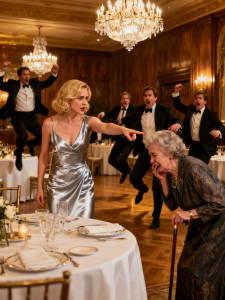
My daughter-in-law stood up so suddenly that her chair scraped sharply against the marble floor—an ugly, violent sound that sliced straight through the soft music and polite laughter filling the private dining room.
Every head turned.
The waiter froze mid-pour, the red wine hovering at the lip of a crystal glass like a drop of blood refusing to fall. The pianist in the corner didn’t stop playing, but his notes thinned, unsure, as if the room itself had taken a breath and forgotten how to exhale.
My wife sat beside me, her hands folded neatly on her lap the way she did when she was trying to make herself smaller. She wore the pearl earrings I gave her twenty-five years ago, and a navy dress she’d ironed herself because she still didn’t trust “those dry cleaners that charge you like they’re washing money.”
She looked beautiful. She looked gentle. She looked tired.
And my daughter-in-law pointed at her like she was pointing at a stain.
“Get up,” she said, loud enough for the whole room to hear. “And leave.”
There’s a particular silence that follows words like that. It isn’t the respectful kind. It’s the kind that happens when people realize they’re watching something they shouldn’t be watching, and they don’t know whether to look away or lean in.
My son’s face went slack, like a man watching a car accident in slow motion and still believing he might be able to stop it by thinking hard enough.
My daughter-in-law—Camille—didn’t look at him. She didn’t look at me. She kept her eyes locked on my wife, smiling the way someone smiles when they think they’ve finally won.
Camille had been practicing that smile since the day my son brought her home.
It was the smile of a woman who knew exactly how to behave in public and exactly how to punish in private.
My wife’s shoulders flinched. Not dramatically—just a small, instinctive jerk, like a body remembering a past it doesn’t talk about. Her fingers tightened together. I felt the tiny tremor in the air between us.
I didn’t say anything.
I didn’t clear my throat. I didn’t raise my voice. I didn’t ask Camille what she thought she was doing.
I simply turned to my wife and took her hand.
Her skin was cool. Her palm was slightly damp.
I squeezed once, the way I always did when words were too slow.
Then I pushed my chair back and stood.
The legs of my chair made the same scraping sound Camille’s chair had made—only mine wasn’t violent. Mine was final.
I helped my wife to her feet, as if we were leaving a concert early or stepping out for fresh air. As if this wasn’t a knife dragged across the middle of a family dinner.
Camille’s smile widened, confident.
That was the moment she thought she’d gotten what she wanted.
That was the moment she thought the room belonged to her.
I didn’t look at Camille.
I looked at my wife.
“Let’s go,” I said softly.
My wife blinked, confused. “But—”
“Let’s go,” I repeated, gentle but unmoving.
We walked away from the table.
And that was when Camille’s expression froze—because the most important guests quietly got up and followed us.
Not one. Not two.
Nearly all of them.
The mayor—who had shaken my wife’s hand earlier and thanked her for her scholarship fund—stood without a word and fell in behind us. The head of the hospital foundation rose next, his napkin still in his lap, his chair barely making a sound. Dr. Mehta, the surgeon whose daughter my wife had tutored for free when no one else had time, stood and pushed his chair in. Sister Agnes from St. Luke’s, who had once called my wife “the spine of this town,” crossed herself once and followed.
Even the restaurant owner—Luca, a man who treated our family like family because my wife once helped him keep his first tiny kitchen from going under—stepped out from behind the service station and joined the line.
It wasn’t dramatic. No one shouted. No one clapped. No one made a speech.
They simply rose, one by one, and walked away from Camille like the room’s oxygen had decided it didn’t belong to her anymore.
Camille’s face went through three emotions in two seconds: confusion, disbelief, and then something sharp and bright—panic.
My son stood halfway up, hands hovering uselessly, torn between wife and parents, between the life he’d chosen and the values he’d been raised in.
Camille’s voice cracked like a whip. “Where do you all think you’re going?”
No one answered her.
And that silence—people refusing to perform for her—was the first real slap she’d ever received.
We reached the double doors to the private dining room. My wife’s grip on my hand tightened.
“I’m sorry,” she whispered to me, as if she’d done something wrong by existing.
That whisper did something inside me.
It turned a quiet ache into steel.
I turned my head slightly. “You have nothing to be sorry for,” I said.
Behind us, Camille’s heels clicked fast and angry as she hurried after us.
“You’re embarrassing me!” she hissed, loud enough that several guests heard.
My wife’s shoulders curled inward.
I stopped walking.
I didn’t turn fully. I just paused—enough that Camille had to stop too.
Then I looked at her calmly.
“Embarrassment,” I said, voice low, “is what happens when your behavior is seen clearly.”
Camille’s lips parted. She wasn’t used to calm. She was used to arguments she could twist.
“You’re choosing her over me,” she snapped, jerking her chin toward my wife like she was pointing at a servant.
My son finally found his voice. “Camille—please—”
She whipped around on him. “No. Not ‘please.’ Not now.”
The room behind her was still full of plates and candles and expensive food—steaks resting in glossy sauces, a seafood tower sweating ice, a bottle of champagne waiting in a silver bucket like a celebration that hadn’t gotten the memo it was dead.
Camille’s perfect event—her perfect night—had just collapsed without anyone lifting a finger.
That’s when she did what people do when their control slips.
She tried to make it ugly enough that everyone would be forced to pay attention.
Camille stormed back into the dining room like a general returning to a battlefield, and she reached for the nearest object that could make a statement.
The champagne bucket.
She grabbed it with both hands and flung it—not at anyone’s head, but across the table.
Ice and champagne and condensation exploded everywhere.
The bucket hit the marble floor with a hollow bang and rolled, spilling melted ice and sticky champagne across the polished surface. A wave of cold liquid rushed under chairs and designer shoes.
A gasp rippled through the guests who hadn’t followed us yet.
Camille turned, breathing hard, eyes wild. “See?” she shouted, voice breaking. “See what you’re doing to me?”
My son stepped forward, panic rising. “Camille, stop.”
She shoved him.
Not a gentle push. A hard shove that made his shoulder slam into the edge of the table.
Plates rattled. Glassware tipped. A fork clattered to the floor and skidded into the champagne puddle.
The smell in the room changed—alcohol and seafood and something sour: the scent of a mask melting.
A waiter rushed forward, hands up. “Ma’am, please—”
Camille swung her arm, knocking a water glass off a tray. It shattered on the floor, sending glittering pieces across the champagne slick.
Someone swore softly.
Sister Agnes murmured, “Lord help us.”
My wife’s breathing turned shallow. I felt her start to tremble beside me.
Camille wasn’t done.
She reached for the seafood tower—a ridiculous, towering thing of oysters and shrimp and lobster on ice, the kind of centerpiece people buy when they want the world to know they can.
She yanked.
The whole tower lurched. Ice cascaded onto the tablecloth. Oysters slid like wet stones. Shrimp scattered, pink and slick, bouncing onto plates and laps.
One oyster—still in its shell—flew off the edge and hit the floor with a crack, releasing a briny, rotten smell that made more than one guest recoil.
It wasn’t blood. It wasn’t gore.
It was worse in a different way: spoiled luxury, wasted food, a tantrum dressed in perfume.
Camille screamed, “This is my family!”
And the room answered her with the sound of chairs scooting back.
Not following her.
Fleeing her.
The restaurant’s security finally stepped in, two men in black suits moving with the practiced speed of people who’ve seen rich people behave badly before.
“Ma’am,” one said firmly, “you need to calm down.”
Camille pointed at my wife with shaking rage. “She doesn’t belong here!”
My wife flinched again. Tears filled her eyes, but she held them back the way she always did—like crying was something you had to earn permission for.
That was it for me.
I stepped forward, not fast, not aggressive. Just present.
“Stop talking about her like she’s an object,” I said.
Camille’s face twisted. “Oh, now you’re defending her? After everything she’s done?”
I took a slow breath. “After everything she’s done,” I repeated softly, “she still came tonight with kindness in her hands.”
Camille’s voice rose. “She hates me!”
My wife finally spoke, voice small but clear. “Camille… I never hated you.”
Camille stared at her like she’d heard a lie.
Then Camille laughed—sharp, ugly. “Right. You just act like you’re better than me with your little charities and your fake humility.”
My wife blinked, stunned. “I—what?”
Camille leaned in, venom bright. “You know what you are? You’re the reason I’ll never be enough for this family. You’ve got everyone fooled with your sweet little saint act.”
I watched my son’s face as those words landed.
He looked like a man realizing the problem in his life wasn’t a misunderstanding.
It was a person.
He whispered, “Camille… what are you talking about?”
Camille snapped, “Don’t you start.”
My son’s voice trembled. “You told me you loved my mom.”
Camille’s eyes flashed. “I said what I had to say.”
That sentence hit the room like a dropped plate.
Because in one careless moment, Camille confessed what she’d always been: someone who performed love because it got her access.
My wife’s mouth parted slightly. She looked at my son—at the boy she’d raised, the man he’d become—and I saw something break in her expression. Not loudly. Quietly. Like a thread finally snapping after years of tension.
She turned to me, a single tear slipping down her cheek.
“I want to go home,” she whispered.
I nodded.
And the most powerful people in that room—people Camille thought she needed to impress—moved again.
Not toward Camille.
Toward us.
Luca, the restaurant owner, stepped beside me. “I’m sorry,” he said quietly to my wife. “This should never have happened here.”
The hospital foundation head looked at me, jaw tight. “If you want, I’ll call your driver,” he offered.
The mayor’s wife took my wife’s other hand gently. “You don’t have to stand there and take that,” she said, voice warm and fierce.
Camille watched them surround my wife with protection and respect, and her face did something strange.
It softened—not into remorse, but into the realization that she was outnumbered by decency.
Then she lunged again, desperate to regain control of something.
She grabbed my wife’s purse off the chair and yanked it up. “Fine,” she snapped. “Then take your stuff and go!”
The purse strap caught on the chair arm, and when Camille yanked harder, the chair toppled sideways into the champagne puddle, splashing dirty liquid—now mixed with oyster brine and shattered glass dust—across the hem of Camille’s own dress.
She shrieked, disgusted, wiping at her skirt like she could wipe away the moment.
But her hands smeared it worse.
My son stepped toward her. “Give her the purse.”
Camille swung it toward him. “No. You’re going to stand there and watch everyone abandon me?”
My son’s face tightened. “They’re not abandoning you. They’re walking away from your behavior.”
Camille’s eyes filled with furious tears. “I did this for us!”
“For us?” he repeated, voice rising. “You screamed at my mother and told her to leave. In front of—” He gestured wildly at the room. “Everyone.”
Camille’s mouth twisted. “Because she ruins everything!”
My son finally snapped—his voice cracking like a whip the way hers had earlier. “No. You do.”
Camille froze.
And in that freeze, I saw it: the moment she realized she could no longer control my son with flirtation and guilt. She’d pushed too hard. She’d shown him the teeth behind her smile.
Then Camille did what people do when they realize they’re losing.
She tried to hurt as many things as possible on the way down.
She flung the purse at my wife’s feet.
It hit the marble and spilled open.
Lipstick rolled out. A small pack of tissues. A pair of reading glasses. A little hand-sewn cloth pouch my wife kept—lavender inside because she said it calmed her nerves.
The pouch burst when it hit the wet floor.
Dried lavender spilled into the champagne brine like purple-gray dirt.
It smelled like bruised flowers and humiliation.
Camille stared at the mess she’d made and laughed again, shaking. “Look,” she said, voice cracking. “Even her purse is a disaster.”
My wife bent slowly, carefully—because her knees weren’t what they used to be—and started gathering her things.
I reached down first.
“Don’t,” my wife whispered, embarrassed, as if she still believed she had to be polite to cruelty.
I picked up the glasses and placed them gently in her hand. “You don’t clean up your dignity,” I said softly. “You hold it.”
The mayor’s wife crouched too, picking up the lavender pouch, tying it closed again with careful fingers like it mattered.
A stranger didn’t do that.
Only someone who respected you did.
Camille watched that kindness, and something in her face turned monstrous.
She grabbed a plate—still half-full of steak and sauce—and flung it at the wall.
It hit with a wet crack.
Dark sauce streaked down the cream wallpaper like a wound.
Pieces of meat slid to the floor.
The smell—rich, greasy, ruined—spread fast.
Guests gasped. One woman gagged quietly behind her napkin.
Security stepped in hard now, hands reaching for Camille’s arms.
Camille shrieked and tried to yank free.
My son moved toward her instinctively, then stopped—like he remembered every time he’d “managed” her tantrums and how those management tactics had only empowered her.
He stood still, eyes wide, and watched security escort his wife away from the wreckage she’d created.
Camille screamed over her shoulder, “You’re all against me!”
Nobody answered.
Because the room had already answered her.
With silence.
With distance.
With people choosing peace over her performance.
My son stood there, breathing hard, eyes glassy.
Then he looked at my wife.
His voice cracked. “Mom… I’m sorry.”
My wife’s lips trembled. She looked like she wanted to say something comforting—the way mothers do, even when they’ve been cut.
But she didn’t.
She just nodded once, small and broken.
And that nod—quiet acceptance without rescue—did something to my son’s posture.
He sagged. Like the weight of what he’d allowed finally landed.
I took my wife’s hand again.
We walked out.
And behind us, our “most important guests” followed—not as a show, but as a statement.
Camille wanted to exile my wife.
Instead, she exiled herself.
Outside, the hallway smelled cleaner. The restaurant’s main dining room carried on in soft, unaware conversation, the normal world continuing like a train that doesn’t stop for one family’s collapse.
In the lobby, Luca apologized again, eyes angry with embarrassment. “I’ll handle the bill,” he said quickly.
I shook my head. “No,” I said. “We pay. But not as a celebration.”
He understood immediately and nodded.
My wife’s breathing was still shallow. Her fingers were cold in mine.
When we reached the valet stand, my son appeared behind us, alone.
His tie was crooked. His eyes were red. He looked smaller than he had in years.
“Dad,” he said quietly.
I waited.
He swallowed. “I didn’t know it was that bad.”
My wife turned slightly, staring at him. There was no accusation in her face. Only sadness. That was worse.
“You saw enough,” she whispered.
My son flinched like she’d slapped him without lifting a hand. “I’m sorry,” he said again. “I—”
I held up a hand. “Don’t,” I said calmly. “Not here. Not now.”
His eyes darted between me and my wife. “What happens now?”
I answered honestly. “Now you decide who you are.”
He looked like he wanted to argue, but his voice failed him.
My wife squeezed my hand once.
“Home,” she whispered.
So we went home.
That night, my wife sat at our kitchen table in silence. She washed her hands three times like she was trying to scrub off the feeling of being pointed at.
I made tea. Chamomile, honey, the way she liked it.
When I placed it in front of her, she looked up at me with eyes that finally let the tears fall.
“I tried,” she whispered.
“I know,” I said.
“I never wanted him to choose me over her,” she said, voice shaking. “I just… wanted respect.”
I sat beside her. “Respect isn’t something you request from people like Camille,” I said quietly. “It’s something you remove yourself from when they refuse to give it.”
My wife stared into her tea like it might answer. “I feel embarrassed.”
I felt my chest tighten.
“Don’t,” I said firmly. “The only person who should feel embarrassed is the one who behaved like that.”
She nodded, but her mouth trembled. “She hates me.”
“She hates what you represent,” I corrected. “Because you can be kind without needing applause. And she can’t.”
My wife closed her eyes. “What if he stays with her?”
I didn’t lie. “Then we stop financing his denial.”
My wife’s eyes opened, startled. “You would—”
“I would,” I said, and my voice was calm because I’d already decided it in the moment Camille pointed. “Our son is a grown man. He can build his life. But he cannot build it on disrespecting you.”
She stared at me, and then she let out a shuddering breath—relief mixed with grief.
“I’m tired,” she whispered.
“I know,” I said again.
Three days later, my son came to our home alone.
No Camille. No excuses wrapped in perfume. Just him, standing on our porch with a face that looked like it had finally seen itself clearly.
He didn’t sit right away. He stood in the living room as if he didn’t know whether he deserved the couch.
“I left,” he said quietly.
My wife inhaled sharply.
He continued quickly, like he had to get the words out before his courage evaporated. “Not permanently—yet. But I told her she needs help. I told her she can’t speak to Mom like that ever again. I told her if she touches anything in our home, I’ll call the police. She—” He swallowed hard. “She threw a lamp at me.”
My wife flinched.
He looked at her, eyes wet. “I’m sorry,” he whispered. “I let it happen. I kept thinking I could smooth it over. I kept thinking if I worked harder, she’d be happier. I didn’t realize I was… sacrificing you.”
My wife’s hands trembled. “Why?” she asked softly. “Why didn’t you stop her the first time?”
My son’s face crumpled. “Because I thought love meant enduring,” he said. “And because she made me feel like if I didn’t defend her, I was betraying her.” He looked down. “I didn’t realize she’d trained me to confuse her rage with loyalty.”
I watched him carefully.
This wasn’t a man asking for forgiveness as a shortcut.
This was a man finally admitting the cost.
My wife stood slowly and walked toward him.
For a moment, I thought she might hug him.
Instead, she reached up and gently straightened his crooked tie—something she’d done for him since he was little.
Then she lowered her hand.
“You don’t get to buy back years with one apology,” she said softly. “But… you can start being better today.”
My son nodded, tears slipping down his face. “I will.”
“And Camille?” I asked calmly.
He swallowed. “I’m meeting with a lawyer,” he said. “And a therapist. Camille keeps calling everyone, telling them Mom humiliated her.” He laughed bitterly. “No one believes her. Everyone saw.”
He looked at me, voice cracking. “When the mayor stood up… when Dr. Mehta followed you… when Luca left his own restaurant to walk out behind you… I realized something.”
“What?” I asked.
He wiped his face. “I married someone who thinks power is who’s left at the table,” he said. “But you and Mom showed me power is who’s willing to walk away.”
My wife’s eyes filled again, but this time the tears looked different.
Not just pain.
Pride, trying to return.
Camille didn’t disappear quietly.
People like her never do.
She posted vague messages about betrayal and “being attacked.” She called relatives. She tried to rewrite the story into one where she was the wounded heroine and my wife was the villain.
But the truth had too many witnesses.
Witnesses with reputations she couldn’t intimidate.
The “most important guests” who followed us that night weren’t important because of money or titles. They were important because they were the kind of people others listened to.
And they listened—quietly, firmly—to the truth.
Months passed.
My son filed for separation. Camille tried to fight it, then tried to charm it, then tried to destroy it. But she couldn’t undo what happened in that private dining room.
She had revealed herself in a place she thought was safe.
She had pointed at my wife and demanded she leave.
And the room had answered, without violence, without shouting, without negotiation:
No.
On my wife’s birthday later that year, we went to a small restaurant with just a few friends. No marble. No private room. No performance. Luca sent over dessert anyway, on the house, because kindness recognizes kindness.
My wife wore her pearl earrings again.
Her shoulders were straighter.
Her laugh came easier.
And when she leaned close to me at the end of the night, she whispered something that made my throat tighten.
“I thought walking away meant losing,” she said.
I squeezed her hand. “It means you finally stopped letting other people decide your worth.”
She smiled—a real one, soft and bright—and for the first time in a long time, the blanket of peace didn’t feel like something we were begging for.
It felt like something we had chosen.
Để lại một phản hồi