Tuesday afternoons are supposed to be harmless.
They’re supposed to smell like warm laundry, stale coffee, and whatever baby lotion you overpaid for because the label promised “gentle.” They’re supposed to sound like the soft hum of a ceiling fan and the little hiccup-laugh your child makes when you kiss the fat part of her cheek.
arrow_forward_ios
Read morePause
00:00
00:24
01:31Mute
Powered by
GliaStudios
That Tuesday, sunlight spilled through the half-open blinds in Lily’s nursery, turning the dust in the air into glitter. Lily had just turned six months old, and she was in that golden stage where she wasn’t quite crawling but had opinions about everything—diaper changes included. She kicked her heels against the changing pad like she was drumming out her own protest song, her tiny socks slipping off one at a time.
“Okay, okay,” I told her, smiling even though my back ached. “You win. You’re the boss.”
She answered with that bubbling laugh that made me feel like maybe I could survive anything. Like maybe the way my family treated me when I was growing up—like I was always too sensitive, too dramatic, too much—was something I could finally outgrow.
They were visiting for the week. That was the mistake.
My parents had arrived the day before with enough luggage to survive an apocalypse and the kind of energy that instantly made the house feel smaller. My mother, Diane, had walked in and started “helping” without asking—rearranging my kitchen drawers, commenting on the dust on my baseboards, lifting Lily out of my arms like Lily was community property.
My father, Mark, had clapped me on the shoulder and called me “kiddo,” like I was still sixteen and couldn’t be trusted with a credit card.
And then there was my sister.
Jenna had always been the star of our family’s show. Two years younger than me, but somehow treated like she was the firstborn, the main event, the reason my parents had bothered to become parents at all. She had a laugh that made people lean in, and a habit of turning every room into her audience.
She also had a mean streak that she disguised as humor.
“It’s a joke,” she’d say, when someone’s face fell.
“Don’t be so dramatic,” my parents would add, like it was the family motto stitched into our DNA.
That Tuesday afternoon, Jenna was somewhere in the house, probably filming a “cute auntie moment” for her social media or checking her reflection in every dark surface. My parents were in the living room with the TV too loud, arguing about what to order for dinner like it was a United Nations summit.
I was in the nursery, doing what I always did—keeping Lily clean, fed, safe. Keeping my world small and manageable.
I finished wiping her down, tossing the diaper into the pail. Lily squirmed, impatient, her legs churning. I reached for the baby powder—an almost automatic motion, the kind you do without thinking.
The container sat where it always sat, on the top shelf of the changing table organizer. Same brand, same shape, same pale-blue cap.
I popped it open with one hand while I kept my other palm gently on Lily’s tummy.
“Just a little,” I murmured, tapping the bottle.
A soft cloud puffed into the air.
For half a second, I didn’t register what my eyes were seeing. The powder didn’t fall like it usually did—light, silky, almost invisible.
This was… heavier. Denser. It hit Lily’s skin in pale, chalky streaks.
It also smelled wrong.
Not the clean, baby-fresh scent I was used to. This smelled like… a pantry. Like dough.
I froze, bottle still angled.
Lily’s face changed before mine did. Her mouth opened like she wanted to complain, then she coughed—one sharp little cough that made my stomach drop.
Then another.
Her hands jerked, fingers splaying. Her eyes blinked hard, watery and wide, and she drew in a breath that didn’t sound like a breath at all.
It sounded like a tiny choke.
“Oh my God,” I whispered, and my voice came out thin.
I dropped the bottle onto the changing table. It bounced and rolled, scattering more of the pale dust into the air like smoke.
Lily coughed again, but it didn’t clear. Her chest fluttered. Her tiny face went from annoyed to startled to scared in a heartbeat, and then her mouth opened and no sound came out.
No cry.
No cough.
Just a silent, awful “O” of panic.
“Lily?” I said, too loud, too sharp. “Lily, breathe—baby, breathe.”
I scooped her up so fast her head bobbed against my arm. I turned her upright, patting her back, trying not to let my terror spill into my hands.
She didn’t respond.
Her eyes were still open, but they didn’t look at me.
Her lips began to shift—an unnatural dusky color that didn’t belong on my daughter.
My mind tried to bargain with reality.
She’s just startled. She’ll cry in a second. She’s messing with you. She’s—
And then her body went limp.
Something inside me broke cleanly in two.
I don’t remember crossing the hallway. I don’t remember how I got the phone. I only remember my own voice screaming into it like it belonged to a stranger.
“My baby—she’s not breathing—please—six months—please!”
The dispatcher’s voice was calm and firm, telling me to stay on the line, telling me help was coming, telling me to do things with my hands that felt impossible because my hands were shaking so hard they didn’t feel like mine.
I laid Lily on the floor because the nursery rug was the closest soft place and I couldn’t risk dropping her. I begged her with every word I had, like she could hear me through wherever she’d gone.
“Come back,” I sobbed. “Please, Lily, please, please—”
Somewhere behind me, footsteps pounded.
“What’s going on?” my mom snapped, like I’d spilled juice on the couch.
Then she saw Lily.
For once, Diane didn’t have a comment ready.
My dad appeared in the doorway, his face tightening. Jenna slipped in behind him, phone in hand, like she was looking for content.
“What did you do?” Jenna blurted, and the audacity of it—like I’d caused this—lit something in me so hot I thought I might catch fire.
“I didn’t—” I choked out. “Call 911—no, I already did—just—move!”
My mother dropped to her knees, hands fluttering uselessly. “Oh my God. Oh my God.”
My father stood frozen, like his brain couldn’t compute a crisis that wasn’t happening to him.
Jenna edged closer, peering. “Is she—like—”
“GET OUT!” I screamed. “GET OUT OF HERE!”
The dispatcher kept me anchored, voice steady like a rope. The world narrowed to Lily’s tiny body and the awful, endless seconds that stretched like years.
When the paramedics finally arrived, the sound of the siren was the most beautiful and terrifying thing I’d ever heard. They moved with a kind of practiced urgency that made my frantic movements feel childish. One of them gently but firmly guided me back while they took over.
I stood pressed against the nursery wall, my body buzzing like it had been plugged into an outlet, my eyes fixed on Lily as if staring could pull air back into her lungs.
I heard my own mother crying. I heard my father murmuring something about “how could this happen.”
And then I heard Jenna, in a small voice that was almost… amused.
“It was just flour.”
Everything stopped.
The paramedic nearest me flicked his eyes toward her, sharp and quick.
“What?” I rasped.
Jenna shrugged, like she was confessing to switching sugar with salt. “I swapped the baby powder with flour. Just as a joke. It’s funny, right? Like—because it puffs up more.”
I stared at her, certain I’d misheard. My ears rang. My stomach turned, heavy and cold.
“You did what?” I said, each word breaking apart.
Jenna’s face tightened, defensive now. “I didn’t think you’d actually use it that fast.”
My mother’s head snapped toward her. “Jenna—”
My father’s mouth opened and closed like he couldn’t decide whether to be furious or protective.
I looked at my sister—my sister, who had always been allowed to turn cruelty into comedy—and something in me went so still it felt like death.
Lily’s body was lifted onto a gurney. A paramedic told me to grab shoes and follow them. I stumbled, barefoot, into the hallway, my mind screaming one coherent thought over and over:
Please let her live.
The ride to the hospital was a blur of fluorescent lights and clipped voices and the suffocating fear that I was too late. I rode in the ambulance while my parents followed behind in their car. Jenna, I later learned, had insisted on coming too.
Of course she had.
At the emergency room, everything moved fast and slow at the same time. Someone put a wristband on me. Someone asked questions I could barely answer because my tongue felt swollen and useless. I signed forms with hands that didn’t feel attached to my arms.
I kept trying to see Lily. I kept asking where she was. They kept telling me “the team is working on her” like those words could fill the hole in my chest.
A doctor finally approached—young, tired eyes, calm voice. “Mom?”
I stood so fast my vision tilted. “Is she—”
“She has a pulse,” he said, and I almost collapsed from relief. “She’s breathing with assistance right now. We’re moving her to the pediatric ICU to monitor her closely.”
Breathing with assistance.
Not breathing on her own.
I nodded like I understood, like I wasn’t falling apart from the inside out. “Can I see her?”
“In a moment,” he said gently. “We need to stabilize her first.”
My mother grabbed my arm. “Thank God,” she whispered, crying. “Thank God.”
I stared at her hand on my skin and felt nothing but a deep, quiet rage.
In a family waiting room that smelled like antiseptic and burnt coffee, my parents tried to gather themselves, tried to shape the narrative the way they always did.
“It was an accident,” my dad said, pacing. “She didn’t mean it.”
My mom’s mascara had smeared into gray shadows. “Jenna is devastated.”
I looked across the room.
Jenna sat in a plastic chair, scrolling her phone, her face pinched like she was inconvenienced. When she noticed me looking, she rolled her eyes slightly, as if I was about to start another one of my “episodes.”
My hands curled into fists.
“You could’ve killed her,” I said, my voice low.
Jenna scoffed. “She’s fine.”
“She is not fine,” I snapped, and heads turned. I didn’t care. “She stopped breathing.”
Jenna lifted her chin. “I said I didn’t think it would—”
“Because you don’t think,” I cut in. “You never think. You just do things, and everyone laughs, and if someone gets hurt, you say it’s their fault for not taking a joke.”
My mother stood abruptly. “That’s enough.”
I laughed once—short, bitter. “Enough? My baby almost died.”
“She didn’t almost die,” Jenna muttered.
My vision tunneled.
My father stepped in, voice hardening. “Watch your mouth.”
“My mouth?” I repeated, incredulous. “My baby—”
“It was a prank,” he said, like that explained everything. “Jenna made a mistake.”
“A mistake is forgetting to buy diapers,” I said, my voice shaking now. “A mistake is putting a onesie on backward. This was—this was—”
My mother moved closer, her face severe. “You’re overreacting. She didn’t intend any harm.”
I stared at them.
It hit me with the clarity of a slap: they weren’t scared the way I was. They weren’t shattered. They weren’t even truly angry.
They were managing optics. They were managing Jenna.
And I was standing alone in the ruins.
“I’m calling the police,” I said.
My mother’s eyes widened like I’d announced I was joining a cult. “Don’t be ridiculous.”
“I’m serious,” I said, my voice steadier than I felt. “She tampered with my baby’s products. She caused my child to stop breathing.”
Jenna sprang up, laughing sharply. “Oh my God, you cannot be serious.”
My dad’s face flushed. “You are not doing that to your sister.”
“Watch me,” I said.
My father moved faster than I expected. One second he was in front of me, and the next his hand connected with my face.
The sound cracked through the room.
Pain flashed bright and hot, but the shock was worse. My cheek burned. My eyes watered instantly.
For a second, the whole world went silent except for the rushing in my ears.
My mother’s hand shot out—not to comfort me, not to stop him—but to grab my hair at the roots and yank me forward.
“Stop it,” she hissed, her nails digging into my scalp. “You are not ruining this family.”
She shoved me back, my shoulder hitting the wall hard enough to jolt my teeth.
I tasted metal.
Somewhere nearby, someone gasped. A nurse appeared in the doorway, her expression shifting from confusion to alarm in a split second.
“Ma’am,” the nurse said sharply. “Step away from her.”
My mother’s grip tightened, as if she could physically force me into obedience.
“I’m her mother,” Diane snapped, as if that gave her rights over my body at thirty years old.
The nurse didn’t flinch. “Security.”
The word carried weight.
My father took a step back, suddenly aware of witnesses. My mother released my hair with a jerk, smoothing her blouse like she’d just adjusted a curtain.
Jenna’s face had gone pale.
Security arrived quickly, along with another nurse and a man in scrubs who looked like he’d seen too much to be surprised by family ugliness anymore.
“Is everything okay here?” he asked, though his eyes were on me—on my reddening cheek, my shaking hands, the tear tracks I hadn’t noticed.
“No,” I said, my voice breaking. “Everything is not okay.”
The nurse guided me out of the room and into a hallway. “Do you feel safe?” she asked.
I looked back at the waiting room door like it was a barrier between me and a past I didn’t want anymore.
“No,” I whispered. “Not with them.”
She nodded once, like she’d already understood. “We can help you. If you want to make a report, we can call a social worker and hospital security can keep them away from you and your baby.”
My throat tightened. “Yes,” I said. “Please.”
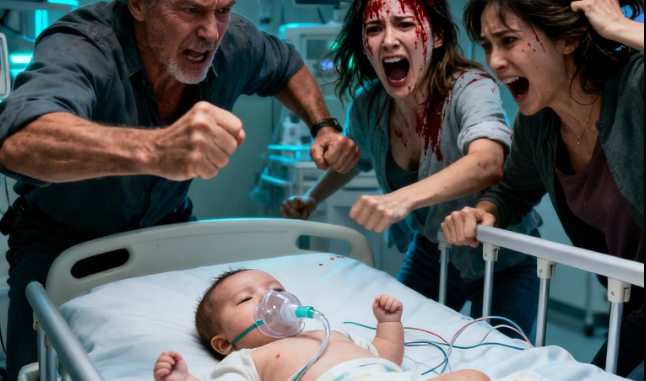
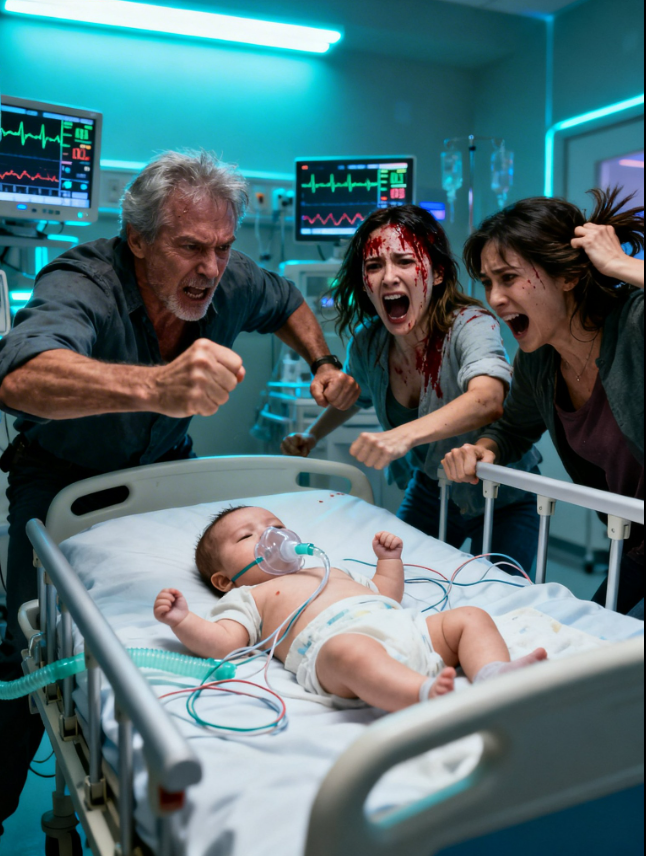
When I finally got to see Lily, she was in a hospital crib surrounded by machines. Tubes and wires made her look smaller, more fragile, like the world had swallowed her and spit her back out with damage.
Her eyes were closed. A soft hiss came from the oxygen support, steady and mechanical.
I stood beside her, my hand hovering above her tiny fingers, terrified to touch her and somehow make things worse.
“She’s stable,” the ICU nurse told me softly. “You did the right thing bringing her in quickly.”
I swallowed hard. “Will she be okay?”
The nurse’s eyes were kind, but honest. “We’ll know more in the next day or two. Right now, the goal is rest and observation.”
Rest.
Observation.
Words that meant time. Waiting. Fear with nowhere to go.
I kissed Lily’s forehead, careful around the tape. “I’m here,” I whispered. “I’m right here.”
A hospital social worker met with me an hour later. She listened while I told her everything—about Jenna’s “joke,” about my father’s slap, my mother’s hands in my hair. She didn’t interrupt. She didn’t minimize. She didn’t tell me to forgive.
When I finished, my voice raw, she said, “You’re not overreacting.”
The relief of hearing that—of having someone sane in the room—made me cry so hard I had to put my head in my hands.
A police officer arrived after that. He was calm, professional, and his presence made my parents’ power shrink to something manageable.
They tried to push into the ICU anyway, tried to demand access to Lily, but security stopped them at the door. For the first time in my life, my parents were told “no” by someone who didn’t care about their opinion.
I watched from inside the unit as my father argued with a uniformed guard. I watched my mother gesture wildly, her mouth twisted in outrage. I watched Jenna stand behind them, arms crossed, her face set in wounded indignation—like she was the victim of my cruelty.
The officer took my statement. He asked if I wanted to press charges.
I thought of Lily going limp in my arms.
“Yes,” I said, my voice steady. “I do.”
He nodded, writing. “And the assault?”
I touched my cheek, still tender. My scalp still ached where my mother had yanked.
“Yes,” I said again. “That too.”
When my parents were told they had to leave, the meltdown was spectacular.
My mother screamed in the hallway. My father demanded to speak to “someone in charge.” Jenna cried loudly enough for strangers to hear, insisting she “didn’t mean it.”
And through it all, I sat beside Lily, my hand finally wrapped around her tiny fingers, holding on like it was the only solid thing left in the universe.
That night, Lily’s breathing improved. Not dramatically, not magically, but enough that the nurse smiled when she checked the monitor.
“She’s fighting,” the nurse said. “She’s a tough little girl.”
“I know,” I whispered, tears sliding down my face again, but this time they weren’t only fear.
They were gratitude. And something harder.
Resolve.
The next morning, Lily opened her eyes.
They were still a little glassy, still tired, but when she saw me, her gaze focused—slowly, then sharply.
And then, like she was reminding me what mattered, her mouth pulled into the smallest, wobbliest smile.
I sobbed into her blanket.
My lawyer—because yes, I got a lawyer—filed for an emergency protective order that afternoon. The social worker helped me with paperwork and resources and a plan. The police officer returned to confirm charges: reckless endangerment for Jenna, assault for my parents.
When my mother called my phone, her name flashing on the screen like a warning, I didn’t answer.
When my father left a voicemail, his voice cold and furious, calling me “ungrateful” and “a liar,” I saved it for evidence.
When Jenna texted, I can’t believe you’re doing this to me, I didn’t respond.
Instead, I wrote one message, the only one they would get from me:
You are not allowed near my child. Do not contact me again.
Then I blocked them all.
Two weeks later, Lily came home.
She was smaller than she’d been before the hospital, like the ordeal had stolen something from her body. But she was breathing on her own. She was eating. She was awake and curious and still, somehow, able to laugh when I made stupid faces at her in the kitchen.
On our first night home, I sat on the living room floor with Lily in my lap, the house quiet in a way it hadn’t been in weeks.
I stared at the spot on my cheek where my father’s hand had landed. The bruise had faded, but the memory hadn’t.
I thought about the years I’d spent trying to earn my parents’ love. Trying to be easier, quieter, more forgiving. Trying to make Jenna’s cruelty roll off me like water.
I thought about how close Lily had come to not coming home at all.
And I realized something so plain it felt like it should’ve been obvious my whole life:
If someone can hurt your child and still demand your forgiveness, they don’t love you. They love control.
In the months that followed, Jenna’s case moved through the system. She cried in court. My parents showed up behind her like bodyguards, glaring at me like I was the villain in their story.
But in that courtroom, under fluorescent lights that made everything look too real to deny, Jenna had to answer to someone who didn’t care about her charm.
The judge listened to the facts. The swapped container. The timing. The hospital report. The officer’s notes about my bruises.
When the judge said the words “reckless endangerment,” Jenna’s face finally cracked—not into tears for Lily, not into remorse for what she’d done, but into fear for herself.
My parents tried to speak. They tried to excuse. They tried to rewrite.
The judge shut them down.
And for the first time, I watched my family’s old power fail.
Jenna received probation and mandatory counseling, along with a no-contact order with Lily and me. My parents’ assault charges resulted in court-ordered anger management and a restraining order that kept them away from my home.
It wasn’t perfect justice. It didn’t erase what happened.
But it drew a line. A hard, legal, undeniable line.
The day the restraining order was finalized, I drove home with Lily in her car seat behind me. She babbled to her stuffed elephant, completely unaware that the world had changed.
At a stoplight, I looked at my reflection in the rearview mirror—my own eyes, tired but clear.
I wasn’t the daughter in their story anymore.
I was Lily’s mother.
And I would rather be called heartless by everyone who ever enabled them than let my child grow up learning that love means swallowing pain.
That night, I put Lily to bed in her nursery. The blinds were half-open, and dust motes drifted in the soft light like tiny stars.
I stood over her crib for a long time, watching her chest rise and fall—steady, real, miraculous.
“I’ve got you,” I whispered. “No matter what.”
Lily sighed in her sleep, peaceful.
And for the first time since that Tuesday afternoon, my own lungs finally remembered how to breathe.
THE END
Để lại một phản hồi