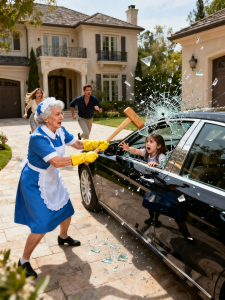
She Said “Five Minutes.” The Millionaire’s Girlfriend Laughed in the Shade—While a Little Girl Suffocated in a Locked Luxury Car, and the Cleaning Lady Was the Only One Who Acted

She said she’d only be gone for “just five minutes.”
Not “five minutes” the way a timer means it. Not the honest kind of five minutes that includes a quick errand and a quick return.
The kind people say when they want the world to stop demanding accountability.
“Just five minutes,” the woman chirped, already half-turned away, phone pressed to her ear like it was a crown. She had sunglasses the size of dinner plates and a laugh that landed sharp and easy, like she’d never once had to check behind her for consequences.
The little girl in the back seat—no more than six—waved a small hand through the tinted glass. Her bracelet caught the sun and flashed once like a signal.
Then the door shut.
Click.
And the luxury car—black, polished, gleaming like a promise—swallowed the sound.
Across the parking lot, the air shimmered with heat. It was one of those summer afternoons where even the shadows felt tired. The shopping plaza sat like a mirage: designer boutique on one end, a sleek café with white umbrellas on the other, and a fountain in the center that looked expensive enough to have a personality.
I was on my knees near the entrance, scrubbing gum off the sidewalk with a plastic scraper that had seen better decades. My name tag said MARA, but most people didn’t read it. They rarely looked down long enough to notice names on uniforms.
I wasn’t really supposed to be there. Officially, my shift ended at two. Unofficially, my supervisor had glanced at a smear on the glass doors and said, “Can you just… handle it?” the way managers say “just” when they mean “I don’t care about your time.”
So there I was, in a faded blue cleaning vest, the smell of citrus solution in my nose, sweat collecting at the base of my spine.
When the woman shut the car door, I noticed the child because I always noticed children.
Not because I was a saint. Because I used to be one.
I used to be small in a world full of adults who moved too fast and assumed they were right. I used to be the kid no one kept track of because everyone was too busy showing off.
I learned early: if you’re invisible, you learn to watch.
The woman—maybe late twenties, maybe early thirties—crossed to the café’s patio and leaned into a circle of people like they were her natural habitat. A man in a crisp linen shirt stood up to kiss her cheek, laughing like he’d been waiting for her entrance.
He didn’t look like a husband. He looked like a man who bought time the way other people bought coffee.
Behind them, a security guard stood near the boutique entrance, scanning the lot with the bored posture of someone paid to look serious. He was big, clean uniform, belt full of equipment that suggested authority.
And yet.
The only one who truly saw the little girl was me.
At first, she looked fine. She was strapped into a booster seat, hair in neat pigtails. She had a small cup in her lap, the kind with a straw. Her head turned slowly, watching her caretaker walk away.
She tapped the window once with the flat of her palm. Not panicked. Not yet. More like: Hey, don’t forget me.
I stood up, wiped sweat off my forehead with my sleeve, and watched for what happened next.
Nothing.
The woman didn’t turn back.
The circle at the café closed around her like a curtain. Someone offered her a drink. Someone handed her a phone with a picture of a dress on it, and she squealed like the dress was the most urgent matter in the universe.
I went back to scraping gum, but my eyes kept sliding to the car.
The sun hit the windshield and turned it into a magnifying glass.
The air in the parking lot felt thick, heavy, like you could chew it.
Five minutes passed.
Then ten.
By fifteen, the little girl wasn’t waving anymore.
She was squirming.
Her face pressed close to the window, cheeks smearing the tint. Her small hand reached for the door handle, tugging, pulling, testing. Locked.
I dropped my scraper.
I walked closer, pretending I was just picking up trash. I did it the way people in my job learn to move—quiet, unannounced, like a ghost. My shoes squeaked on the hot pavement.
Up close, I could see it: her breathing was faster. Her lips parted. Her eyes were bright in a way that had nothing to do with excitement.
She lifted her cup and tried to sip. The straw bent. She shook it, frustrated. The cup was empty.
She looked out at me, and our eyes met through the tint.
I don’t know what she saw—maybe my uniform, maybe my tired face, maybe just another adult.
But I saw her clearly.
A child trapped inside a locked car.
A child who did not understand why the world had abandoned her.
I knocked on the window lightly, then pointed to myself and mouthed, “It’s okay.”
She stared, confused.
Then she lifted her hand and pressed it against the glass.
Her palm was tiny.
Hot air pooled in the car like invisible water.
I stood there for a second too long, because my brain wanted to believe there was an easy fix. There’s always a moment where you tell yourself, Maybe someone else will notice. Maybe she’ll be back any second.
Then the girl’s head tilted back, and I saw the panic finally arrive—quiet, creeping, the way it does when a child’s body realizes something is wrong before her mind can name it.
I turned and headed toward the café patio.
I didn’t run. Running makes people ignore you. Running makes you look dramatic.
I moved with purpose.
“Excuse me,” I said as I approached the table. My voice came out steadier than I felt. “Ma’am?”
The woman didn’t look at me. She raised one finger like she was training a dog. “Hold on,” she said into the phone, then covered the speaker with a manicured hand and glanced at me like I was a smudge.
“Yes?”
“Your child is locked in your car,” I said. “It’s very hot. She’s—she’s struggling.”
The circle went quiet in that quick, awkward way rich people get quiet when reality interrupts leisure.
The man in linen raised his eyebrows like I’d delivered a rude review.
The woman laughed once. “She’s fine,” she said. “It’s like… five minutes.”
“It’s been longer than five,” I said. I kept my voice respectful, because disrespect gives people excuses. “She needs to be out of the car now.”
The woman rolled her eyes and waved her phone like a wand. “Relax. The AC is on.”
I looked at the car. I could see the sunlight blazing on the hood. I could see the child’s face pressed to the glass.
“I don’t think it is,” I said. “And even if it was—she’s alone. She’s scared.”
One of the women at the table—perfect hair, perfect teeth—made a face like she’d smelled something unpleasant. “Is this… your business?”
I turned my head and looked at her. “It’s everyone’s business when a child can’t breathe.”
The millionaire-looking man leaned back, amused. “She can breathe. Look at her. She’s sitting.”
My jaw clenched. “She’s overheating. She’s trapped.”
The woman with the phone sighed dramatically as if I were a customer complaint. “Okay, okay. You can stop with the performance.”
Performance.
That word hit me like a slap. Because people like her always call urgency “performance” when it makes them uncomfortable.
I turned and pointed—open hand, no accusation—toward the car.
“Please,” I said. “Come now.”
She glanced over her shoulder, squinting into the sun, and finally saw the small shape in the back seat.
Her smile flickered.
But it didn’t become concern.
It became irritation.
“God,” she muttered. “Why is she making that face?”
I stared at her. “Because she’s in danger.”
The woman stood up slowly, like she was doing me a favor. The chairs scraped. Her friends watched like this was entertainment.
She strutted toward the car, still talking into her phone.
When she reached the door, she tugged the handle once.
Nothing.
Her brows drew together.
She tugged again.
Nothing.
She patted her purse, then laughed nervously. “Hold on.”
She looked back at the patio table, then at me, then at the car again. She finally ended the call, annoyance turning into something sharper.
“My keys,” she said.
The man in linen stood, casual. “Babe, did you leave them inside?”
She gave a tight smile. “No.”
She checked her purse again. Then her face went pale.
“I—” she started.
I didn’t wait for her pride to catch up to her panic.
“Call security,” I said. “Now.”
The woman snapped at me, voice rising. “Don’t tell me what to do.”
I turned and shouted to the security guard near the boutique. “Hey! Child locked in car! We need help now!”
The guard looked over, annoyed at first, then saw the cluster of people and started walking slowly, the way some men walk when they’re deciding whether an emergency is worth their energy.
The woman yanked her purse open and dumped it onto the hood of the car.
Lipstick.
Card holder.
A small perfume bottle.
Loose cash.
A designer keychain.
No keys.
Her friends drifted closer, voices rising, a chorus of useless commentary.
“Did you check the other bag?”
“Why would you lock her in there?”
“It’s not that hot.”
The little girl started crying now—silent at first, then louder. Her hands slapped the glass. Her face was red.
The guard finally arrived and looked into the back seat. His posture changed—slightly. Not enough.
“What’s going on?” he asked.
“She locked her kid in the car,” I said.
The woman whirled. “I did not lock her in! The door—like—shut. It’s a malfunction.”
The guard looked at the handle, tried it. “It’s locked.”
He turned to the woman. “Do you have the keys?”
“I’m looking,” she snapped, panicked and angry in equal measure.
I stepped closer to the window. The child’s breath fogged the glass in quick bursts.
I’d seen that look before.
Not in a car.
In a bathroom stall at a diner when I was a kid, locked in by accident while adults laughed and said, “She’ll figure it out.”
I wasn’t laughing now.
I turned to the guard. “We need to break the window.”
The guard stiffened. “Ma’am, we can’t just—”
“She’s overheating!” I said, louder. “You can see she’s overheating!”
The guard raised his hands like he was negotiating. “We need to call the police. Or the owner. Or—”
“While she suffocates?” I snapped before I could stop myself.
The woman’s friend gasped, offended. “That’s dramatic.”
I looked at her with pure disbelief. “Do you hear yourself?”
The guard pulled out his radio, slow, and spoke into it like he was ordering a sandwich.
The woman started screaming at her phone, calling someone—probably the driver, probably the man with money who made her feel untouchable.
The girl’s crying became frantic.
Her small body slumped sideways for a second, like her muscles were giving up.
That was it.
The ice in my chest turned into steel.
I grabbed the metal trash can near the entrance—the kind bolted to a stand but loose enough to lift if you’re desperate. It was heavy. My arms strained.
The guard shouted, “Ma’am, stop!”
I didn’t stop.
I dragged the can across the pavement, the metal scraping loudly, drawing every eye in the parking lot.
The millionaire’s girlfriend shrieked. “What are you doing?!”
“Saving her,” I said through clenched teeth.
I lifted the trash can and swung it toward the back passenger window—aiming low, away from the child’s face.
The guard lunged, grabbing my arm.
The trash can clipped the car and dented the door with a sickening thunk instead of breaking glass.
My shoulder jolted. Pain shot down my arm.
The guard shoved me back. “Are you insane? That’s property damage!”
I stared at him, breathing hard. “That’s a child.”
He held my arm like I was the threat. “Step back!”
The woman screamed, high and ugly. “Oh my God! You broke my car!”
I pointed at the child. “Your car can be fixed!”
The girl’s cry turned weak.
The air around us seemed to thicken with panic and stupidity.
And then the woman did something that made my stomach twist.
She shoved me.
Hard.
Not a gentle push. A full-bodied shove fueled by rage and humiliation.
I stumbled into the trash can stand, my hip slamming metal. Pain flared.
“Don’t touch me,” I said, voice low.
She shoved again, screaming, “You’re ruining everything!”
The guard didn’t grab her.
He grabbed me—again—like it was easier to restrain the cleaning lady than confront the rich woman.
Something in me broke loose.
Not into violence.
Into clarity.
I twisted my arm free and shouted, “Back off me! Help the CHILD!”
The crowd had grown—shoppers, employees, people with phones out recording like it was a show.
A man in a polo shirt stepped forward, holding his phone up. “I’m calling 911.”
“Do it!” I yelled.
The little girl sagged in her seat, head tipped. Her eyes were half-lidded.
My heart pounded.
The guard finally looked scared—not of me, but of the reality he’d been trying to delay.
He reached for his baton, then hesitated.
A boutique employee ran out with a small hammer used for emergency glass cases. “Use this!” she shouted, thrusting it forward.
The guard grabbed it.
The millionaire’s girlfriend screamed, “No! Don’t you dare!”
The guard ignored her—finally.
He struck the window once.
Glass spiderwebbed.
He struck again.
The window shattered inward with a crash, glittering shards falling onto the seat and pavement.
Hot air rushed out like a released breath.
The girl coughed, a thin, desperate sound.
The guard reached in and fumbled with the lock, yanking the door open.
The woman lunged forward. “My baby!”
I stepped between her and the door without thinking.
“Let them take her out safely,” I snapped.
The woman slapped at my arm, nails scraping my skin. “Move!”
The guard, now frantic, unbuckled the child and lifted her out carefully, cradling her limp body.
A horrible hush fell.
The girl’s face was red and slick with sweat. Her hair clung to her forehead. Her lips were dry. Her eyes fluttered.
The boutique employee grabbed bottled water, twisting the cap off. “Ambulance is coming,” she said, voice shaking.
The millionaire’s girlfriend started wailing—not concern, not remorse—wailing like her reputation was bleeding.
“I was only gone five minutes!” she sobbed.
The people around us didn’t buy it.
Someone shouted, “It was way longer!”
Another voice: “You were laughing the whole time!”
The woman’s friends tried to form a protective circle, but the crowd pressed in, angry now.
That’s when it turned into a different kind of ugly.
The millionaire’s girlfriend swung her purse like a weapon at the boutique employee, screaming, “This is your fault! You gave them the hammer!”
The purse caught the employee’s shoulder. The employee yelped, stumbling back into a display rack near the entrance.
A decorative stand toppled, scattering brochures and small glass ornaments across the pavement. One shattered. The sound was sharp and nasty.
The guard shouted, “Ma’am! Stop!”
The woman’s friend grabbed the employee by the wrist and shoved her. “Don’t touch her! Don’t—”
The employee shoved back.
Someone else shoved someone else.
A chair from the patio area got knocked over as people stumbled.
The scene turned chaotic—bodies pushing, voices screaming, phones recording, the air thick with sweat and perfume and outrage.
Disgusting.
Not because of blood.
Because of how quickly people would rather fight to protect status than admit wrongdoing.
I turned away from the chaos and looked at the little girl.
The guard had laid her gently on the pavement in the shade near the boutique entrance. The boutique employee knelt by her, fanning her with a magazine. Someone held an umbrella to block the sun.
The girl’s chest rose and fell fast.
Her eyes opened a sliver.
She looked around, confused, then her gaze found me.
Even in that dazed moment, she stared at me like she recognized the one face that had been watching her from the beginning.
I knelt beside her and kept my voice soft.
“You’re okay,” I whispered. “You’re okay now.”
Her small hand lifted weakly, fingers searching.
I offered my hand, palm up.
She placed her fingers in mine.
They were hot.
A police siren wailed closer.
The millionaire’s girlfriend was still screaming behind us, now at the security guard, now at the crowd, now at the universe.
“I’m suing! I’m suing all of you! You broke my car!”
The guard barked, “Ma’am, step back!”
Someone shouted, “What about the kid?!”
An older woman in the crowd hissed, “Shame on you.”
The millionaire’s girlfriend turned, eyes wild, and screamed, “You don’t know me!”
And that’s when I knew—deep in my bones—that she was right.
We didn’t know her.
We only knew what she chose when she thought no one important was watching.
The ambulance arrived in a rush of doors and red lights. Paramedics jumped out, professional and calm in a sea of chaos.
They assessed the girl, placed cool packs, checked vitals. One paramedic looked up sharply at the woman.
“How long was she inside?” he demanded.
The woman sobbed louder. “Five minutes!”
The paramedic’s stare was flat. “Ma’am. I need an honest answer.”
The crowd murmured.
The boutique employee spoke up, voice trembling but clear. “At least twenty. Maybe thirty.”
The woman’s friends started shouting, “That’s not true!”
The paramedic ignored them and lifted the girl onto a stretcher.
The girl’s fingers loosened from mine as she was moved.
I stood slowly, legs shaky.
A police officer approached me. “Ma’am, did you witness what happened?”
“Yes,” I said.
He looked at my uniform. His eyes flicked to my name tag. For a moment, he seemed surprised I was someone worth asking.
“What’s your name?”
“Mara,” I said.
He nodded, pulling out a notebook. “Tell me everything from the beginning.”
So I did.
I described the “five minutes.” The phone call. The laughter in the shade. The locked doors. The guard hesitating. The woman shoving me. The crowd growing. The window breaking. The child’s condition.
As I spoke, the officer’s face hardened.
Not at me.
At the facts.
Behind him, the millionaire’s girlfriend’s voice rose again, shrill. “This is harassment! That cleaning lady attacked me!”
The officer turned and said sharply, “Ma’am, you need to calm down and step aside.”
She pointed at me, eyes full of hatred. “She damaged my car!”
The officer’s voice didn’t change. “Your child was in medical distress.”
The woman blinked, shocked that the universe wasn’t bending to her.
Her boyfriend—the linen-shirt man—finally stepped in, jaw tight, trying to regain control. “Officer, we can handle this privately.”
The officer looked at him. “This isn’t private.”
The boyfriend’s smile flashed, tight. “You don’t understand. There are… circumstances.”
The officer’s expression didn’t budge. “I understand a child was trapped in a locked vehicle in extreme heat.”
The boyfriend’s eyes narrowed. He tried again, softer. “Let’s be reasonable.”
The officer gestured toward the ambulance. “Reasonable is what she should’ve been.”
The crowd murmured approval.
The millionaire’s girlfriend looked around, realizing the audience wasn’t hers anymore.
Her face twisted into something ugly.
She lunged toward me again like she needed a target to blame.
But the officer stepped between us, hand raised. “Ma’am, stop.”
She tried to shove past him.
He grabbed her wrist and held her firmly.
She screamed like she was the victim.
The officer didn’t flinch.
That was the moment the entire scene shifted.
Because power only works when everyone agrees to it.
And finally, people weren’t agreeing.
The police separated the crowd. They took statements. They photographed the broken window and the dented door. They asked the guard why he hadn’t acted sooner, and the guard’s face went pale as he tried to explain “protocol.”
The boutique employee—her name was Jessa—stood beside me, still shaking.
“You did the right thing,” she whispered.
I looked at her, then at the ambulance pulling away with the little girl inside.
“I should’ve broken the window sooner,” I said.
Jessa shook her head. “You tried. They stopped you.”
I stared at the dent in the door where my first swing hit. “I let them make me hesitate.”
Jessa’s voice was bitter. “People always hesitate when it’s a poor person yelling.”
That sentence landed heavy, because it was true.
The officer came back to me. “We may need you to testify,” he said. “What you did—trying to intervene—matters.”
I nodded, throat tight. “Is the girl okay?”
He glanced toward the ambulance’s direction. “She’s alive. They got her out in time.”
Time.
Five minutes.
Ten minutes.
Thirty minutes.
The numbers felt like knives.
As the crowd dispersed, the millionaire’s girlfriend’s friends started packing up their bags, eyes down, trying to evaporate before accountability could stick to them.
The boyfriend spoke quietly to an officer, still trying to tilt the world with money.
But the officer wasn’t tilting.
Maybe the heat made everyone raw enough to see clearly.
Maybe the sight of a limp child on the pavement broke the spell.
Or maybe—just maybe—people were tired of watching cruelty hide behind luxury.
My supervisor arrived late, as supervisors always do, rushing over with wide eyes.
“Mara!” he hissed. “What happened? Why is there police—why is there an ambulance—”
I looked at him. “A child was locked in a car.”
He blinked, then looked at the broken glass and dent. His face tightened—not with concern for the child, but with concern for the property, the client, the reputation.
“Oh my God,” he muttered. “This is going to be a nightmare.”
I stared at him, stunned. “A child almost died.”
He swallowed. “Yes, yes, of course, but—”
“But what?” I demanded, louder than I meant to.
He flinched. He looked around, realizing people were watching him now too.
He lowered his voice. “You can’t just—swing a trash can at someone’s car.”
I stared at him. “Would you rather I watched her pass out?”
He opened his mouth, then closed it.
Because in that moment, he didn’t have a script that made him look good.
The officer overheard and turned sharply. “Ma’am did what she could. If anyone failed here, it wasn’t her.”
My supervisor’s face went stiff. “Officer, we appreciate—”
The officer cut him off. “Do you?”
Silence.
My supervisor looked away.
I felt something inside me settle—something old and weary.
This wasn’t the first time I’d watched people step over someone invisible.
It was just the first time the invisible person refused to stay quiet.
Later, hours later, after statements and reports and the crowd finally thinned to regular shoppers who stared at the broken glass like it was gossip, I sat on the curb in the shade and drank water with shaking hands.
Jessa sat beside me.
“My knees won’t stop wobbling,” she admitted.
“Mine either,” I said.
We sat in silence for a while, listening to the fountain splash in the distance, absurdly calm.
Then Jessa said quietly, “You know what’s messed up?”
“What?”
“She didn’t even look at her kid,” Jessa said. “Not once. Not until she needed a reason to scream.”
I swallowed. “I saw.”
Jessa stared at the parking lot. “And everyone just… walked past.”
I looked down at my scuffed shoes. “Not everyone.”
Jessa nudged my shoulder gently. “Yeah. Not you.”
The sun shifted. The heat softened slightly.
My phone buzzed—a text from my own daughter’s babysitter asking if I was still picking her up at six. I stared at the message, heart clenching.
I typed back: Yes. I’m on my way soon.
Jessa glanced at my phone. “You have a kid?”
“Yeah,” I said.
Her eyes widened. “God. That must’ve made it worse.”
I nodded slowly. “It made it real.”
Because the truth is, when you’ve had someone look at you like you don’t matter, you start to recognize the moment it happens to someone else.
And you either walk past.
Or you stop.
I picked up my cleaning vest from beside me and stood, joints aching, shoulder still throbbing from the trash can swing.
My supervisor approached again, tentative. “Mara…”
I didn’t look at him.
He cleared his throat. “Corporate might… ask questions.”
I turned my head, calm now. “Good.”
He blinked. “Good?”
“Yes,” I said. “They should.”
He looked uncomfortable. “You might’ve put us in a difficult position.”
I stared at him. “A child was in a difficult position.”
He opened his mouth, then shut it again.
I walked away.
As I crossed the parking lot toward the employee entrance, I glanced once at the luxury car. The broken window gaped like a wound. The dented door caught the sun at a harsh angle.
The car looked ruined.
But it wasn’t ruined.
It was exposed.
And so was she.
Somewhere in a hospital, a little girl was breathing air that hadn’t been trapped inside leather seats and tinted glass.
That mattered more than any car.
That night, when I picked up my daughter from the babysitter, she ran into my arms and asked, “Mom, why do you smell like lemons?”
I hugged her tight, tighter than usual, and said, “Because I was working hard today.”
She leaned back and looked at my face. “Are you okay?”
I smiled, but it wobbled. “Yeah. I’m okay.”
In the car, she chattered about a cartoon she watched and a cookie she ate and a game she played.
Normal kid stuff.
Life.
When we got home, I tucked her into bed. She yawned and grabbed my hand.
“Tell me a story,” she mumbled.
I looked at her small fingers wrapped around mine and felt my throat tighten.
So I told her a story—not the whole ugly truth, not the shouting, not the broken glass. Just the lesson.
I said, “Once there was a little girl who got stuck, and everyone was too busy to notice… but one person did. And that person helped.”
My daughter’s eyes fluttered. “Was the helper a superhero?”
I laughed softly. “No. Just a person who paid attention.”
My daughter squeezed my hand once, sleepy. “I wanna be like that.”
I kissed her forehead. “You will.”
After she fell asleep, I sat at my kitchen table and stared at my bruised hip and torn sleeve, and I realized something that made my chest feel both heavy and bright:
People walk past cleaning ladies because they think invisible work means invisible people.
But today, the invisible person saw what everyone else refused to see.
And because of that, a child lived.
The next morning, my phone rang.
Unknown number.
I answered cautiously. “Hello?”
A woman’s voice—tired, older—said, “Is this Mara?”
“Yes,” I said, heart thudding.
“This is the hospital,” she said. “You gave your name to the paramedics. The little girl’s stable. Dehydrated, overheated, but stable.”
I closed my eyes, relief flooding me so hard my hands shook. “Thank God.”
The woman hesitated. “She kept asking for… the lady in blue. The one who looked at her.”
My throat tightened. “Is she… is she okay emotionally?”
The woman’s voice softened. “Scared. But she’s safe. Social services is involved.”
I nodded even though she couldn’t see it. “Good.”
Before hanging up, the woman added, quietly, “Thank you for not walking past.”
When the call ended, I sat very still.
Because I knew what would happen next.
The millionaire’s girlfriend would hire lawyers. She’d claim she was “distracted.” She’d blame the car. She’d blame everyone except herself. People in her world would try to smooth it over.
And my supervisor would probably ask me to “keep quiet.”
But I’d already decided something the moment I saw that small hand press against the glass.
My war wasn’t with her alone.
It was with the world that kept letting people like her get away with it because they wore expensive clothes.
So if they asked me to testify, I would.
If they tried to blame me for “damaging property,” I’d tell the truth anyway.
If my job punished me, I’d still know what I did mattered.
Because when the air runs out, there’s no such thing as “just five minutes.”
There’s only the moment someone notices.
And the moment someone acts.
And the moment a little girl learns—maybe for the first time—that even if the world walks past you, someone can still see you.
That day, I was the one who saw her.
And I would live with the dented door and the broken glass for the rest of my life if it meant she got to live at all.
Để lại một phản hồi