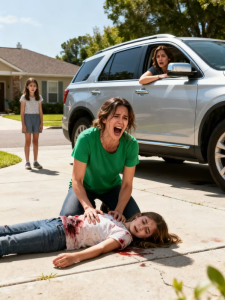
They Laughed Off the Tire on Her Hand—Until X-Rays Exposed Old Breaks, and My Mother’s “Perfect Family Day” Shattered in Public

The driveway was full the way my childhood always looked from the outside—busy, cheerful, convincing.
Mom had her “family day” voice on, the one she used when neighbors might hear: bright and sing-song, like nothing ugly had ever happened under her roof. A grill smoked in the backyard. Plastic cups clinked. Somebody’s speaker played country pop just loud enough to feel festive, not loud enough to feel like a party. From the curb you could’ve sworn this was a normal family, the kind that took photos and said grace and argued about harmless things like whether hot dogs counted as dinner.
I stood there with my keys still in my hand, staring at the scene like it was a painting I’d seen a thousand times—pretty from far away, warped up close.
My daughter, Lila, stayed pressed to my side. She was six, wearing the pink sneakers she loved so much she begged to sleep in them, her fingers wrapped around mine with a grip that said more than any sentence ever could. My husband, Grant, had the casserole balanced in both arms like it might explode if he breathed wrong.
Mom swept toward us with her smile already in place. “There she is!” she called, loud enough for Aunt Connie on the patio and loud enough for Mr. Halvorsen next door who always watered his lawn like it was his job. “My girls! Come here!”
My girls. She said it like she owned the phrase.
Lila’s grip tightened.
Grant leaned down, murmuring, “You can stay right by me, kiddo.”
Mom’s eyes flicked to him—just a flash, quick as a knife. She didn’t like Grant. Not because he’d ever disrespected her. Because he didn’t worship her.
“Lila,” Mom said, dipping into a sugary tone. “Come give Grandma a hug.”
Lila didn’t move. She stared at Mom’s shirt buttons like they were more interesting than her face.
Mom’s smile held, but the muscles around her mouth went stiff. “Don’t be rude,” she said softly, still smiling. “Grandma missed you.”
“I’m staying with Mommy,” Lila whispered.
Mom laughed—a light, airy sound designed for witnesses. “Oh honey, your mommy worries too much. Come on.”
Grant cleared his throat. “She said she’s staying.”
Mom’s smile dropped for half a second. “I wasn’t talking to you, Grant.”
There it was—the line in the sand. It had always been there. In Mom’s world, men were welcome as long as they didn’t challenge her. Daughters were welcome as long as they didn’t resist her. Grandchildren were welcome as long as they didn’t have boundaries.
I forced my own smile, the one I’d learned like a survival skill. “We’re happy to be here,” I said.
“Good,” Mom chirped. “Because today is about family.”
That word—family—landed in my stomach like a stone.
We walked in. We sat where we were told. We made the right small talk. Everyone looked normal. My dad flipped burgers with the same slow confidence he used to flip away conflict. My brother, Evan, wandered around with a beer and a grin, acting like the charming neutral party who never had to choose a side because he was never the target. My sister, Mara, glided through the yard like she was hosting a show, tossing her hair and laughing too loudly.
Mara was Mom’s masterpiece. The favorite. The golden child. The one who could spill a drink and get a “sweetheart” while I spilled a drink and got a lecture on carelessness that lasted three days.
Mara came up behind me and kissed the air near my cheek. “You made it,” she said, like I’d arrived to her event. “Lila, come see what I brought you.”
She held out a little bag with tissue paper. Lila glanced at it but didn’t take it.
“It’s okay,” Lila said, polite the way I’d trained her to be. “Thank you.”
Mara’s smile twitched. “She’s shy,” she told Mom, not me.
Mom’s laugh was sharp. “She’s manipulative,” she said lightly. “Like someone I know.”
Her eyes cut to me. The smile stayed. The message didn’t need words.
I pretended I didn’t hear it. I pretended a lot of things, once.
For a while, it almost worked. Lila colored at the patio table while Grant stayed close. I tried to enjoy the harmless parts—the smell of grilled onions, the sun slipping through the tree leaves, the moment Dad handed Lila a ketchup packet like it was a treasure and she giggled.
Then Mara jingled her keys and announced, “I’m gonna pull the car out and run to the store. Mom forgot ice.”
“I did not,” Mom snapped.
Mara grinned. “You did. But it’s okay. I’ll fix it. I always fix things.”
She said it like a joke, and everyone laughed because Mara made everything sound like a joke. Even cruelty.
Her SUV was parked halfway up the driveway, nose pointed toward the street. The driveway was narrow, cluttered with Dad’s old tool chest and Mom’s potted flowers lined up like an obstacle course. Kids from the neighborhood darted in and out, chasing each other with sticky hands.
My skin prickled.
“Lila,” I said, “stay away from the driveway. Cars are moving.”
Lila nodded and scooted her chair back. She was a good kid. Careful. The kind of kid who watched the world like she’d learned early that grown-ups didn’t always protect you.
Mom heard me and rolled her eyes. “Claire, stop. You’re always screeching.”
“I’m not screeching,” I said through my teeth. “I’m parenting.”
Mom’s smile sharpened. “You’re panicking. That’s what you do.”
Mara climbed into the driver’s seat, already looking down at her phone as if she couldn’t live without it for twenty seconds. Her engine turned over. The reverse lights came on.
“Lila,” I said again, louder. “Come here.”
Lila took one step toward me—
—and someone bumped her chair behind her.
It wasn’t dramatic. It was small. A cousin reaching for a plate, a hip bump, a chair scraping. Lila startled and stepped sideways, toward the edge of the driveway.
Mara’s SUV rolled backward.
Not fast enough to look reckless to a casual observer.
Just fast enough to be dangerous.
Time didn’t slow into poetry. It stayed brutally normal. I saw Lila’s sneaker slip on a patch of gravel. I saw her go down on one knee. I saw her hand shoot out—instinct, pure reflex—landing on the asphalt.
Then the tire met her fingers with a dull, horrifying thump.
Lila’s scream ripped through the yard like a siren.
Grant moved first, lunging forward with a sound that wasn’t even a word. “STOP!”
I ran too, my heart battering my ribs so hard it felt like it might break through.
Mara’s face was frozen in the rearview mirror—eyes wide, mouth open—as if reality had insulted her.
“MOVE!” I screamed.
Mara hit the brake. The SUV jolted, stopped.
For one split second, my daughter’s hand was pinned under the tire.
Lila’s face was twisted in pain, cheeks instantly wet, her little body shaking violently. She screamed again, rawer, higher.
Grant slammed his palm on the tailgate. “PUT IT IN DRIVE!”
Mara blinked, dazed, then shifted and rolled forward a few inches.
Lila yanked her hand free and curled into herself, clutching it to her chest. Her fingers already looked wrong—swelling fast, bending at strange angles. Blood smeared across her knuckles like a bright, ugly signature.
“It hurts! Mommy!” she sobbed. “It hurts!”
I scooped her up, careful and frantic. Her body was trembling so hard I could feel it through my arms. I pressed my face into her hair and smelled sunscreen and sweat and terror.
“I’ve got you,” I whispered, voice breaking. “I’ve got you. I’m here.”
Mom rushed over, hands fluttering. “Everybody calm down! It’s fine—she’s fine!”
Grant rounded on Mara, eyes blazing. “What the hell is wrong with you? You were on your phone!”
Mara’s voice came out thin. “I didn’t see her.”
“You didn’t look,” Grant snapped.
Mom shoved herself between them, the way she always did—blocking consequences like her body was a shield. “Stop accusing Mara! It was an accident!”
Lila whimpered in my arms. “Grandma, I can’t move it.”
Mom’s face tightened. “Don’t be dramatic.”
That sentence hit me harder than the tire did. Because it was so familiar. Because it was the exact kind of sentence that turned pain into a personality flaw.
“It’s not a scratch,” I said, shaking with fury. “We’re going to the hospital.”
Mom waved a hand like I’d announced I was taking Lila to the moon. “Oh, for God’s sake, Claire. Put ice on it. Kids bounce back. You want to turn everything into an emergency.”
Grant’s voice turned cold. “A tire rolled over her hand.”
Mom snapped, “And she’s still alive, isn’t she? Stop making a scene.”
A scene. There it was again—the most important thing in Mom’s universe: appearances.
I looked at my daughter’s face, at the way she tried to be quiet through sobs because she’d learned loud pain got punished.
I felt something inside me harden into a decision so final it didn’t even feel like anger. It felt like clarity.
“Get out of my way,” I said to Mom.
Mom’s eyes widened, offended. “Excuse me?”
Grant had already grabbed our keys. He opened the car door while I strapped Lila into her booster seat with shaking hands. Lila’s sobs turned into little hiccuping breaths. Grant’s jaw was clenched so tightly a muscle jumped near his cheek.
Mom leaned into the open window. “Claire, if you drag her to the ER over a scratch, you’re going to embarrass this family.”
I stared at her and said, “Good.”
Then Grant shut the door and we drove away while the speaker kept playing country pop behind us like the world hadn’t cracked open.
The ER lights were too bright. The air smelled like disinfectant and stale coffee. The nurse at triage took one look at Lila’s hand and her face shifted into professional seriousness.
“This isn’t a scratch,” she muttered.
Lila’s hand was wrapped and splinted. She trembled on the bed, trying to be brave. “Mommy,” she whispered, “did I do something bad?”
My throat closed. “No, baby. No. You did nothing wrong.”
Grant paced like a caged animal. Every time Lila whimpered, his hands clenched. He kept looking at the door like he wanted to go back in time and drag the tire off her fingers with his bare hands.
They took X-rays. They made us wait in a room with cartoon fish on the walls that felt like an insult. Lila’s eyes drooped from exhaustion, but every time she drifted, she jerked awake, startled, like her body didn’t trust rest.
Then the hand surgeon came in.
He was in his forties, tired eyes, calm voice. His badge read Dr. Herrera. He smiled at Lila gently, asked her name, told her she was brave. Then he turned to the lit-up X-ray images and studied them longer than I liked.
Grant’s pacing stopped. We both held our breath.
“Her hand has multiple fractures,” Dr. Herrera said carefully. “Two fingers, possibly three, and some crushing trauma. We need to set them, monitor circulation, and she may need a procedure depending on swelling.”
My stomach dropped. “Okay,” I whispered. “Do what you need.”
Dr. Herrera nodded. Then he frowned slightly, eyes still on the film.
“And,” he said slowly, “there are older fractures.”
The room went silent.
Grant’s head snapped up. “Older?”
Dr. Herrera nodded once. “Healed breaks. Not from today. Bone remodeling suggests weeks ago. Possibly longer.”
My blood went cold so fast I felt dizzy.
“That’s not—” I started, then stopped because memories were already lining up like they’d been waiting for this moment.
Lila crying after a weekend at Mom’s.
Mom saying, “She fell. She’s fine.”
Lila flinching when I touched her wrist.
Grant and me arguing quietly in our kitchen about whether to confront Mom, whether we were overreacting, whether we’d be “making drama.”
Dr. Herrera’s voice softened, but his eyes didn’t. “I need to ask you directly,” he said. “Who has been hurting her?”
The question landed like a gavel.
Grant sank into the chair, elbows on his knees, hands gripping his hair like he could hold his mind together.
I looked at my daughter—my little girl with her swollen hand and tired eyes—and I felt shame like a physical weight. Not because I had hurt her. Because I hadn’t protected her from people I already knew were dangerous in the ways that mattered.
“I—” My voice broke. “My mother watches her sometimes. And my sister. But—”
Dr. Herrera nodded, already moving into procedure. “A social worker will speak with you,” he said gently. “I’m required to report suspected abuse. This is about safety.”
I nodded, tears spilling. “Yes. Yes. Whatever you need.”
The social worker arrived—Denise, soft voice, sharp eyes. She asked questions calmly while my world spun.
Who watches Lila?
Where does she sleep when she’s there?
Has she ever said she’s afraid?
Has anyone disciplined her physically?
At each question, more memories snapped into focus, ugly and undeniable.
Lila whispering, “Grandma gets mad when I cry.”
Lila refusing to hug Mom goodbye.
Lila peeing the bed after visits and apologizing like she’d committed a crime.
Mom saying, “She’s dramatic, just like you,” with that laugh meant for witnesses.
Denise took notes. “Thank you for answering honestly,” she said softly. “I know this is painful.”
My phone buzzed over and over in my pocket—Mom’s name lighting the screen like a warning sign. When I finally checked, there were missed calls, voicemails, and a text from Mara: Mom says you’re overreacting. It was a scratch.
Another text came through a second later, from Mom: Bring her home. You’re making this worse.
I felt my hands go numb.
Grant looked at me. “Don’t answer,” he said, voice rough. “Not now.”
But I did. Because I needed to hear her say it. I needed the last piece of proof that I wasn’t imagining the pattern.
Mom answered on the first ring, already angry. “Claire, what are you doing? Why are you dragging her to the hospital over a scratch? People are calling me.”
“It wasn’t a scratch,” I said, voice shaking. “Her hand is broken. And the surgeon saw old fractures.”
Silence.
Then Mom’s voice snapped into place like a mask. “That doctor is wrong.”
Grant made a strangled sound. “Unbelievable.”
“Old fractures,” I repeated, louder. “Healed breaks, Mom. How do you explain that?”
Mom sighed, long-suffering. “Kids fall. You’ve always been paranoid.”
My mouth tasted like metal. “Did you hurt her?” I whispered.
Mom’s voice went cold. “Don’t you accuse me of that.”
“Then who?” I choked. “Because she was with you. Because she comes home scared—”
Mom cut in, sharp as glass. “Lila needs discipline, Claire. She cries to manipulate you. She’s learning it from you. If she got a little hurt, maybe it taught her something.”
My stomach lurched. Grant reached over and gently took the phone from my hand, ending the call.
He stared at the black screen like it was poisonous. “She just admitted it,” he whispered.
I couldn’t speak. I just nodded, tears streaming, because in that moment the denial finally died.
Lila went into a procedure that night. We waited in a fluorescent purgatory, holding each other like we were the only solid thing left. When Dr. Herrera came out, he said Lila’s circulation looked good. The fractures were set. She’d have a cast and follow-ups. She’d need rest.
“She also needs to feel safe,” he added, and his eyes held mine like a warning and a promise.
The next morning, Mom showed up at the hospital like she owned the building. Mara was with her, both of them dressed like they were going to church—hair done, faces arranged.
Mom marched up to the nurses’ station. “I’m here for my granddaughter.”
Denise the social worker appeared almost immediately. “Mrs. Caldwell,” she said politely, “you are not permitted to visit at this time.”
Mom’s smile froze. “Excuse me?”
Grant stepped into the hallway, shoulders squared. “Leave.”
Mara scoffed. “Grant, don’t be ridiculous. Claire’s spiraling.”
Mom’s eyes locked on me as I stood in Lila’s doorway. “Claire,” she hissed, loud enough for people to turn. “Tell them this is a misunderstanding.”
I looked at my daughter in her bed, her tiny hand in a bright white cast, her face pale with exhaustion. Then I looked at Mom.
“No,” I said quietly.
Mom’s face twisted. “After everything I’ve done for you—”
“You did the same thing to me,” I said, and my voice didn’t break this time. “You just called it love.”
Mom’s eyes flashed. “You are not taking my granddaughter away from me.”
Denise’s tone sharpened. “Threatening a parent in a pediatric ward will not help your situation.”
Mom’s tears came instantly—fast, practiced. “This is unbelievable,” she sobbed. “My granddaughter needs family and you’re weaponizing doctors—”
A nurse picked up the phone. “Security,” she said calmly.
Mom’s tears vanished. She shoved a brochure stand so hard pamphlets flew everywhere. Mara kicked a chair. It toppled with a loud clatter.
Lila flinched in bed, eyes wide, and I stepped forward without thinking, blocking Mom’s line of sight.
“Get out,” I said, voice shaking with controlled fury. “And if you come near her again, I’ll get a restraining order.”
Mom stared at me like I’d become a stranger. “You’ll regret this,” she hissed.
I whispered, “I regret not doing it sooner.”
Security escorted them out while Mom shouted about betrayal and Mara muttered insults, and the hallway finally went quiet again—quiet in that heavy way that follows a storm.
We brought Lila home two days later. Our house felt too small for everything I now knew. Lila slept in our bed the first night, cast between us like a fragile boundary. Every time a car drove by outside, I startled awake.
Mom and Mara didn’t stop. They texted. They called. They recruited relatives. Aunt Connie left a voicemail that started with “I’m not taking sides” and ended with “but you’re really hurting your mother.”
Mara sent one message that made my stomach turn:
If you keep this up, Mom will tell them you’re unstable. You know people believe her.
Grant saved everything. Screenshots. Voicemails. Dates. Times. Evidence, stacked like sandbags against a flood.
Child protective services interviewed us. They interviewed Lila, gently. They asked her if anyone ever grabbed her too hard, if anyone ever hit her, if anyone ever told her not to tell.
Lila hesitated, then whispered, “Grandma says crying is bad. She squeezes my arm to make me stop.”
I closed my eyes and felt something inside me scream.
The investigator’s face stayed calm, but her pen moved fast.
A week later, Denise called and said, “We need to retrieve any belongings Lila has at your mother’s house. It’s better if you go with law enforcement.”
My throat went tight. “She’ll lose it.”
“Then we’ll be there,” Denise said simply.
So on a bright Tuesday afternoon, we drove back to the house that had always looked cheerful from the outside.
Two officers met us in the driveway. Neighbors peeked through curtains like it was free entertainment.
Mom opened the front door before we even knocked, like she’d been waiting. She wore her “family day” smile even now, bright and sing-song. “Claire,” she said, voice ringing for the neighborhood. “Oh honey. Are you feeling better? We’ve all been so worried.”
The lie was so smooth it almost worked on my nervous system out of habit.
Then Mom’s eyes flicked to the officers. The smile thinned. “This is ridiculous,” she snapped.
Mara appeared behind her, arms folded, chewing gum like she was bored. “Wow,” she said. “You brought cops. Classy.”
I didn’t answer her. I stepped inside with Grant and one officer while the other stayed by the door.
The house smelled like grilled meat even though nobody was grilling. It smelled like performance.
Mom led us toward the hallway, still talking loud enough for imaginary witnesses. “Lila’s things are in the guest room,” she said. “She’s always welcome here. Unlike some people who want to turn family into criminals.”
We reached the guest room. Lila’s backpack sat on the bed, already packed, as if Mom wanted to look cooperative.
Grant reached for it.
Mom’s hand shot out and grabbed his wrist. “Don’t you touch that,” she hissed, quiet now, venomous.
The officer stepped between them. “Ma’am,” he warned.
Mom released Grant’s wrist slowly and smiled again like a switch flipped. “Of course,” she said. “Officer. I’m cooperating.”
Mara leaned in the doorway and laughed. “You’re really doing this, Claire? Over a scratch?”
The officer glanced at Mara. “Ma’am, a child had fractures.”
Mara rolled her eyes. “Kids break stuff. That’s called childhood.”
Mom’s smile dropped completely. “You’re filling her head,” she snapped at Grant. “You’re poisoning her against her own family.”
Grant’s voice was ice. “You hurt her.”
Mom’s face twisted like he’d slapped her. “How dare you.”
I spoke before I could stop myself. “I heard you,” I said, voice trembling. “On the phone. You said pain teaches her something.”
Mom’s eyes flashed. “You took my words out of context.”
Mara snorted. “She always does.”
The officer’s presence should’ve kept things contained. It didn’t. Not with Mom. Mom had never respected rules unless she made them.
Mom stepped closer to me, finger pointing at my chest. “You think you’re better than me,” she hissed. “You think you can judge me. You were a difficult child. You always were. I did what I had to do.”
My heart hammered. “You did what you wanted.”
Mom’s breath came fast. “You’re tearing this family apart.”
Mara suddenly grabbed a decorative bowl off the dresser and flung it at the wall. It shattered into ceramic shards that skittered across the floor like teeth.
“STOP!” Mara screamed. “Stop making Mom the villain!”
The officer barked, “Ma’am—calm down!”
But Mom didn’t calm down. She fed off chaos like oxygen.
“You see?” Mom cried loudly, turning toward the officer with tears already forming. “This is what I deal with! Claire is unstable! She’s always been unstable! She’s doing this for attention!”
The officer’s eyes narrowed. “Ma’am, I need you to step back.”
Mom stepped forward instead, grabbing at the backpack like it was a hostage. “That’s my granddaughter’s bag,” she snarled. “You’re not taking her away from me.”
Grant grabbed the backpack strap. Mom yanked. The strap snapped against my knuckles.
“Stop!” I shouted.
Mara kicked the trash can in the corner. It flew, spilling old tissues and something wet and foul onto the carpet. The smell hit immediately—sour, rotting leftovers like someone had thrown away food days ago and forgotten it.
Disgust rolled through me. Mom loved cleanliness when neighbors were watching. Behind doors, she loved control more.
The struggle escalated in seconds. Mom shoved Grant in the shoulder. Grant shoved her back—not hard, just enough to keep her away. Mom stumbled into the dresser, knocking picture frames over. Glass cracked. A framed photo of us—me, Mara, Mom—hit the floor and splintered.
Mom screamed like she’d been stabbed. “ASSAULT! He assaulted me!”
The officer stepped in, hand up. “Ma’am—if you continue, you will be detained.”
Mom’s eyes snapped to me, pure hatred. “This is your fault,” she hissed. “You made her like this.”
She reached past me, toward the hallway—toward where Lila would be if she were here.
My body moved before my brain caught up. I blocked her, arms out.
Mom slapped me.
Not hard enough to knock me down.
Hard enough to make a statement.
The sting burned across my cheek. For a second, the room went silent, even Mara.
Grant made a sound like a growl. “Don’t touch her.”
The officer’s voice turned sharp. “Ma’am, turn around. Hands behind your back.”
Mom froze. “What?”
“You just struck her,” the officer said. “Turn around. Now.”
Mom’s eyes widened, shocked—truly shocked, like consequences were a myth that only applied to other people. “I—she—she provoked me!”
Mara sprang forward. “Are you kidding me? She’s lying!”
The other officer appeared in the doorway, taking in the broken glass, the spilled trash, the mess, the smell. His expression hardened.
Mom backed away, shaking her head wildly. “No. No. This is insane. This is my house!”
The officer stepped closer. “Turn around.”
Mom’s face contorted, then she lunged toward the hall as if she could escape through sheer will. The officer caught her arm. Mom jerked hard, knocking over a lamp. It crashed to the floor. The bulb shattered. Glass scattered everywhere, glittering on the carpet around rotten leftovers.
Mara screamed and threw a handful of something—maybe a stack of mail, maybe a magazine—into the air. Papers fluttered down like frantic birds.
“Claire, you did this!” Mara shrieked.
I stood there breathing hard, cheek burning, heart pounding, watching my mother—my smiling, convincing mother—be handcuffed in the same house where she’d taught me to fear anger more than pain.
Mom twisted to look at me one last time, eyes wild. “You’re dead to me,” she spat. “You hear me? DEAD.”
The officer guided her toward the front door. Mom fought, heels scraping, knocking into the hallway table hard enough to send a bowl of potpourri tumbling. Dried petals scattered across the floor, mixing with the stench like some grotesque attempt at perfume.
Outside, the neighborhood watched.
Mom’s “family day” voice cracked into something animal as she screamed about betrayal, about ungrateful daughters, about how she’d sacrificed everything. Mara followed them onto the porch, sobbing loudly, performing for the audience like she always had.
Grant took my hand, squeezing. “We’re done,” he murmured.
I nodded, staring at the wrecked room—the broken frame, the rotten spill, the scattered papers, the glass. It looked like the inside of my childhood finally exposed.
When we got back to our car, my hands were shaking so hard I could barely put the key in the ignition.
Grant started the engine. He looked at me, voice gentle. “Are you okay?”
I laughed once—small, shaky. “No.”
Then I breathed in slowly, and for the first time in days, the air went all the way down.
“But I’m not confused anymore,” I said.
That night, Lila slept in her own bed. She woke once, crying quietly. I rushed in and sat beside her, rubbing her back gently.
“Mommy,” she whispered, eyes half-closed, “is Grandma mad?”
I swallowed, choosing words that wouldn’t put grown-up terror into a child’s chest. “Grandma made unsafe choices,” I said softly. “And you don’t have to be around unsafe people.”
Lila’s lip trembled. “I tried to be good.”
I kissed her forehead. “You don’t have to earn kindness,” I whispered. “You just deserve it.”
Weeks passed. The cast came off. Physical therapy appointments followed. Lila’s fingers stiffened, then slowly loosened. The bruises faded. The nightmares came less often.
CPS closed the loop with paperwork and final interviews. A protective order went into place. Supervised contact only, and only if we ever agreed—and we didn’t.
Mom left voicemails from unknown numbers until the restraining order cut even that off. Mara posted online about “family betrayal” and “false accusations,” vague enough to avoid legal trouble, dramatic enough to collect sympathy. Some relatives unfollowed me. Some texted quietly to say they were sorry they hadn’t seen it sooner.
My dad showed up at our door one evening alone, hands empty, shoulders slumped like a man who’d finally realized neutrality was just another choice.
He didn’t make excuses. He didn’t blame me. He stood there with wet eyes and said, “I should’ve protected you. I should’ve protected her.”
I stared at him for a long moment, feeling years of anger rising like heat—and under it, something else: grief for the childhood I’d never gotten.
“I’m not doing this anymore,” I said quietly. “No more pretending. No more ‘just a scratch.’”
Dad nodded, tears slipping. “I understand,” he whispered.
When he left, I watched him walk down the driveway—the same driveway that had hosted so many convincing family days. The same driveway where a tire had pinned my daughter’s hand while my mother tried to pin down the truth.
Inside, Lila laughed softly at a cartoon, her hand—healing—resting on her lap without fear.
I stood in the doorway, listening.
The house wasn’t loud. It wasn’t festive. It wasn’t convincing for neighbors.
It was real.
And for the first time in my life, real felt safer than perfect.
Để lại một phản hồi