The Christmas lights outside our house were still blinking when I got the call from the hospital.
The blinking was uneven this year—half the strand had gone out, but I hadn’t bothered fixing it. Between my shifts, Lily’s schoolwork, and everything else that had filled our lives since Ryan’s accident, I hadn’t had the energy to make Christmas perfect. Still, our little tree stood glowing in the corner, its silver tinsel shining like it was trying too hard to be festive.
The phone vibrated on the coffee table beside a stack of unpaid envelopes.
When I saw the hospital name on the screen, my stomach dropped like it always did now—like my body had learned to fear that ringtone the way animals fear thunder.
arrow_forward_ios
Watch MorePause
00:00
00:09
05:09Mute
Powered by
GliaStudios
“Hello?” I answered, already standing.
“Mara?” a voice said, calm and practiced. “This is Nurse Caldwell on Ryan’s floor.”
I pressed my fingers hard into the edge of the couch, bracing for impact. “Is he—?”
“He’s stable,” she said quickly. “But his blood pressure spiked. We need you to come in. And… his mother is here.”
My throat tightened.
Of course she was.
Diane Lane—Ryan’s mother—moved through tragedy like it was her personal stage. She wore grief like pearls and used it like a weapon. She had taken one look at me in the ICU waiting room two months ago, right after the accident, and said, “Don’t make this about you, Mara. This is about my son.”
As if my husband was a trophy she’d won and I’d merely borrowed.
“I’ll be there in twenty minutes,” I said.
“Bring any paperwork you have,” the nurse added gently. “There’s… confusion about medical decisions.”
Confusion. That’s what they called it when someone tried to take your life out of your hands.
I ended the call and turned toward Lily.
She was on the floor in pajamas that were too short at the ankles, working on a math worksheet with her tongue sticking out in concentration. Ten years old and already carrying herself like someone who knew bills could swallow you whole.
She looked up. “Is it Dad?”
I tried to smile. The muscles in my face didn’t cooperate. “I have to go in, honey.”
Her pencil froze. “Is he worse?”
“No,” I lied, because children deserve something softer than the truth when it comes wrapped in needles. “They just want me there.”
She nodded, too mature, too used to this. “Grandma Diane said she’d pick me up for Christmas Eve.”
The word Grandma sat wrong in my chest now, like a stone.
“Yeah,” I said slowly. “She did.”
Diane had insisted Lily spend Christmas Eve at their house—“a real family Christmas,” she’d called it—because I’d been working doubles and “couldn’t give her the holiday she deserves.” She said it with that sharp politeness that made it sound like concern and feel like a slap.
I’d wanted to refuse.
But Ryan was in a hospital bed. I was drowning. And Diane had shown up that afternoon with a casserole and a smile and a promise to “help.”
Help always came with strings in that family. Thick ones. Tight ones.
I knelt beside Lily and smoothed her hair back. “You’re going to be okay at Grandma’s?”
Lily’s eyes flickered away, just for a second. “Yeah.”
That second was small. But I noticed it. Mothers notice the smallest fractures.
“Do you want to come with me instead?” I asked, already knowing the answer would be complicated.
Lily shook her head, too fast. “No, it’s fine. I’ll just… be good.”
That phrase—be good—made something pinch behind my ribs.
“I don’t want you to be good,” I said softly. “I want you to be safe. Those are different things.”
She gave me a quick smile, like she didn’t want to open whatever door that conversation would lead to. “I’ll be safe.”
Ten minutes later, Diane’s SUV pulled up outside. The headlights swept across our half-dead Christmas lights, making them flash like a warning.
Diane stepped out wearing a cream coat and red lipstick—holiday-perfect. Her husband, Frank, stayed in the driver’s seat, expression blank, hands on the wheel like he was bracing through a storm.
And behind them, in the back seat, Ryan’s younger brother—Cal—sat scrolling his phone, smirking at something no one else could see.
Cal was thirty-five, unemployed by choice, and had that special talent for making everything feel slightly dirtier just by being in the room.
Diane came inside without waiting to be invited.
“Mara,” she said, kissing the air near my cheek. “You look exhausted.”
Translation: You look like you’re failing.
“Hospital called,” I said. “I’m going in.”
Diane’s smile tightened. “Of course. We’ll take Lily. She needs Christmas.”
“She needs her dad,” Lily mumbled.
Diane ignored that. She crouched in front of Lily with a practiced sweetness. “Come on, sweetheart. We have cocoa. And we’re doing presents tonight, since your mother is… busy.”
Busy. Like I was getting my nails done instead of keeping my husband alive.
Lily stood slowly, backpack in hand.
As she passed me, she slipped her fingers into mine for half a second—an anchor. Then she let go.
“I love you,” I said.
“I love you too,” she whispered.
Diane ushered her out like she was collecting property.
I watched them drive away, and for no logical reason at all, the uneven blink of our broken lights made me feel like something was counting down.
The hospital smelled like antiseptic and sleeplessness.
When I reached Ryan’s floor, I found Diane already at the nurses’ station, arms crossed, voice sharp but controlled.
“I’m his mother,” she was saying. “I’ve always been his decision-maker.”
The nurse looked relieved when she saw me. “Mara—thank you for coming.”
Diane turned and gave me a smile that didn’t reach her eyes. “There she is.”
I kept my voice even. “What’s going on?”
Diane held up a folder like it was evidence in court. “Ryan’s paperwork is… unclear.”
The nurse cleared her throat. “We have an advance directive on file that lists Mara as healthcare proxy.”
Diane’s lips twitched. “That’s old.”
“It’s dated last year,” the nurse said.
Diane turned her head slightly, like she was listening to a distant sound only she could hear. Then she looked back at me and spoke quietly, venom wrapped in silk.
“You’re taking advantage of my son while he can’t speak.”
My hands clenched. “I’m his wife.”
“You’re his wife on paper,” Diane said. “But blood is blood, Mara.”
That old argument—like love didn’t count unless it came with matching DNA.
I forced myself to breathe, because anger was what Diane fed on.
The nurse led me into Ryan’s room.
He lay there under pale sheets, his face still handsome but drawn, a bruise shadowing his jaw from the accident. Machines beeped with quiet insistence, like they were the only ones keeping time.
I took his hand carefully.
It was warm. Alive.
“Hey,” I whispered. “I’m here.”
His eyelids didn’t move.
Sometimes I could pretend he was sleeping. Sometimes I couldn’t.
Behind me, Diane stood like a judge, watching.
“Ryan would never want you making decisions alone,” she said.
“Ryan would never want you bullying hospital staff,” I replied without looking up.
Diane’s breath sharpened. “Don’t talk to me like that.”
I finally turned. “Then stop acting like you own him.”
For a moment, her mask cracked. Her eyes flashed with something ugly—rage, maybe fear.
She leaned closer. “You’re not family,” she said, very quietly. “You’re a chapter. We are the book.”
I stared at her, feeling something in me go cold and clear.
“I’m the one sitting here every day,” I said. “I’m the one paying bills. I’m the one holding Lily together. And if you think you’re going to use Ryan’s accident to erase me, you’re going to find out what I’m capable of.”
Diane’s mouth tightened.
The nurse gently interrupted, asking me to sign updated consent forms and discuss Ryan’s medication adjustments. I did, methodically, while Diane hovered like a shadow.
When it was done, I kissed Ryan’s knuckles and whispered, “I love you. I’m going to protect her.”
I meant Lily.
I didn’t know how much I meant it until that moment.
I got home close to midnight.
The Christmas lights were still blinking unevenly, stubborn in their broken pattern.
I made myself a cup of instant coffee that tasted like burnt water, stared at the silent apartment, and tried not to spiral.
Lily would be fine, I told myself. Diane was cruel, but she wouldn’t do anything crazy.
That was the lie I’d used for years to survive her.
My phone buzzed at 12:18 a.m.
Unknown number.
My heart jumped.
I answered. “Hello?”
A tiny inhale.
“Mom?” Lily whispered.
I sat up so fast the coffee sloshed. “Lily? Baby, why are you calling? Are you okay?”
Silence. Then a shaky whisper.
“They made me wear a sign.”
My skin went cold. “What sign?”
Lily swallowed. I could hear it through the phone like a stone dropping.
“It says,” she whispered, “‘FAMILY DISGRACE.’”
For a second, I couldn’t speak.
“They made me stand by the tree,” she continued, voice trembling. “And they said I had to tell everyone what I did.”
“What did you do?” I asked, already hating myself because my voice sounded like panic.
“I didn’t do anything,” Lily whispered. “I told the truth and they said I lied.”
My brain raced, trying to catch up to the shape of this nightmare.
“The truth about what, honey?”
Another pause. Then, so quiet I almost missed it:
“About Uncle Cal.”
My throat tightened. “About… the night of the accident?”
Lily’s breath hitched.
The night Ryan’s car had gone off the road, the police report said it was “likely weather-related.” Black ice. A tragic accident.
But Lily had told me something different. Not loud. Not confident. Just a small, scared confession in our kitchen the next morning:
“Mom… Uncle Cal was yelling at Dad. And then he drove away really fast. Dad followed him.”
I’d asked Cal about it once. He’d laughed in my face.
Diane had smiled and said, “Lily has an imagination.”
Now Lily whispered, “Grandma said I’m a liar and liars shame the family.”
My hands were shaking. “Where are you right now?”
“In the guest room,” she said. “Grandma took my phone but I hid the old one you gave me. The one without games.”
The prepaid flip phone I’d kept for emergencies.
“Is the sign still on you?” I asked.
“Yes,” Lily whispered, voice breaking. “I can’t take it off. Grandma said if I take it off, she’ll tell everyone at church I’m a thief too. And she said Dad would be disappointed.”
My vision blurred with rage.
“Listen to me,” I said, voice low and steady the way you speak when you’re holding back a scream. “You are not a disgrace. You are not a liar. You did nothing wrong.”
A small sob. “But they’re laughing.”
Something inside me snapped into a hard, clean line.
“I’m coming,” I said. “Right now.”
“Mom—don’t yell,” Lily begged. “Grandma said if you come angry, she’ll—”
“I’m not coming angry,” I promised, and in that moment I realized it was true.
I wasn’t coming angry.
I was coming calm.
Because calm was what you needed when you were going to end someone’s reign.
Diane’s house glowed like a postcard: perfect lights, perfect wreath, perfect holiday music leaking through the windows.
I parked down the street on purpose.
Not because I was afraid.
Because I didn’t want them to see me coming.
I walked up the driveway and noticed something I hadn’t seen before: a small camera above the garage, pointed at the front door.
Security.
Good.
They loved being watched when they thought it made them look innocent.
I rang the doorbell once.
No answer.
I rang again, longer.
Footsteps.
The door swung open.
Diane stood there in a red sweater with tiny embroidered reindeer, holding a mug like she was the picture of cozy. The smell of cinnamon and roasted ham floated out behind her.
“Mara,” she said, eyebrows lifting in fake surprise. “It’s late.”
“I’m here for my daughter,” I said evenly.
Diane’s smile tightened. “Lily is asleep. It’s Christmas Eve. Don’t be dramatic.”
I stepped forward slightly. “Put Lily in her coat. I’m taking her home.”
Diane’s eyes narrowed. “You don’t get to barge into my home in the middle of the night.”
“I’m not bargaining,” I said, still calm. “Bring me my child.”
Diane’s jaw flexed. “She’s being disciplined.”
My hands curled into fists inside my coat pockets.
“Disciplined for what?” I asked.
Diane tilted her head, like she was humoring me. “For telling disgusting lies about Cal. For trying to ruin her father’s family at Christmas. For attention.”
My voice stayed soft. “Show me the sign.”
Diane blinked, just once. “Excuse me?”
“The sign,” I repeated. “Show it to me.”
Diane’s smile returned, small and cruel. “If Lily called you, she’s violating a rule. That’s on her.”
Before I could respond, Cal wandered into the hallway behind Diane, wearing a Santa hat crooked on his head, beer bottle in hand.
“Well, well,” he said. “The martyr mom came to save the day.”
I stared at him, my calm deepening into ice.
“Where’s Lily?” I asked again.
Cal grinned. “You mean little Pinocchio? She’s upstairs. Probably practicing her lies.”
My stomach turned. Beer bottle. Christmas Eve. Ryan in the hospital. Cal drinking like the world owed him fun.
“Move,” I said.
Diane stepped in front of the doorway, blocking me with her body. “You’re not going upstairs.”
I nodded once, as if accepting that.
Then I took out my phone and hit record.
Diane’s eyes flicked to it instantly.
I held it up at chest level, so it captured her face clearly.
“Diane Lane,” I said calmly, “I’m recording this. I’m here to pick up my daughter. My daughter called me crying and said you forced her to wear a sign that says ‘Family Disgrace.’ Is that true?”
Diane’s face tightened. “Put that away.”
“Answer the question,” I said.
Cal laughed. “Oh my God, she’s recording. You’re insane.”
I looked at Cal. “Ryan’s accident,” I said evenly. “You were with him that night, weren’t you?”
Cal’s grin faltered for half a second.
Diane snapped, “Don’t you dare.”
I kept my eyes on Diane and spoke with the same calm tone you’d use ordering groceries. “Is it true you made Lily wear the sign?”
Diane’s nostrils flared. “It was a harmless lesson.”
“Harmless,” I repeated, letting the word hang there. “A ten-year-old humiliated as entertainment is harmless.”
Diane’s gaze flicked to the camera above the garage, then back to my phone. I could see her recalculating—how this looked, how it sounded.
Cal scoffed. “She’s always been dramatic. Ryan should’ve listened—”
“Shut up,” Diane hissed, then caught herself.
I took a slow breath. “I’m going upstairs,” I said.
Diane’s voice sharpened. “If you take her, I’ll call the police. You can’t just—”
“Do it,” I said.
That stopped her.
Because there was something in my tone that told her I meant it. And more importantly, that I wanted her to do it.
Diane’s eyes narrowed. “Why are you so… calm?”
I stared at her.
“Because I’m not here to fight you,” I said quietly. “I’m here to end this.”
Then I stepped past her.
She grabbed my wrist.
Her nails dug in.
That was the moment my calm became something else.
Not rage. Not screaming.
Control.
I angled my phone so it caught her hand gripping me.
“Diane,” I said, voice steady, “you’re putting your hands on me. On camera.”
Her fingers loosened immediately like she’d touched a hot stove.
I walked upstairs.
No one stopped me.
And that told me everything: Diane wasn’t brave. She was just used to people backing down.
The guest room door was cracked.
I pushed it open gently.
Lily sat on the bed in a Christmas nightgown, shoulders hunched, eyes swollen from crying.
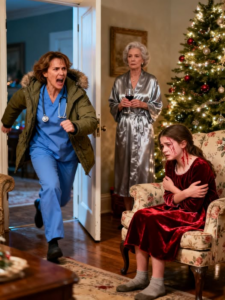
And around her neck, hanging from a string, was a piece of cardboard.
In thick black marker: FAMILY DISGRACE.
My vision tunneled.
Lily looked up at me like I was a dream. “Mom?”
I walked to her slowly, like fast movement might shatter her.
“I’m here,” I said, voice soft.
Her chin trembled. “Don’t be mad.”
“I’m not mad at you,” I said, and my voice stayed calm only because I had to. “I’m mad at them.”
I untied the string gently. When it came off, Lily’s neck had a red line where it had rubbed.
I swallowed down something hot and poisonous.
I held the sign in my hands. The cardboard was cheap. The humiliation was expensive.
I set my phone on the dresser facing us and turned the camera toward Lily.
“Sweetheart,” I said gently, “I need you to tell me what happened tonight. Just your words.”
Lily wiped her face with her sleeve. “Grandma said we were doing Christmas pictures. Then she gave me the sign and said I had to wear it because I lied.”
“What did she say you lied about?”
Lily’s voice shook. “About Uncle Cal being with Dad. About him yelling. About him smelling like beer.”
My stomach turned.
“She said I was trying to ruin the family,” Lily whispered. “And Grandpa Frank just… sat there. And Uncle Cal kept smiling and saying, ‘Say it again, Lily. Tell everyone your big story.’”
I kept my voice even. “Did Grandma tell anyone else?”
Lily nodded. “She called Aunt Melissa on video. And Grandma made me stand by the tree so Aunt Melissa could see the sign.”
I inhaled slowly.
Video call meant witnesses. Digital footprint.
Good.
I hugged Lily, careful and firm. “You did the right thing calling me. You did the right thing telling the truth.”
Lily’s voice muffled against my shoulder. “Grandma said Dad would hate me.”
I pulled back and looked her in the eyes. “Your dad would never hate you,” I said. “And I’m going to make sure you never have to be alone with them again.”
Then I picked up my phone, still recording, and walked back downstairs with Lily holding my hand.
Diane was in the living room now, next to a perfectly decorated tree, like she’d moved the confrontation into a prettier setting on purpose.
Frank sat in his recliner, eyes fixed on the TV like it could save him.
Cal leaned against the mantel, beer still in hand.
When Diane saw Lily without the sign, her face tightened.
“I told you,” she said sharply to Lily, “that comes off when you earn it.”
Lily flinched.
I stepped in front of Lily without raising my voice. “We’re leaving.”
Diane’s smile snapped back into place. “Not until Lily apologizes.”
I looked around their beautiful living room—the shiny ornaments, the framed family photos, the fake warmth. It all felt like frosting smeared over rot.
I lifted my phone slightly. “Diane,” I said, “I have you on video admitting it was a ‘lesson.’ I have Lily’s statement recorded. And you have cameras outside that likely recorded you grabbing my wrist.”
Diane’s lips parted.
Cal laughed nervously. “You think you can scare her with your phone?”
“I’m not trying to scare her,” I said, still calm. “I’m telling you what’s going to happen next.”
Diane stepped forward, voice lowered. “Mara, stop. You’re embarrassing yourself.”
I met her eyes. “You embarrassed my child.”
Diane’s face hardened. “She lied.”
I nodded once, like I was considering it. “Then let’s clear it up.”
I turned toward Cal.
“Cal,” I said evenly, “where were you the night Ryan crashed?”
Cal’s smile faltered. “What?”
“Where were you,” I repeated, “the night Ryan crashed?”
Diane snapped, “Don’t answer that.”
Cal’s jaw tightened. “I wasn’t—”
I cut him off. “Lily says you were yelling at Ryan. She says you smelled like beer.”
Cal’s face flushed. “Kids make stuff up.”
I tilted my head. “Do you want me to tell the hospital social worker that Cal—who is drunk right now—was involved in the same night Ryan ended up unconscious in a ditch?”
Frank’s head jerked toward Cal.
Diane’s eyes narrowed dangerously. “You wouldn’t.”
“Oh, I would,” I said softly. “Because I’m done protecting the family story.”
Diane’s voice rose, losing control. “You’re a nobody, Mara. You’re a tired little nurse with a broken string of lights and a cheap tree, and you think you can take my family from me?”
There it was.
The truth behind every smile.
I didn’t flinch. “I’m not taking your family,” I said. “I’m taking my daughter.”
Diane stepped closer like she might block the door. “If you walk out, I will make sure you regret it.”
I looked at her for a long moment.
Then I smiled—small, calm, terrifying in its steadiness.
“You already made your move,” I said. “Now you’re going to watch mine.”
And I walked Lily out the front door.
Diane didn’t call the police.
Because on some level, she knew police questions didn’t go well for people who humiliate children and keep drunk men in the living room on Christmas Eve.
Back home, Lily sat on the couch wrapped in a blanket while I made hot chocolate with shaking hands.
I didn’t tell her my plans yet. I didn’t give her my storm. She’d had enough weather for one night.
Instead I said, “Drink this. Then we’re going to sleep. And tomorrow, we’re going to start something new.”
Lily stared into the mug like it held answers. “Are they going to be mad?”
“Yes,” I said honestly. “But they don’t get to be in charge of us anymore.”
After Lily fell asleep, I opened my laptop.
I didn’t cry. I didn’t pace. I didn’t call friends to vent.
I worked.
I sent an email to Lily’s school counselor: urgent, need to report emotional abuse and coercive humiliation.
I filled out the online form for a protective order consultation.
I downloaded our marriage certificate and Ryan’s healthcare proxy documents from the patient portal.
Then I opened my bank app.
Because one thing Diane didn’t know about me was this:
I may have been tired, but I wasn’t careless.
When Ryan’s accident happened, bills started moving fast—ambulance, imaging, ICU. Diane had offered to “help with finances,” which had sounded generous until I realized she was asking for account access.
I’d refused.
But I’d noticed something else: Ryan’s old joint account with Diane—an account he’d kept out of guilt—had started transferring money after the accident. Little amounts. Then bigger ones.
I hadn’t confronted it because I’d been drowning in survival.
Now I pulled up the transaction history and took screenshots until my fingers cramped.
A pattern emerged like a bruise blooming:
Ryan’s disability deposit → transferred out within hours → routed to a family account Diane controlled.
My hands went cold.
Control didn’t start with a sign.
Control started with money, paperwork, and fear.
I scrolled further back and found an email Ryan had sent me six months ago—before the accident—when he’d finally admitted he wanted boundaries.
“If anything ever happens to me,” he’d written, “my mom will try to take over. I’m updating my proxy. Keep it safe.”
I stared at the message until the words stopped blurring.
Then I printed it.
And that’s when I understood the real reason Diane hated Lily’s “lies.”
Because Lily’s truth threatened more than reputation.
It threatened access.
To Ryan.
To Lily.
To money.
To the story Diane used to keep everyone obedient.
Christmas morning arrived gray and quiet.
Lily woke up stiff, like her body didn’t trust joy yet.
I made pancakes anyway. I put on a dumb Christmas playlist. I pretended the world could still be gentle.
Halfway through breakfast, my phone buzzed.
Diane.
I didn’t answer.
It buzzed again.
Then a text came through:
Bring Lily back. You are poisoning her against family.
Another text:
If you go to court, I will tell them about your “temper.” I will tell them you’re unstable.
I stared at the screen.
Then I forwarded the texts to myself in an email thread labeled EVIDENCE.
Lily watched my face. “Is it Grandma?”
“Yes,” I said.
Lily’s shoulders tensed. “Am I in trouble?”
I walked around the table and knelt beside her.
“No,” I said firmly. “You are not in trouble. You were brave. What they did was wrong. And now it’s my job to handle it.”
She searched my face. “Are you going to yell at them?”
I shook my head. “No.”
Lily looked confused. “But… they hurt me.”
“I know,” I said softly. “And that’s why I can’t afford to yell. Yelling is what they expect. Yelling is what they can use to call me crazy.”
I took Lily’s hands. “I’m going to be calm,” I said. “And calm is going to scare them more than shouting ever could.”
The first consequence arrived two days later.
The school counselor called me back, voice gentle but serious.
“We need to file a report,” she said. “This is emotional abuse and coercion. The sign, the humiliation, the threats—that’s not discipline.”
I stared at the wall, feeling something steady inside me.
“Yes,” I said. “We do.”
That same afternoon, the hospital social worker called.
“Mara,” she said carefully, “Ryan’s mother is attempting to override your proxy. She’s also asked about transferring Ryan to a facility near her home.”
My mouth went dry. “She can’t do that.”
“She’s insisting,” the social worker said. “But your paperwork is clear. I just… wanted you to be aware.”
“I’m aware,” I said. “And I’m done being polite.”
I sent the social worker the screenshots of the account transfers.
There was a pause on the line.
“Mara,” she said quietly, “this may need to be escalated to legal.”
“Yes,” I replied. “It will.”
Diane’s second move came fast.
She filed an emergency petition for “temporary guardianship” of Lily—claiming I was “emotionally unstable due to caregiver stress.”
She included statements from Cal and Aunt Melissa.
It was a play ripped straight from Diane’s favorite kind of cruelty: make the victim look like the problem.
When the court date arrived, I wore a plain navy dress and no makeup. Not because I wanted sympathy, but because I wanted to look like exactly what I was:
A mother who worked too much, slept too little, and still showed up.
Diane arrived dressed like a Christmas card again. Pearls. Perfect hair. That practiced grief face.
Cal came smirking, chewing gum like it was a joke.
I sat with my folder—thick, organized, tabbed like a textbook.
When the judge asked why Diane wanted guardianship, Diane spoke with trembling passion.
“My son is incapacitated,” she said. “And Mara is overwhelmed. She’s lashing out at family. She ripped Lily away on Christmas Eve, causing trauma. We only wanted to teach Lily honesty.”
The judge frowned. “Teach honesty how?”
Diane hesitated, then smiled like she was about to win. “It was symbolic. A sign. Harmless.”
My lawyer stood. “Your Honor, we have video.”
Diane’s face tightened.
The video played: Diane in the doorway saying it was a “harmless lesson.” Diane admitting Lily was being disciplined for “disgusting lies.” Diane grabbing my wrist—visible on camera—then releasing when she realized she was recorded.
Then my lawyer played Lily’s short statement—just her words, describing the sign and the forced video call.
The courtroom got very quiet.
The judge looked at Diane. “You forced a ten-year-old child to wear a sign saying ‘Family Disgrace’?”
Diane swallowed. “It’s being taken out of context.”
The judge’s voice hardened. “There is no context where that is appropriate.”
Then my lawyer submitted Diane’s text messages—the threats about telling the court I was unstable.
The judge’s eyebrows lifted.
I watched Diane’s face twitch—small cracks in the mask.
Finally, the judge asked the question that mattered most:
“Do you have proof Mara is unfit?”
Diane’s lips parted. She glanced at Cal. Cal shrugged.
No proof. Only a story.
My lawyer stood again. “We also have financial evidence of Diane Lane transferring Ryan’s disability deposits into a personal family-controlled account without authorization.”
Diane’s head snapped toward us. “That’s—”
The judge held up a hand. “This is not the hearing for financial fraud,” she said calmly. “But it is relevant to motive.”
Diane’s face went pale.
The judge leaned forward. “Petition denied. And I am issuing a temporary order: Diane Lane and Calvin Lane will have no unsupervised contact with the child pending investigation. Mara retains sole physical custody.”
For the first time since Ryan’s accident, I felt air move into my lungs like it belonged there.
Diane stared at the judge like she’d been slapped in public.
Cal muttered, “This is bullshit.”
The judge’s eyes snapped to him. “One more word, and you’ll find yourself in contempt.”
Cal shut up.
Diane’s mouth moved, searching for power.
But power doesn’t work on people who stop being afraid.
The “nightmare of consequences” didn’t come with fireworks.
It came with paperwork, phone calls, and public truth.
CPS interviewed Lily. Lily told them about the sign. About the forced video call. About Cal’s beer smell. About Diane’s words.
Lily didn’t cry this time.
She spoke like someone who’d finally realized she was allowed to be believed.
The hospital opened an investigation into the unauthorized transfers because Ryan’s deposits were intended for his care.
A fraud unit got involved.
Diane’s church friends—her precious circle—started whispering when uniformed officers showed up at her house asking questions.
She tried to spin it as “Mara being vindictive.”
But the sign didn’t spin well. Family Disgrace didn’t sound like love no matter how pretty you wrapped it.
Frank finally called me one evening.
His voice was tired. “Mara,” he said quietly, “Diane went too far.”
I didn’t feel satisfaction hearing it. I felt something colder: inevitability.
“She always does,” I replied.
Frank sighed. “Cal… he’s in trouble too. They asked about the accident night. They asked about drinking.”
I closed my eyes.
“Did he do it?” I asked.
Frank didn’t answer right away.
That silence was an answer.
Two months later, Ryan opened his eyes.
Not fully. Not like a movie miracle.
But enough.
Enough that he squeezed my hand when I spoke.
Enough that the doctor said, “He’s responding.”
Enough that Lily sat beside the bed and whispered, “Dad, it’s me,” and Ryan’s eyes shifted toward her.
Lily’s face crumpled, and she leaned her forehead against the bed rail, shaking silently.
I put my arm around her, feeling her small body tremble with a grief that had been trapped too long.
Outside the room, Diane appeared—hair perfect, eyes red.
She stepped toward Ryan’s bed like she belonged there.
But the nurse stopped her gently. “Visiting restrictions,” she said. “Only immediate household.”
Diane’s face tightened. “I am his mother.”
The nurse’s voice stayed polite. “The court order is clear.”
Diane looked at me like she wanted to tear my skin off.
I looked back calmly.
Ryan’s eyes flickered toward the doorway, unfocused, but then they slid back to Lily.
As if he was choosing.
Diane’s lips trembled. “Ryan,” she whispered. “Baby—”
Ryan’s fingers tightened around mine.
Just a small squeeze.
But it felt like a verdict.
Diane’s face twisted, and for a moment, the mask fully slipped—pure fury, humiliation, and something close to panic.
She turned sharply and walked away.
Lily watched her go.
Then Lily looked up at me and whispered, “Mom?”
“Yes, baby.”
“Do you think she knows she’s wrong?”
I stroked Lily’s hair.
“No,” I said honestly. “But she knows she’s not in control anymore.”
Lily swallowed. “Is that why she’s mad?”
“Yes,” I said. “Because control feels like love to people who don’t know how to love.”
Lily stared at her father’s hand in mine, at the machines, at the quiet room.
Then she nodded, slow and steady.
The kind of nod that meant a child had learned something heavy but true:
That being believed is a kind of freedom.
That shame only works if you accept it.
And that sometimes the calmest person in the room is the most dangerous—because they’re not reacting.
They’re deciding.
That night, when we got home, the broken Christmas lights were still hanging outside, half-dead.
Lily stood at the window and watched them blink unevenly.
“Are we going to fix them?” she asked quietly.
I walked up beside her.
The lights blinked. Off. On. Off. Like a pulse that couldn’t decide if it wanted to live.
“Yes,” I said. “We’ll fix them.”
Lily’s face softened. “So next Christmas is normal?”
I thought about the sign. The court. Diane’s mask cracking. Ryan squeezing my hand.
Normal was a word that didn’t fit anymore.
But safe did.
I put my arm around Lily’s shoulders. “Next Christmas,” I said, “we’ll do it our way.”
Lily leaned into me. “No signs?”
I kissed the top of her head. “No signs,” I promised. “Only names. Only love. Only truth.”
Outside, the lights blinked again—uneven, imperfect.
Still shining.
And inside, for the first time in a long time, I felt something in our home that Diane could never manufacture:
Peace that wasn’t performative.
Control that wasn’t cruel.
A family that didn’t need someone to be the disgrace so someone else could feel powerful.
Just us.
Healing.
And consequences that had finally done their job.
Để lại một phản hồi