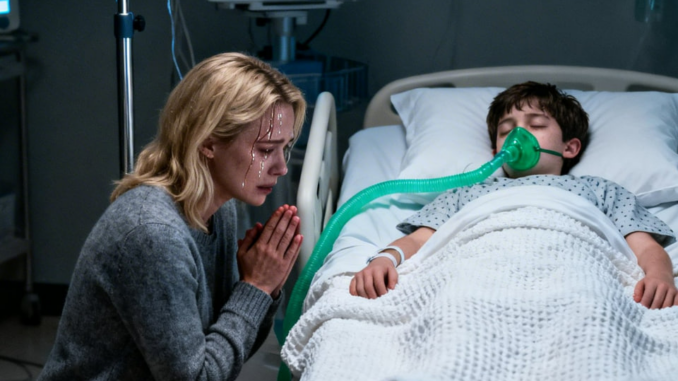
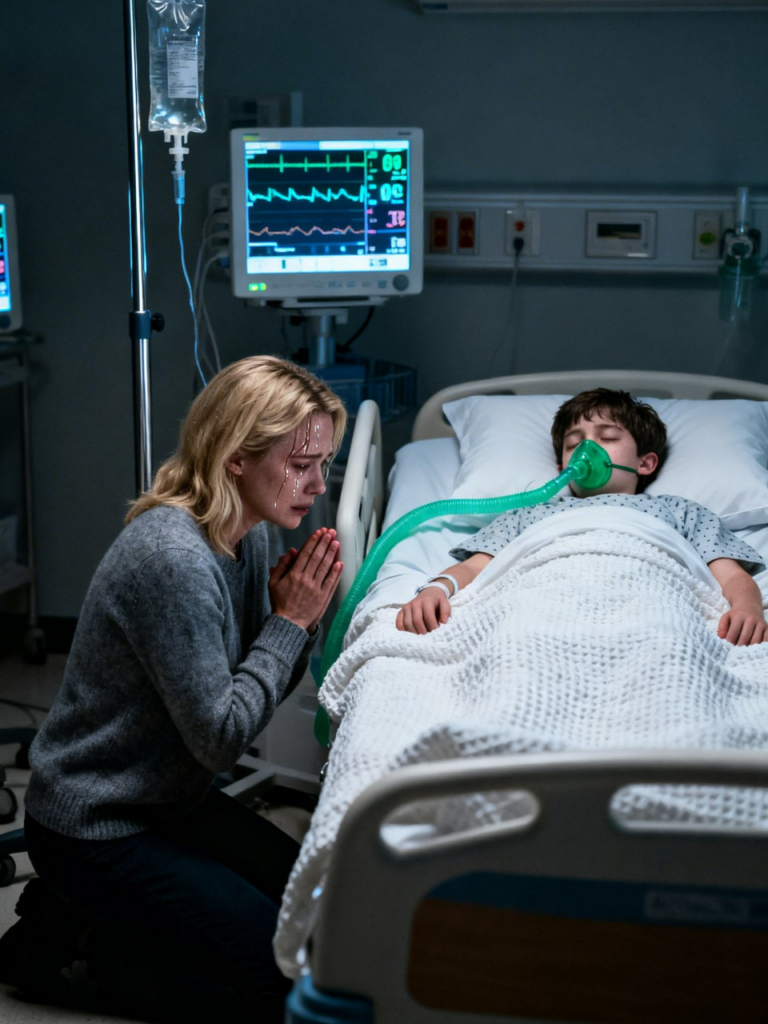
I still hear my son’s voice from that night—small, terrified.
“Mom… am I going to d!e?”
He didn’t pronounce the word right. He was seven, and fear makes kids sound younger. The hospital room was too bright and too cold, the kind of fluorescent light that makes everything look guilty. The air smelled like antiseptic and panic. Machines beeped in steady, indifferent rhythms, like the world had decided to keep time no matter who broke.
I held his hand and tried not to let him feel how badly mine was shaking.
“No,” I lied, because sometimes mothers lie like soldiers—because the truth would destroy the person you’re trying to protect.
The doctor didn’t hesitate. He was a man with tired eyes and a voice that didn’t waste time on comfort.
“Eighty-five thousand,” he said. “Tonight. If we wait, we risk sepsis. We risk organ failure. We risk—” He stopped because he could see my face turning white. “Do you understand?”
My mouth was dry. I nodded like I did, like I wasn’t about to fall through the floor.
I didn’t have eighty-five thousand dollars.
I had a maxed-out credit card, a checking account that would barely cover groceries, and a job that paid just enough to keep us afloat if nothing went wrong—which is exactly what the universe likes to punish.
I was a single mother then. I’d become one the way women often do: slowly at first, then all at once. My husband had left in pieces—missed birthdays, late nights, unexplained “work trips”—until one day he left for real and didn’t come back.
My parents had called it “my choice.”
They said I was too emotional. Too impulsive. Too dramatic.
They said I made mistakes.
And now the hospital was handing me a number like a weapon.
Eighty-five thousand.
Tonight.
My hands shook as I called my parents, because when you’re desperate you reach for the place you learned to reach, even if that place has teeth.
My mother answered first. Her voice was sleepy, annoyed.
“Hello?”
“Mom,” I whispered, because my voice had already broken somewhere between the hallway and the phone. “It’s Noah. He’s in the hospital. He needs emergency surgery. It’s—” I swallowed hard. “It’s eighty-five thousand tonight.”
Silence.
Then her breath, sharp and disbelieving. “What did he do?”
“What did he—?” My throat tightened. “He’s sick. He has an infection. They—”
My father’s voice cut in, already hard. He must’ve been listening on speaker.
“We’re not paying for your mistakes.”
It felt like the air left my body.
“Dad,” I choked. “He’s your grandson.”
“Your grandson,” my father corrected coldly. “Because you couldn’t keep a husband. Because you had to play grown-up before you were ready.”
I stared at the hospital wall, eyes burning.
“Please,” I whispered. “It’s not about me. He could—he could die.”
My mother clicked her tongue. “Don’t be dramatic.”
My father’s voice turned even colder, like stone dipped in ice water. “You should’ve thought about consequences. We warned you. You always want everyone to rescue you.”
I couldn’t breathe.
I heard my son’s voice in the background of my memory—Mom… am I going to die?—and something in me went quiet and sharp.
“I’m not asking you to rescue me,” I said, voice trembling. “I’m asking you to save a child.”
My father snorted. “A child you chose. Handle it.”
Then he hung up.
The dial tone was loud in my ear, mocking.
For a second I just stood there holding the phone like it was a dead thing.
Then my knees buckled and I slid down the wall in the hallway outside the ICU, my face in my hands, trying not to make sounds because I didn’t want Noah to hear his mother falling apart.
A nurse stepped out and saw me. Her eyes softened, but she didn’t ask questions. She just knelt and said gently, “Honey, we’re going to figure something out. Okay?”
I didn’t believe her.
But I nodded anyway.
Because what else can you do when the people who raised you slam the door on your child?
2
We figured it out the way people always do when they don’t have rich parents to catch them.
We begged.
We bartered.
We signed papers with shaking hands.
The hospital finance office gave me a stack of forms and the kind of sympathetic look that said they’d seen this story before. I applied for emergency assistance programs. I asked about payment plans. I called every number they gave me like I was dialing a lifeline.
Then I did the thing that hurt the most.
I called my estranged uncle—my father’s brother—the one my parents said was “a loser” because he’d never played the family game.
He answered on the second ring. His voice was rough, surprised.
“Lena?”
“It’s Noah,” I blurted, no time for pride. “He needs surgery. Tonight. I need help. I’m sorry—I know we haven’t talked—”
My uncle didn’t let me finish. “How much?”
“Eighty-five thousand,” I whispered, throat tight.
There was a pause, and my heart sank—because it was too much, and I knew it—
Then he said, “I have forty. I can wire it right now. And I can call my credit union for the rest. Don’t thank me. Just tell me where to send it.”
I started sobbing so hard I couldn’t speak.
“Hey,” he said, voice gentler now, “listen to me. You’re not alone. Your father doesn’t get to decide who deserves help.”
That night, Noah went into surgery.
I sat in a waiting room with cheap chairs and a vending machine that ate my last dollar. I watched other families pace and pray and pretend not to watch each other’s fear.
When the surgeon finally came out, mask lowered, eyes tired, he said, “We got it in time.”
I inhaled like I’d been drowning.
Noah lived.
But something else in me died quietly that night.
Not love for my parents. Love dies slower.
It was trust.
The belief that blood meant safety.
That belief never came back.
3
Years passed, because time is cruel like that. It keeps moving even after it breaks you.
Noah grew. He got taller. His voice deepened. The scar on his abdomen faded into a thin line he barely remembered, but I remembered every millimeter.
I worked two jobs for a while. Then one job and a side hustle. I learned the language of survival: budgeting apps, secondhand clothes, scholarships, “we can’t afford that right now.” I learned to smile through exhaustion so my son wouldn’t think hardship was his fault.
My parents stayed distant—just close enough to hurt.
They sent birthday cards late. They posted Facebook photos of themselves at church with captions about “family values.” They occasionally called to offer advice disguised as concern.
“How’s Noah?” my mother would ask, and when I answered she’d say, “Well, you know, kids need fathers.”
My father never apologized. He didn’t even admit the night happened the way it did.
In his version, I had been irresponsible, demanding, dramatic. He had been “setting boundaries.”
Then my sister got engaged.
My sister, Camille—the golden child who could do no wrong because she’d learned early how to be what my parents wanted.
Camille’s wedding became a family religion.
They talked about it for a year like it was the Second Coming. They toured venues. They tasted cakes. They flew to New York for “inspiration.” My mother called me just to brag about centerpieces.
“Two hundred and thirty thousand,” she said once, laughing like it was charming. “Can you believe it? But it’s worth it. Camille deserves the best.”
I pressed the phone hard against my ear, feeling the old rage rise like bile.
I thought of the hospital’s fluorescent lights. I thought of Noah’s small voice asking if he was going to die. I thought of my father’s cold words: We’re not paying for your mistakes.
And now they were spending $230,000 on flowers and a ballroom and imported champagne.
I didn’t scream. I didn’t fight.
I learned something more effective than fighting:
I stopped needing them.
Noah got a part-time job as a teenager and insisted on contributing to his own school trip. I cried in the kitchen when he wasn’t looking because he was becoming the kind of man my parents pretended to be—responsible, loyal, kind—without ever being taught by them.
I rebuilt my life brick by brick while my parents built my sister a palace.
So when my mother called and said, “Camille would love it if you came,” I said politely, “I won’t be attending.”
My mother’s voice went sharp. “Don’t be spiteful.”
“I’m not,” I said. “I’m protecting my peace.”
My father got on the line. “You’re punishing us.”
I laughed softly. “No,” I said. “I’m just not offering myself for punishment anymore.”
They didn’t like that.
People who thrive on control never like it when you stop playing.
4
The day my parents showed up at my door was a warm afternoon in early fall.
The sun made the neighborhood look gentle—kids chalking the sidewalk, sprinklers ticking, dogs barking lazily. My small house smelled like laundry detergent and tomato sauce because I’d been meal-prepping for the week like the boring, stable adult I’d fought to become.
Noah was at school. The house was quiet.
The doorbell rang.
When I opened the door and saw them, my body reacted before my mind did—a tightness in my chest, a sour twist in my stomach. Like an old wound recognizing the hand that caused it.
My mother stood on the porch in a cardigan that looked expensive. My father stood slightly behind her, posture stiff, eyes scanning my house like he was measuring its worth.
They were smiling.
Not warm smiles.
The kind of smile you wear when you want something and you think you’re entitled to it.
“Lena,” my mother said brightly. “Surprise!”
My father nodded. “We were in the area.”
I didn’t invite them in.
I didn’t ask why.
I simply smiled back and shut the door.
It wasn’t dramatic. It wasn’t a speech. It was a quiet, controlled motion—wood meeting frame, latch clicking into place.
For one second I leaned against the door and breathed, heart pounding.
Then the knocking started.
“Lena!” my mother called through the door, voice rising. “Open this door!”
I didn’t.
I walked to the kitchen, poured myself a glass of water, and took a slow sip like I was teaching my own nervous system a lesson: We don’t panic anymore.
My phone buzzed.
A text from my mother:
This is childish. We need to talk.
Then another:
Your father is willing to forgive you.
I stared at that one until I laughed out loud.
Forgive me.
For what? For surviving without them?
The doorbell rang again. Then pounding—harder.
My father’s voice rose, angry now. “Lena, don’t do this! You’re embarrassing us!”
There it was. Always the same god.
Embarrassment.
Not guilt. Not regret.
Just the terror of looking bad.
I set my glass down carefully and walked back to the door. I didn’t open it fully. I cracked it with the chain on.
My mother’s face was flushed. “Finally.”
“What do you want?” I asked, voice flat.
My mother’s expression shifted instantly into a wounded look. “Want? We came to see you. We miss you.”
My father nodded sharply. “And Noah. Where is he?”
At the mention of my son, my spine stiffened.
“Noah is not available,” I said.
My mother’s eyes narrowed. “Don’t be like this.”
“Like what?” I asked. “Protective?”
My father’s voice turned cold. “You can’t keep our grandson from us.”
I stared at him. “You kept yourselves from him.”
My mother’s lips trembled. Tears appeared like magic. “Lena, we didn’t mean—”
“Stop,” I said quietly. “Don’t do the tears. Not today.”
My father pushed closer to the door. “We’re here because we heard about Noah.”
My stomach dropped. “He’s fine.”
My mother shook her head. “Don’t lie. Camille told us he applied to colleges. That he might go out of state.”
Ah.
There it was.
It wasn’t love. It wasn’t reunion.
It was control slipping away.
My father’s jaw tightened. “We are his family. We should be involved.”
I felt something inside me go very, very calm.
“Family,” I repeated softly. “Is that what you called him the night he needed surgery?”
My mother flinched.
My father’s eyes hardened. “That was different.”
“It was life and death,” I said. “How is that different?”
My mother whispered, “We were trying to teach you responsibility.”
I stared at her. “By letting a child die?”
My father snapped, “He didn’t die.”
“No,” I said. “Because someone else loved him enough to help. Someone you called a loser.”
My mother’s tears slid down her cheeks. “Lena, you’re twisting things.”
I smiled, small and sharp. “You’re used to twisting reality until it fits your comfort. That won’t work here.”
My father’s voice rose, anger cracking his control. “We came here to offer peace. And you’re being hostile.”
I nodded slowly. “Yes. Because peace with you has always required me to bleed quietly.”
My mother leaned closer, voice suddenly sweet again. “We can start over. We can be a family again.”
I looked at them—really looked. Their perfect clothes. Their rehearsed expressions. Their entitlement.
And I realized they weren’t here because they’d changed.
They were here because I had.
They could smell the boundary like smoke, and they hated it.
So I said the sentence that finally made the porch go still:
“Noah doesn’t know you,” I said. “And I’m going to keep it that way.”
My mother gasped like I’d stabbed her. “How dare you.”
My father’s eyes went flat. “You think you can do this without consequences?”
I nodded. “I already did.”
Then I started to close the door.
My mother shoved her hand forward, trying to stop it. The chain caught, holding the door with a metallic snap.
“Lena!” she cried. “We’re not leaving like this!”
I stared at her hand, pale fingers pressing against my door like a claim.
“Move your hand,” I said calmly.
My father barked, “Don’t threaten your mother!”
I met his gaze through the crack. “I’m not threatening her. I’m enforcing my home.”
My mother yanked her hand back as if the door had bitten her.
I closed it again.
The knocking became furious. My father shouted. My mother cried. A neighbor’s dog barked. I heard a curtain twitch across the street.
Old me would’ve crumpled. Old me would’ve opened the door to make it stop.
New me picked up my phone and called the non-emergency line.
When the dispatcher answered, I said, “My parents are refusing to leave my property. I need an officer.”
The pounding stopped for a split second, like they’d heard the word officer through the door.
Then my mother screamed, “You would call the police on us?!”
I didn’t answer.
I didn’t need to.
5
When the officer arrived, my parents switched masks so fast it was almost impressive.
My mother became the trembling victim. My father became the dignified patriarch. They spoke about “misunderstandings” and “family conflict,” trying to make me look unstable without using the word.
The officer listened, then turned to me.
“Ma’am,” he asked gently, “do you want them trespassed?”
My parents’ faces tightened.
My mother whispered, “Lena… don’t.”
My father’s jaw clenched. “You’ll regret making this official.”
I thought about Noah in that hospital bed, asking if he was going to die. I thought about how official their cruelty already was, even without paperwork.
“Yes,” I said.
The officer nodded. “Okay.”
My mother started sobbing. My father’s face went red. He tried to argue, but the officer’s tone stayed calm, professional, immovable.
They were instructed to leave. They left with their pride bleeding in the driveway.
But that wasn’t the end.
Because the next move my parents made was the one I should’ve predicted:
They tried to get to Noah through Camille.
Camille called me that night, voice tight.
“Mom and Dad are devastated,” she said. “Why would you do that? They’re getting older. You’re being cruel.”
Cruel.
The word tasted bitter.
I laughed softly. “Did you call them cruel when they refused to help Noah?”
Camille hesitated. “That was years ago.”
“It was a child’s life,” I said. “Time doesn’t make it smaller.”
Camille sighed. “You always have to make everything dramatic.”
I went quiet. Then I said, “Camille… did they pay for your wedding?”
Camille snapped, “What does that have to do with anything?”
“Answer the question,” I said calmly.
Silence.
Then, smaller, “Yes.”
“How much?” I asked.
Camille’s voice went defensive. “It was our day. They wanted it perfect.”
“How much?” I repeated.
Camille swallowed audibly. “Two hundred and thirty.”
I let that hang.
Then I said, “Noah needed eighty-five.”
Camille’s voice cracked. “That’s not fair.”
I laughed—one short, humorless sound. “No,” I agreed. “It wasn’t.”
Camille got angry then, because truth makes people angry when it threatens the story they live in.
“You’re jealous,” she snapped. “You’ve always been jealous.”
I took a deep breath. “I’m not jealous,” I said. “I’m awake.”
Then I told her, “If you bring them to my house again, I will trespass you too.”
Camille went silent.
“Are you threatening me?” she whispered.
“I’m warning you,” I replied. “There’s a difference.”
6
Two weeks later, Noah got a letter.
A big, fancy envelope. Thick paper. My parents’ return address in the corner like a stamp of ownership.
Noah brought it to me at the kitchen table, eyebrows raised.
“Grandma and Grandpa?” he asked carefully. “Why are they writing me?”
My hands went cold.
I took the letter and opened it.
Inside was a check.
$85,000.
And a note in my father’s handwriting:
We are willing to put the past behind us. This is for Noah’s surgery, as a gesture of forgiveness and reconciliation. We expect to be included in his graduation and college decisions. Family is family.
For a second, I couldn’t breathe.
It was so… calculated. So clean. Like money could rewrite the night they’d hung up on me.
Noah stared at the check. “Is that… real?”
“Yes,” I whispered.
His voice was small. “Are we… supposed to take it?”
I looked at my son—sixteen now, tall, eyes steady. The boy who had once asked if he was going to die, now watching me like he was learning what kind of adult to become.
I swallowed hard.
Then I tore the check in half.
Noah’s eyes widened. “Mom—”
“I’m not doing this,” I said, voice shaking, tears burning. “They don’t get to buy access to you.”
I tore it again. And again. Paper ripped like something finally breaking free.
Noah stared at the pieces, then at me.
“Why now?” he whispered.
“Because they’re afraid,” I said. “You’re growing up. You’re leaving. And they can’t control you if they don’t own the story.”
Noah swallowed. “They want… credit.”
I nodded. “Exactly.”
He was quiet for a long time. Then he reached across the table and took my hand.
“I’m glad you shut the door,” he said softly.
My throat closed. “Me too.”
That night, I drove to the post office and mailed my parents’ shredded check back in the same envelope, along with one sentence written on plain paper:
You don’t get to abandon a child in an emergency and call it a lesson. Stay away from my son.
7
The fallout was loud.
My mother left voicemails sobbing and screaming, switching between victim and villain like it was a talent show.
My father sent a letter threatening legal action for “grandparents’ rights” like my son was property.
Camille posted vague quotes online about “toxic people” and “forgiveness.”
And I did something I’d never done before.
I told the truth out loud.
Not in a dramatic public post. Not in a family group chat war.
I told it to the people who mattered.
To my aunt who’d always suspected. To a cousin who’d been treated like the scapegoat too. To my uncle—the one who saved Noah—who simply said, “About time.”
Word traveled the way it always does. Quietly at first. Then faster. Because families run on secrets, and when one secret breaks, others get nervous.
My father’s church friends started asking questions. My mother’s “perfect family” story began to wobble.
And suddenly, the thing my parents feared most—public embarrassment—wasn’t caused by me calling the police.
It was caused by their own history surfacing.
One Sunday, my father showed up at my door alone.
No smile this time. No performance. Just a man who looked older than I remembered.
“I want to talk,” he said quietly.
I stood in the doorway, not inviting him in. “Talk.”
His throat moved as he swallowed. “We made a mistake,” he said.
The word mistake almost made me laugh.
“You didn’t forget,” I said. “You chose.”
His eyes filled with tears he didn’t seem to know what to do with. “We were… angry,” he whispered. “We thought you needed—”
“Don’t,” I said softly. “Don’t rewrite it.”
He flinched.
I continued, voice steady. “You’re here because you want access to Noah.”
My father’s shoulders sagged. “Yes.”
At least he was honest now.
I nodded once. “Then here’s my condition. You don’t get him until you tell the truth. To Camille. To Mom’s friends. To anyone you lied to. You tell them what you did that night. You say it out loud without blaming me.”
My father stared at me, stunned. “That would… ruin us.”
I tilted my head slightly. “It already ruined me.”
Silence stretched.
Then my father whispered, “I can’t.”
I nodded. “Then you can’t have him.”
My father’s face crumpled. He looked like he might argue, might plead, might revert to anger.
Instead, he just stood there for a long moment, then turned away slowly, like a man walking back into a house made of lies because it was the only house he knew.
I watched him go.
And for the first time, I didn’t feel like chasing him.
8
Noah got into college out of state.
On move-in day, we loaded the car with boxes and bedding and the cheap plastic bins that always smell like new beginnings. Noah stood in the driveway—our driveway, not my parents’—and looked at our small house with a fondness that made my chest ache.
“You did this,” he said quietly.
“What?” I asked, confused.
He nodded toward the house, toward our life. “You built this. Without them.”
I swallowed hard. “We built it,” I corrected.
Noah smiled. “Yeah,” he said. “We did.”
As we drove away, my phone buzzed.
A message from Camille.
Mom says you’re heartless. Dad is sick from stress. I hope you’re happy.
I stared at it for a moment, then set the phone facedown.
Noah glanced over. “You okay?”
I looked at my son—alive, healthy, heading into his future—and felt something warm spread through my chest that had nothing to do with revenge.
Peace.
“I’m okay,” I said.
And I meant it.
Because the truth is, the worst thing my parents ever did wasn’t refusing to pay $85,000.
It was teaching me that love had to be earned through obedience.
The best thing I ever did was unlearn it in time to teach my son something different.
That love shows up in emergencies.
That family isn’t a title. It’s a choice.
And when someone tells you they won’t pay for your “mistakes” while a child begs to live—then later shows up smiling, expecting a reunion—
You don’t owe them your door.
You owe your child your courage.
So I shut it.
And this time, I didn’t open it again.
Để lại một phản hồi