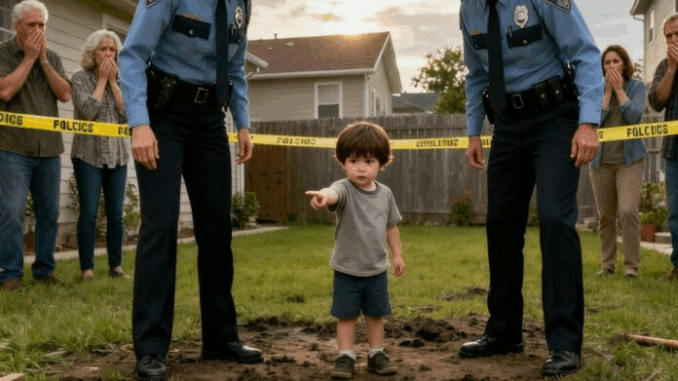
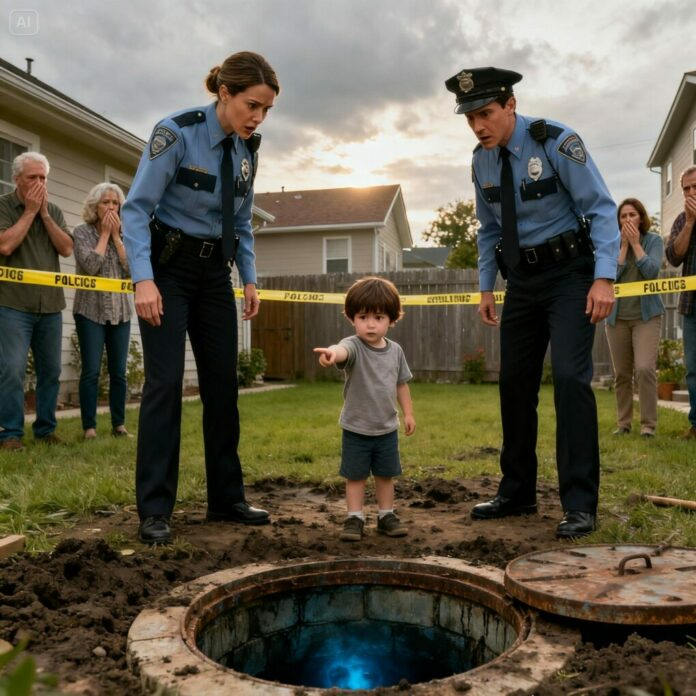
It was a quiet Sunday afternoon in Silverwood, Maine. Four-year-old Marcus Sullivan was rolling his toy truck across the carpet when he suddenly said, “My real mother is in the well.”
His adoptive mother, Clara Sullivan, froze mid-stitch. “What did you say, sweetheart?”
Marcus looked up, calm and serious. “She wore a blue dress. She fell in the well in our backyard. Daddy Vincent was there.”
Clara’s husband, Vincent, sitting by the window with his newspaper, frowned. “He’s just making up stories again,” he said sharply. But Clara couldn’t ignore the chill crawling up her spine—because there was an old well buried under the garden, sealed years ago before Marcus ever arrived.
Over the next few days, Marcus repeated the same thing. He drew pictures of a woman with long dark hair and a blue dress, falling into a black hole. Each drawing made Clara’s stomach twist tighter. When she mentioned it to her neighbor Lucy, the woman laughed it off. “He’s from the orphanage, Clara. Kids invent stories. Don’t let it bother you.”
But Clara couldn’t shake the feeling that Marcus wasn’t inventing anything. His details were too precise. When she asked him where he had heard about the well, Marcus simply said, “I remember it. Daddy Vincent said not to tell.”
That night, Clara lay awake, staring at the ceiling. Vincent’s words echoed in her mind from months ago—how oddly persistent he had been about adopting that particular child, how the adoption agent had never provided full documentation.
One evening, Clara decided to check the adoption file again. The pages were thin, photocopied, and missing signatures. The social worker’s name—Daniel Crane—led nowhere when she tried searching online. It was as if he had never existed.
When she confronted Vincent, his face turned red. “Why are you snooping? You think a four-year-old knows the truth about anything? Stop this nonsense.” He threw the file onto the floor and stormed out.
Clara sat there in silence, the sound of the slamming door still echoing. She looked at Marcus’s newest drawing—this time, the woman’s face had tears running down.
In the corner, Marcus had written something shaky but legible:
“She’s still waiting down there.”
Clara stared at the picture, heart pounding, realizing she could no longer pretend nothing was wrong.
The next morning, she decided to dig.
Clara waited until Vincent left for work before calling in Sam Harlan, a local handyman. “I just want to see what’s under the old well cover,” she explained, trying to sound casual. Sam hesitated, but agreed when she offered double pay.
When the concrete was finally chipped away, a heavy, foul odor drifted upward. Clara gagged and stumbled back. “Probably an animal,” Sam muttered, shining his flashlight down. But his voice soon trembled. “Ma’am… you might want to call the police.”
Inside the well lay scraps of blue fabric tangled in the dirt—and something pale that looked disturbingly human.
Detective Carmen Walker arrived within an hour. “Who found this?” she asked.
“I did,” Clara said, her voice shaking. “My son kept talking about someone in the well.”
The police sealed off the yard. When Vincent came home to flashing lights and yellow tape, he exploded. “What the hell is going on?”
Carmen’s tone was firm. “Mr. Sullivan, we’ll need to ask you a few questions.”
The next few days unfolded like a nightmare. The medical examiner confirmed the remains belonged to a woman who had died about twenty years ago. Near the body, they found a rusted bracelet engraved with the initials A.O.
Marcus, too young to fully grasp what was happening, kept whispering to Clara, “Mom will be happy now.”
Vincent was taken in for questioning but denied everything. “I bought this property years ago. I never saw a damn well.” Yet, when detectives checked property records, they discovered that Vincent had once employed a live-in maid named Anna Oliver—who had gone missing in 2004.
Clara’s blood ran cold. She searched old newspaper archives and found the headline:
“Local Woman Disappears—Police Suspect Domestic Dispute.”
The accompanying photo showed a smiling woman in a blue dress, standing beside a familiar white picket fence. Behind her, half-hidden, was Vincent.
When confronted with the picture, Vincent’s hands trembled. “It was an accident,” he whispered. “She fell. I tried to save her.”
Detective Walker stared hard at him. “Then why bury her and forge adoption papers?”
Vincent didn’t answer.
That night, Clara packed a bag for Marcus and drove away to her sister’s house. She knew her husband’s secret had finally cracked open—but the truth was still deeper than she imagined.
Because the next day, DNA results came back—and they weren’t just identifying the body.
They identified Marcus.
The DNA report confirmed it: the body in the well belonged to Anna Oliver, and Marcus was her biological son.
Detective Walker’s voice was calm but grave when she told Clara. “Your husband forged the adoption papers. Marcus isn’t just the victim’s child—he’s Vincent’s son too.”
The room spun around Clara. Vincent had hidden an affair, a death, and an entire child under one roof.
Police arrested Vincent that evening. During interrogation, he broke down. “She told me she was pregnant,” he said hoarsely. “I couldn’t let it ruin me. When she threatened to go public, I lost control.” His voice cracked. “I didn’t mean to kill her. I just wanted her to stop screaming.”
The confession shattered what little remained of Clara’s trust. She attended every day of the trial, holding Marcus’s hand as testimony revealed years of deceit. Vincent received a life sentence for second-degree murder and document forgery.
After the verdict, reporters surrounded Marcus outside the courthouse. “How do you feel knowing your father killed your mother?” one asked.
Marcus looked straight into the camera. “I feel free,” he said simply. “She can finally rest.”
In the months that followed, Clara sold the house and donated the proceeds to establish The Anna Oliver Foundation, dedicated to helping abused women and children find safe homes. Marcus worked alongside her, determined to turn tragedy into purpose.
On the former site of the Sullivan property, a memorial garden was built, filled with white chrysanthemums—Anna’s favorite flower. At its center stood a stone plaque that read:
Truth, once buried, will always find the light.
Years later, Marcus opened a small café nearby called Anna’s Place. Its walls were lined with books and children’s drawings. Every morning, he brewed coffee while the laughter of families filled the air—a sound that once felt impossible.
One evening, as the sun set over the garden, Clara joined him outside. “You gave her peace,” she whispered.
Marcus placed a white flower at the base of the memorial. “She gave me the strength to find it,” he said.
For the first time in decades, there was silence—peaceful, not haunting.
The past had been dark, but Marcus had learned one truth that he would never forget:
“Speak, even when they call you crazy—because silence only buries the truth deeper.”
→ Share this story to remind others: the truth may sleep, but it never dies.
Để lại một phản hồi